Personalized Genomics: A Very Personal Post
Both 23andMe and deCODEme (using my 23andMe data) have interpreted my SNP results to indicate that I have a greatly increased genetic risk for Type 2 Diabetes. This post interprets the information from both companies and applies some of the primary research that the companies relied upon to predict my risk. Hopefully, this information will be useful to me as I strive to more completely understand my own risk factors, and will be useful to others as an example of using SNP data to potentially understand more about your health.
I. The Genetics
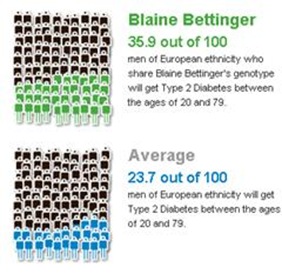
My 23andMe analysis makes it clear that I have an elevated risk for type 2 diabetes:

And, upon clicking upon the link, I receive the following additional information:
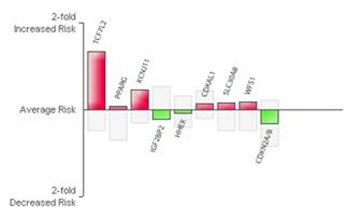
deCODEme, which used my 23andMe data, provides a similar interpretation:


Three of the major risk alleles analyzed by both 23andMe and deCODEme are the following (with my genotype for each allele). There are others, but interestingly these three have been examined together in several studies.
|
Gene |
SNP |
My Genotype |
Relative Risk (23andMe/deCODEme) |
Genotype Frequency |
| KCNJ11 |
rs5219 |
TT (aka E23K) |
1.17/1.19 |
12.2% |
| PPARG |
rs1801282 |
CC (aka Pro12) |
1.02/1.03 |
81.0% |
| TCF7L2 |
rs7903146 |
TT |
1.59/1.54 |
7.8% |
(note that the rs5219 SNP – which is the risk allele from numerous research studies - is 90% correlated with rs5215, which is the SNP tested by deCODEme, so keep this in mind if you tested with that company). You can learn more about the other two SNPs at SNPedia (rs7903146 and rs1801282). EDIT - a previous version stated that 23andMe tested the correlated rs5215 SNP; that was incorrect. 23andMe does test the rs5219 SNP.
As you can see, from the six possible risk alleles for the above three SNPs, I happen to have all six!
Apparently this is very rare, as is shown in this Figure 2 from an October 2006 article in PLoS Medicine (Weedon et al. (2006) Combining Information From Common Type 2 Diabetes Risk Polymorphisms Improves Disease Prediction. PLoS Med 3(10): e374. DOI: 10.1371/journal.pmed.0030374):

Only about 1-2% of the >6,000 people in that study had all six risk alleles. The researchers found that each additional risk allele increased the odds of type 2 diabetes by 1.28 times, and participants with all six risk alleles had an odds ratio of 5.71 compared to those with no risk alleles. From the paper:
“An alternative way to assess the impact of susceptibility alleles on disease risk is to use positive predictive values. Assuming a background risk of 5% in the general population, the probability of people with zero risk alleles developing type 2 diabetes is 2% compared to 10% for people with all six risk alleles.â€
The presence of all six alleles, therefore, doubles the risk of developing type 2 diabetes. Indeed, both companies interpreted my genotype to suggest a vastly increased lifetime risk for diabetes. 23andMe showed a 35.9% lifetime risk compared to 23.7% for the general public (an increase of 51%), while deCODEme showed a 40.2% lifetime risk compared to 25% for the general public (an increase of 61%).
II. The Family History
Not surprisingly, I have a strong family history of type 2 diabetes. I won’t give any further specifics to preserve anonymity (as much as this has already revealed half the genotype of each of my parents), but I can say that type 2 diabetes has had – and continues to have – an impact on close relatives.
III. Conclusions
So what does this all mean? And why post about such a personal issue?
In some ways this post is to further prove the point that I, personally, am not afraid of my genetic information. I’m not afraid of any potential psychological effects it might have, nor am I afraid of any repercussions of sharing my genetic information with others. It is certainly clear that I lost the genetic lottery when it comes to diabetes risk, but there is no genome so perfect that it lacks at least one serious risk. Accordingly, when discriminating against others based on their genetic information, we are discriminating against our own imperfect genome. By discovering or sharing our genetic information we not only learn about ourselves as a singular person, but we learn about the larger ‘ourselves’ as a species.
Further, this post is my attempt to rebut the notion of genetic exceptionalism, the idea that genetic information is somehow different from other types of personal information and thus requires an increased level of scrutiny and/or protection. For me personally, interpreting my genotype is no more dangerous than the receiving the results of a home glucose test. Indeed, the results of the glucose test represent a current reality while the genotype merely suggests a future possibility.
Although I won’t go so far as to say that there is never any danger to anyone upon receiving genetic information, I will go so far as to say that it should be the individual, not the government, that decides whether the danger exists.
IV. The Future
The fact that I’m not afraid of my genetic information, or that I don’t believe in genetic exceptionalism, doesn’t mean, however, that I should ignore my genotype. In my case, my genotype has reinforced and added to my understanding of my diabetes risk, and it would be foolish to waste this opportunity to shape my future.
Time to hit the gym.

Trends in Genetics has an article by