The Genetic Genealogist

Adding DNA to the Genealogist's Toolbox

Archive for the "Famous DNA" Category


Famous DNA Review, Part IV – Jesse James

image Jesse Woodson James, born September 5, 1847 and died April 3, 1882, was an infamous American outlaw. Despite strong evidence that James was killed on April 3, 1882, some theorized that his death was staged and that he in fact survived to father additional children.

In 1995, researchers set out to use relatively new DNA analysis to examine the rumors surrounding James’ death. They exhumed the body believed to be that of James from the Mt. Olivet Cemetery in Kearney, Nebraska. Although the remains were poorly preserved, the scientists were able to obtain DNA from two of four teeth. They also had DNA from two hairs that were recovered in 1978 from James’ original burial site on the James farm.

The mtDNA HVR1 sequence from the teeth and hairs were identical and belonged to Haplogroup T2, with 5 mutations relative to the CRS (16126C, 16274A, 16294T, 16296T, and 16304C).
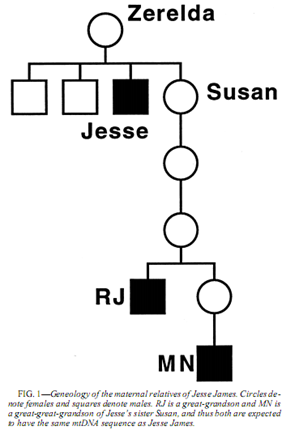
The researchers then compared James mtDNA haplotype to that of his sister Susan’s great-grandson and great-great grandson, both of whom were exact matches. Thus, either the body is that of Jesse James, or it is a body that just happens to have the same mtDNA haplotype as James. The authors of the paper did a great job of clearly stating that while strongly suggestive, the results are not absolutely conclusive:

“Do the mtDNA results prove that the exhumed remains are those of Jesse James? The answer to this question must be no, as there is always the possibility (however remote) that the remains are from a different maternal relative of RJ and MN, or from an unrelated person with the same mtDNA sequence. However, it should be emphasized that the mtDNA results are in complete agreement with the other scientific investigations of the exhumed remains: there is no scientific basis whatsoever for doubting that the exhumed remains are those of Jesse James. The burden of proof now shifts to those who, for whatever reason, choose to still doubt the identification. The mtDNA results reported herein provide a standard which other claimants to the legacy of Jesse James must satisfy.”

I wonder if any of the original DNA could be recovered again for research in the future.

James’ haplotype is available at Mitosearch (EEYCU). Interestingly, even with the increasing popularity of genetic genealogy and the many people who have entered their own haploytpe into Mitosearch, James does not have any exact matches in the database. This fact lends credence to the conclusion that the body tested is that of Jesse James.

Other Posts in the Famous DNA Series:

Famous DNA Review, Part III – Niall of the Nine Hostages

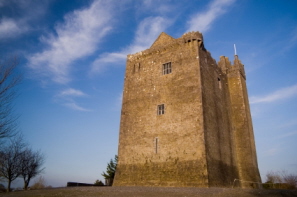
ireland2.jpgAs many as 3 million men worldwide might be directly descended from a single Irish warlord named Niall of the Nine Hostages who was the High King at Tara from 379 to 405.
In February 2006, researchers at Trinity College in Dublin released a paper that studied that Y chromosome signature of men throughout Ireland. They found that 8% of men sampled had the same Y chromosome, with a cluster in the northwest where fully 21% of men carried the signature chromosome (which fell into Haplogroup R1b1c7). The article appeared in The American Journal of Human Genetics and was titled “A Y-Chromosome Signature of Hegemony in Gaelic Ireland.”

The researchers looked at 17 STR markers on Irish Y chromosomes to determine the relatedness of samples they had obtained. They found that there was a strong association between the most common signature and surnames that were related to the most significant dynasty of early medieval Ireland – the Uí Néill. Some of the surnames included (O’)Gallacher, Boyle, O Doherty, O’Connor, Cannon, Bradley, O’Reilly, Flynn, (Mc)Kee, Devlin, Donnelly, Egan, Gormley, Hynes, McCaul, McGovern, McLoughlin, McManus, McMenamin, Molloy, O’Kane, O’Rourke and Quinn (list from Oxford Ancestors). Of course there were no surnames at the time of the earliest Uí Néill dynasty, but when the Irish took surnames around 1,000 A.D., many chose names that were associated with Uí Néill dynasties.

This association suggests that men with the signature Y chromosome are descended from the founder of the dynasty Uí Néill, Niall of the Nine Hostages. Niall of the Nine Hostages, who was the High King at Tara from 379 to 405, founded the dynasty Uí Néill, which ruled until the 11th century. According to the legend, Niall had 12 sons, many of which were rulers after Niall’s death.

The biggest caveat of this research is that without testing DNA from Niall’s remains, it is impossible to say with 100% certainty that Niall is the ancestor (and some argue that there never was a real Niall). For instance, Mrs. Niall could have only reproduced with the friendly neighbor, or a large fraction of the men with the signature Y chromosome could be descended from Niall’s promiscuous uncle George (I don’t know if there was an uncle, or if his name was George – it’s just an example).

As the authors of the study pointed out:

“The fact that about one in five males sampled in northwestern Ireland is likely a patrilineal descendent of a single early medieval ancestor is a powerful illustration of the potential link between prolificacy and power and of how Y-chromosome phylogeography can be influenced by social selection.”

Not surprisingly, the signature Y chromosome has also spread around the world, suggesting that there may be as many as 3 million people who carry it. Using international DNA databases, the chromosome was found in roughly 1 in 10 men in Scotland, and in about 2% of European-American New Yorkers.

For more information, see Times Online, NY Times, Family Tree DNA, Oxford Ancestors, and Wikipedia (for info about the life of Niall of the Nine Hostages, including the source of the name).

Other Posts in the Famous DNA Series:

Genetic Genealogy Eliminates Two As Descendants of Joseph Smith

Update: Ugo Perego is not affiliated withh the website mentioned in the last two sentences.

Did Joseph Smith father children with any of his plural wives? The Deseret News has a lengthy article about recent efforts by a geneticist to answer the long-debated question about the founder of the Latter Day Saint movement.

Ugo Perego, the director of operations at the Sorenson Molecular Genealogy Foundation, has used genetic genealogy in an attempt to identify or rule out potential descendants of Smith. In 2005, Perego showed that three males were not descendants of Smith, and new testing has shown that two more alleged descendants of Smith are not his true descendants.

In order to rule out descendants, it was first necessary to characterize the Y-DNA thought to belong to Joseph Smith. According to the article:

“Perego has mapped Smith’s DNA by retrieving samples from living descendants of two sons he had with Emma Smith [his first wife] — Joseph Smith III and Alexander Hale Smith. ‘Their Y chromosomes were identical, so we know for 100 percent sure what Joseph Smith’s Y chromosome looked like. We can now use that standard to verify any other alleged sons,’ which he did with those who have been eliminated as possible descendants.”

Interestingly, Perego was able to show that the men (1) were not the descendants of Smith, and (2) were actually descendants of the other men who were married to these wives of Joseph.

I especially like Perego’s motivations for doing this independent project supported by Sorenson:

“As a scientist, I like to look for truth. If there is a book that says this person was Joseph’s son, and I have evidence that’s not right, it’s important for me to offer an alternative explanation from science that people can refer to. New authors in the future can then take that new genetic evidence into consideration.”

Perego has an interesting website describing his efforts.  There is a website that discusses the ongoing DNA research, but Perego is not in any affiliated with that site.

True ‘Roots’ – Update on Chris and Alex Haley’s Y-DNA

The 24-7 Family History Circle has an update on a story I wrote about few weeks ago (Chris and Alex Haley’s DNA). Chris Haley, the nephew of author Alex Haley, recently agreed to submit DNA for a Y-DNA test. Like his uncle, Haley is very interested in genealogy and his ancestry.

According to the article, which was written by Megan Smolenyak Smolenyak, the Haleys were already fairly certain of their ancestry: “to the best of the family’s knowledge, the progenitor of the Haley line was of European origin, not African.” Indeed, the results show that the Haley Y-DNA belongs to Haplogroup R1b, a traditionally European haplogroup. My favorite part of this article, and one that many of my readers might find interesting, are all the suggestions regarding future directions that Haley can take to learn more about his ‘roots’ (sorry, I had to). Interestingly, Haley already has an anonymous 46-marker match in the DNA Ancestry database.

One of Megan’s suggestions is to find other people with the surname that the Haleys believe they might be descended from (Baugh), and trade information. Indeed, there is already a Baugh DNA Project with posted results, which might be a great place to start! This is yet another great example of genetic genealogy’s ability to solve genealogical mysteries when combined with traditional research methods.

In case you missed it, the video from Roots Television of Chris Haley swabbing his cheeks for DNA is hilarious:

chris%20haley%20dna.jpg

DNA Analysis of 5 People Who Helped Create America

dna3.JPG

1. Benjamin Franklin – mtDNA Haplogroup V

In addition to being one of the Founding Fathers of the United States, Franklin was a politician, printer, scientist, inventor, diplomat, and author. DNA testing has elucidated the origins of Benjamin Franklin’s mitochondrial DNA through his mother Abiah Lee Folger, who had six sisters. One of those sisters, Doras Folger, passed on her mtDNA to her 9th-great granddaughter, Charlene Chambers King. Sequencing of Ms. King’s mtDNA revealed that she belonged to mtDNA Haplogroup V with the following mutations: T16298C, 315.1C, 309.1C, A263G, and T72C. Haplogroup V (known as “Velda” by Sykes) is believed to have originated in Europe about 12,000 years ago, possibly in Iberia. About 4% of Europeans contain Haplogroup V mtDNa. So far, no known source of Benjamin Franklin’s Y-DNA or autosomal DNA has been discovered (although some believe that his tooth might provide the answer).

2. Thomas Jefferson – Y-DNA Haplogroup K2

Thomas Jefferson was one of the principal authors of the Declaration of Independence, a Framer of the Constitution, and the third President of the United States. Unfortunately, much like Benjamin Franklin, Jefferson does not have any male descendants who possess his Y-DNA. Instead, the DNA of five descendants of Jefferson’s paternal uncle, Field Jefferson, has been tested and retested. The results show that Jefferson’s Y-DNA belongs to Haplgroup K2, a relatively rare haplogroup for Europeans and most common in the middle east. A recent study has shown that there are other males with the surname Jefferson in England who belong to Haplogroup K2, including some who are a perfect 17/17 match with Field (and presumably Thomas) Jefferson. Jefferson’s DNA was studied in part because it is believed that he fathered children with at least one of his female slaves. Much more information can be found here.

3. Alexander Hamilton – Y-DNA Haplogroup I1a

Alexander was one of this country’s most important political theorists. He served as the Secretary of the Treasury, and was one of the authors of the Federalist Papers, some of the most influential documents in American history. The Hamilton Surname DNA Project presents the results of Y-DNA testing of four males who are directly descended from John C.A. Hamilton, the grandson of Alexander Hamilton. All four individuals match at 37 of 37 markers, with the exception of one individual who has a value of 15 for DYS19/394. Due to the relationship of the four individuals, it is impossible to know whether or not Hamilton had a 14 or a 15 at that location. The results suggest that Alexander Hamilton belonged to Y-DNA Haplogroup I1a. I1a (known as “Wodan” by Sykes) is most frequent in Scandinavia, reaching almost 35% in parts of Norway, Sweden, and Denmark.

4. John Adams and John Quincy Adams – Y-DNA Haplogroup R1b1

John Adams was America’s first Vice President and second President. He was also a diplomat and a driving force for American independence. John’s son, John Quincy Adams, was the sixth President of the United States. Although no direct descendant of John and John Quincy has been tested, the Adams Surname Y-DNA Project has results from five individuals who are related to John’s great-great grandfather Henry Adams, born in 1583 in England. The results suggest that John and John Quincy belonged to the R1b1 Haplogroup. R1b, the parent of R1b1, is the most common Y-DNA Haplogroup in Europe, and is believed to have originated with the first modern humans to enter Europe 35,000 to 40,000 years ago.

5. Abraham Lincoln – Y-DNA Haplogroup R1b1

Although Lincoln, the 16th President of the United States, might not have helped “create” America, he played a huge role in shaping the country. His ancestry has been traced back to Samuel Lincoln (1620-1690), an immigrant from Hingham, England. (Note, however, that some researchers (pdf) believe that Abraham Lincoln might have been the illegitimate son of Abraham Enloe, and thus these DNA results would not apply. It is hoped that the cloak Lincoln was wearing the night he was shot might provide DNA samples for future analysis). Two descendants of Samuel Lincoln have submitted their Y-DNA for analysis. Although the allele values have not been revealed, the data shows that the two anonymous individuals match at 36 of 37 markers. One is listed as belonging to Haplogroup R1b1, and the other is R1b2. R1b2 is an older name for the subhaplogroup defined by the M37 snp, now called R1b1c1 (see the ISOGG Y-DNA tree here, and a pdf of more information here). These results suggest that Lincoln belonged to the R1b1 Haplogroup, and perhaps was of the R1b1c1 subhaplogroup. R1b is the most common European haplogroup; R1b1c probably originated in Central Asia/South Central Siberia.

Roots – Chris and Alex Haley’s DNA, and the Launch of JeanTree (GeneTree.com)

At the 2007 Federation of Genealogical Societies Conference in August, Alex Haley, the nephew of the Chris Haley – the author of “Roots”, joined the many people who have tested their DNA for ancestral information.  It turns out that his Y-DNA is of European origin.

There’s a post at Megan’s Roots World, a news report at KUTV.com, and the video of Alex swabbing his cheeks for DNA from Roots Television:

chris%20haley%20dna.jpg

The article at KUTV also contains what MUST be a mistake:

“Next week, The Sorenson Cos. plans to roll out a separate DNA-based Web site called jeantree.com. Chief Executive James L. Sorenson declined to discuss details Tuesday, although it will rely on a larger DNA database.”

Either Sorenson is planning to sell denim-related products, or the journalist misunderstood “Genetree.com”. Stay tuned for further details about the re-launch of this site.

The Personal Genome Project’s “First 10″

Here they are, the “First 10″, the first ten volunteers of the Personal Genome Project, announced today:

  • Misha Angrist, Ph.D. is Senior Science Editor at the Duke Institute for Genome Sciences and Policy in Durham, N.C. His work has appeared in The Michigan Quarterly Review and the Best New American Voices anthology, among other places. Dr. Angrist is also an independent consultant to the life sciences industry. He earned his M.S. in biology from the University of Cincinnati and his Ph.D. in genetics from Case Western Reserve University. His doctoral work focused on the complex inheritance of Hirschsprung disease. Following completion of his post-doctoral in 1998, Dr. Angrist covered the life sciences industry as an analyst for The Freedonia Group and was portfolio manager for the hedge fund Biotech Horizons Fund, LP. Dr. Angrist also holds a M.F.A. from the Bennington Writing Seminars. His firm, Ars Vita Consulting, Inc., provides insight to clients in the biotechnology, pharmaceutical, and broader healthcare arenas. For recent news by or about Dr. Angrist, see The New Atlantis and Future Medicine.
  • Keith Batchelder, M.D. is the founder and CEO of Genomic Healthcare Strategies. Dr. Batchelder received an MD from Hahnemann University School of Medicine, an MS in Materials Science from New York University, a DMD from the University of Connecticut School of Dental Medicine, and a BA in physics from Middlebury College. Dr. Batchelder has been a consultant for personalized health and wellness companies such as Lineagen and an officer in several health-care organizations. He was chief technical officer of Worldcare Clinical Trials, and was a core member of the team that created Harvard Salud Integral, a new HMO in Mexico City, where he helped secure angel funding in a newly privatized healthcare environment and helped to grow the plan to cover 150,000 patients. He was also an early principal with Amicas, a company that was successfully sold for approximately $30 million cash and stock equivalents. For recent news about Dr. Batchelder, see Nature, Mass High Tech, and an interview with our own EyeonDNA!
  • George M. Church, Ph.D. is a Professor of Genetics at Harvard Medical School and Professor of Health Sciences & Technology at Harvard and MIT. With Walter Gilbert he developed the first direct genomic sequencing method in 1984 and helped initiate the Human Genome Project in 1984 while he was a Research Scientist at newly-formed Biogen Inc. He invented the broadly-applied concepts of molecular multiplexing and tags, homologous recombination methods, and DNA array synthesizers. Technology transfer of automated sequencing & software to Genome Therapeutics Corp. resulted in the first commercial genome sequence, (the human pathogen, Helicobacter pylori) in 1994. He initiated the Personal Genome Project (PGP) in 2005 and research on synthetic biology. He is director of the U.S. Department of Energy Center on Bioenergy at Harvard & MIT and director of the National Institutes of Health (NHGRI) Center of Excellence in Genomic Science at Harvard, MIT & Washington University. He has been advisor to 22 companies, most recently co-founding (with Joseph Jacobson, Jay Keasling, and Drew Endy) Codon Devices, a biotech startup dedicated to synthetic biology and (with Chris Somerville) founding LS9, which is focused on biofuels. He is a senior editor for Nature EMBO Molecular Systems Biology. See the Boston Globe, Technology Review, his departmental page, his lab webpage, and our very own PersonalGenome.
  • Esther Dyson is an active member of a number of non-profit and advisory organizations. From 1998 to 2000, she was the founding chairman of ICANN, the Internet Corporation for Assigned Names and Numbers. She has followed closely the post-Soviet transition of Eastern Europe, and is a member of the Bulgarian President’s IT Advisory Council, along with Vint Cerf, George Sadowsky, and Veni Markovski, among others. She has served as a trustee of, and helped fund, emerging organizations such as Glasses for Humanity, Bridges.org, the National Endowment for Democracy, and the Eurasia Foundation. She is also a member of the board for The Long Now Foundation, trustee for the Santa Fe Institute, the Advisory Board of the Stockholm Challenge Award and is a part-owner of the First Monday journal. She is a member of the President’s Export Council Subcommittee on Encryption and sits on the boards of the Electronic Frontier Foundation, Scala Business Solutions, Poland Online, Cygnus Solution, E-Pub Services, Trustworks (Amsterdam), IBS (Moscow), iCat, New World Publishing and the Global Business Network. She is on the advisory boards of Perot Systems and the Internet Capital Group, and a limited partner of the Mayfield Software Fund. She has also been a board member or early investor in tech startups, among them Flickr, PowerSet.com, ZEDO, Medscape, Medstory, XCOR, Constellation Services, Zero-G,Icon Aircraft and Space Adventures. Ms. Dyson is the daughter of Freeman Dyson, a physicist, and Verana Huber-Dyson, a mathematician. She holds a Bachelor’s degree in economics from Harvard University (1972). For recent news about Ms. Dyson, see The Huffington Post, Media Visions, MediaPost, and The Wall Street Journal.
  • Rosalynn Gill-Garrison, Ph.D., is a founder and Chief Science Officer of Sciona, an international company that provides personalized health and nutrition recommendations based on an individual’s diet, lifestyle and unique genetic profile. Dr. Gill-Garrison is also on the panel of experts at Genelex. Dr. Gill-Garrison received her Ph.D. in Biological Sciences at the University of Texas at Austin, where she focused on the DNA-damaging effects of polycyclic aromatic hydrocarbons in animal and bacterial models. She went to the UK in1994 to the Department of Oncology at University College London before co-founding Sciona in 2000. For recent news about Dr. Gill-Garrison, see Time, MedScape, The Scientist, and the BBC.
  • John D. Halamka, M.D., M.S., is Chief Information Officer of Harvard Medical School, Chief Information Officer of Beth Israel Deaconess Medical Center, Chairman of the New England Health Electronic Data Interchange Network (NEHEN), Chief Information Officer of the Harvard Clinical Research Institute (HCRI), and an Associate Professor of Emergency Medicine at Harvard Medical School. Dr. Halamka completed his undergraduate studies at Stanford University where he received a degree in Medical Microbiology and a degree in Public Policy with a focus on technology issues. Dr. Halamka received a medical degree at the University of California San Francisco while pursuing graduate work in Bioengineering at the University of California, Berkeley, focusing on technology issues in medicine. For recent news about Dr. Halamka, see The Boston Globe, BIDMC News, Yahoo Finance News, a podcast about health information exchange, and a newscast about online medical records.
  • Stanley N. Lapidus, B.S.E.E., is the President and CEO of Helicos, a company that develops genetic analysis technologies for research, drug discovery, and clinical diagnostics markets. Helicos is Mr. Lapidus’ third life-science startup. In 1995 he founded EXACT Sciences Corporation, an applied genomics company that develops and markets non-invasive, DNA-based methods for early detection of colorectal and other common cancers. He served as the CEO from 1995 to 2001 and Chairman of EXACT Sciences’ Board of Directors from 2000 until the end of 2005. Prior to EXACT, Mr. Lapidus founded Cytyc Corporation and was President and CEO from 1987 through 1994. In addition to his entrepreneurial activities, Mr. Lapidus holds academic appointments in the Pathology Department at Tufts University Medical School and MIT’s Sloan School of Management. He earned a BSEE from Cooper Union. He has served as a trustee of Cooper Union since 2002. Mr. Lapidus holds 30 issued patents. For recent news about Mr. Lapidus, see Flagship Ventures, MarketingVP, The Hazelton Group, and Technology Review.
  • Kirk M. Maxey, M.D. is the President of Cayman Chemical, a research biochemical company he started while still a student. After receiving his B.S. in Chemistry from Colorado State University, Dr. Maxey worked as a chemist at the Upjohn Company in Kalamazoo, Michigan. He later received his M.D. from the University of Michigan. Dr. Maxey has been a consultant and expert witness for Alcon and Pfizer as well as a contributing editor and reviewer for Prostaglandins and Other Lipid Mediators. While a student in the 1980′s, Dr. Maxey was a frequent contributor at sperm banks. contributed For recent news about Dr. Maxey, see PBS and ABC News.
  • James L. Sherley, M.D., Ph.D. was formerly an associate professor in the Biological Engineering Division at the Center for Environmental Health Sciences in the Massachusetts Institute of Technology. He earned an M.D. and a Ph.D. in molecular biology from the Johns Hopkins University School of Medicine in 1988. Dr. Sherley’s laboratory addressed the problems that limit the development of adult stem cells for biomedicine. Dr. Sherley’s awards include the 2006 NIH Director’s Pioneer Award, an award from the Pew Scholars Program in the Biomedical Sciences, selection for the Pew Science and Society Institute, and the Ellison Medical Foundation Senior Scholar Award in Aging. For recent news about Dr. Sherley, see Future Health, Boston.com, Diverse Education, The Chronicle, and Boston.com.

The 10th participant has not yet given permission for the release of his/her name. From the announcement:

“Word in the newsroom is that InSequence will have a full feature story, with interviews of the participants, in tomorrow’s edition of the newsletter. If you’re a subscriber, you’ll be able to access it here.”

Esther Dyson and the “First 10″

Esther Dyson is a prominent force in the digital world, and is considered to be a member of the ‘digerati’ (a term for people who are the movers and shakers of everything technological). She is the daughter of the famous physicist Freeman Dyson and the mathematician Verana Huber-Dyson.

According to Wikipedia, the company that Ms. Dyson founded, EDventure Holdings, analyzes the impact of emerging technologies and markets on economies and societies. In addition, Ms. Dyson is on the board of the genetics company 23andme. Her interest in genetics and emerging technology is undoubtedly one of the main reasons she has decided to become one of the “First 10.”

The “First 10”

The “First 10” (or “First Ten”) references ten volunteers who are part of the Personal Genome Project, or the PGP. The PGP, headed by Dr. George M. Church of Harvard, aims to develop affordable personal genome sequences as well as user-friendly data applications. Initially, the project will start by releasing the sequencing and complete medical records of 10 individuals. Because of issues of risk versus benefit and informed consent, the first set of ten volunteers will be people who have a “master’s level or equivalent training in genetics or equivalent understanding of genetics research.” According to the PGP website, “[p]roduction costs per subject range from $8K for a limited subset of the genome to over $200K per subject to cover a significant fraction of their DNA.” According to a recent New York Times article, the “project’s volunteers will receive the one percent of their genome currently deemed most useful at a cost of $1,000.” This conflicts with the PGP’s description of the cost, and I’m not sure what the discrepancy is about.

Ms. Dyson’s Decision to Become One of the “First 10”

Ms. Dyson recently gave a short talk (the video is available here) at Fortune’s iMeme conference in San Francisco about her part in the Personal Genome Project. A summer of the talk was posted at Xconomy.com, “Learning from Esther Dyson’s Genome”:

“Famous venture capitalist Esther Dyson explained her reasons for being one of Church’s first ten volunteers last week at Fortune’s first iMeme conference in San Francisco. Church (who is also an Xconomist) hopes to gather enough data from the project to speed research into the links between gene variations and both common and rare human diseases, and to accelerate progress toward more individualized health care based on patients’ genetic profiles.”

In the comment section of the Xconomy.com post, you’ll find a thought-provoking conversation led by Willy Lensch, Ph.D. ThePersonalGenome.com pointed out that the Dr. Lensch’s first comment ended with a great sentence, so go check it out.

“Full Disclosure”

This week also saw an entire article in the Wall Street Journal titled “Full Disclosure” by Ms. Dyson. In the article, Ms. Dyson points out that sometime this summer or early fall, her genome, her answers to a substantial health questionnaire, and all her medical records will be posted on the Internet for the entire world to see:

“I’m one of 10 members of Harvard geneticist George Church’s Personal Genome project. We all come to this with slightly different motivations, histories and medical records. But we share, in theory, the equivalent of a master’s degree in genetics, an age between 30 and 100, and a willingness to come to Boston to give blood, get our faces professionally photographed and sit down with one another to discuss strategy.”

Ms. Dyson goes on to explain her motives for becoming one of the “First 10”:

  1. She wants to show that there’s nothing especially magical about her genome – she’s actually more worried about releasing the questionnaire, which documents her behavior!
  2. She doesn’t have any deep secrets or vulnerabilities;
  3. She won’t get fired and she has insurance (i.e. low potential for discrimination);
  4. She wants to examine the effects of personal genome sequencing on society;
  5. She believes such sequencing is inevitable, and;
  6. The project will generate useful data for others to use.

There is a great discussion of the project and Ms. Dyson’s decision to join it in the comment section of a post at Genome Technology. You can also find more at EyeonDNA.

The Qilakitsoq Mummies

A recent paper in the American Journal of Physical Anthropology examined mtDNA extracted from the hair and nails of eight Inuit mummies. These essentially freeze-dried mummies were discovered in 1972 in a natural tomb at Qilakitsoq in the Uummannaq Municipality of Greenland. Using C14 analysis, the mummies have been dated to approximately 1460.

The bodies were found in two separate positions about 1 meter apart. In Grave I, there were five bodies:

  1. I/1 = Male Infant #1 – about 6 months of age
  2. I/2 = Male Infant #2 – about 4 to 4.5 years of age
  3. I/3 = Female #1 – about 20-25 years of age
  4. I/4 = Female #2 – about 25-30 years of age
  5. I/5 = Female #3 – about 40-50 years of age

In Grave II, there were 3 bodies:

  1. I/6 = Female #4 – about 50 years of age
  2. I/7 = Female #5 – about 18-21 years of age
  3. I/8 = Female #6 – about 50 years of age

The researcher’s primary goals were to sequence the HVR1 region of each individual’s mtDNA, and then to compare the results to determine possible relatedness of the remains. All 8 individuals fell into Haplogroup A2, but belonged to three different maternal lineages which were mixed between the two grave sites:

  1. Male Infant #2, Female #1, Female #4, and Female #6
  2. Male Infant #1, Female #2, and Female #5
  3. Female #3

All of the remains had the following mutations – 16111, 16223, 16290, 16319, and 16362. Of course, this goes along VERY nicely with my hypothesis at my Haplogroup A website that, barring back-mutation, most A haplogroup HVR1′s should have exactly those mutations. That list was the haplotype of subgroup #1. Subgroup #2 had a mutation at 16311, and subgroup #3 had a mutation at 16265. For a description of the possible maternal familial relationships between the remains, click on the figure below.
clip_image002.gif

Genetic Genealogy in Brazil

The BBC has an article about genetic genealogy testing of nine celebrities in Brazil for a project called Afro-Brazilian Roots by the Brazilian Service of the BBC. These lucky individuals received Y-DNA, mtDNA, and autosomal testing, and most were surprised with the large proportion of European genealogy revealed by the tests.

“Brazil has more people with black ancestry than any other nation outside Africa, and its mix of Indians, Africans and Europeans gave rise in the past to the claim that the country was a ‘racial democracy.’ ”

“No one is pure in Brazil. That’s why the country has the face of the future,” said Harvard Professor Henry Louis Gates Jr., coordinator of a similar project in the U.S.”

Thanks to Tim at Genealogy Reviews Online!