The Genetic Genealogist

Adding DNA to the Genealogist's Toolbox

Archive for the "DNA Companies" Category


Genetic Testing With 23andMe – Ancestry Testing

Yesterday I posted about my recent testing experience with 23andMe, focusing on the health and traits information.  This post examines the genealogical aspects of testing at 23andMe.

Ancestry Information

Although I was interested in the health and traits information, I was most excited about the ancestral information.  23andMe’s test looks at mtDNA, Y-DNA, and autosomal coverage.  I believe that the company is working to report on ancestry of the X-chromosome, but as I have previously reported X-DNA ancestry can be extremely challenging.

This was my second foray into autosomal DNA testing.  In 2003 I purchased an AncestrybyDNA 2.0 test from DNAPrint Genomics.  The test looked at 71 Ancestry Informative Markers (AIMs) to determine percentages of Indo-European, East-Asian, Native-American, and African ancestry.  It is worth noting that before AncestrybyDNA went out of business (more info here), the company was offering more advanced tests that examined as many as 1,700 markers (still far below the number of markers used to quantify percentages at 23andMe and deCODEme).

My 2003 test showed the following ancestry percentages:

image

The results show that I was strongly Indo-European, which was not a surprise.  However, the test also suggested that my ancestry was 12% East Asian despite the fact that I am unaware of any Asian contributors to my DNA.  The AncestryByDNA test was often unable to distinguish between East Asian ancestry and Amerindian ancestry despite the fact that they reported the two separately.  Based on my understanding of my genealogy, I had concluded that the East Asian ancestry reported by AncestryByDNA was most likely Amerindian.

The Ancestry Painting created by 23andMe suggested that I was 98% European, 2% Asian, and >1% African:

image

Why the discrepancy between 23andMe’s test and the AncestrybyDNA test?  It is undoubtedly due to the number of markers included in the two tests.  This early AncestrybyDNA test looked at less than 75 markers, while the 23andMe test presumably examined thousands of locations.  Below is a graph of 23andMe’s autosomal coverage, although it is unclear how many of these SNP results are actually used to determine ancestry:

image

The 98% European certainly wasn’t a surprise, nor was the 2% Asian, although I’m quite certain that it is Amerindian based on other clues in my results and my genealogy (which we will see under “maternal ancestry”).  The small percentage of African DNA was surprising, although it has been suggested that the small percentage could be an artifact.  More research (and perhaps more testing) will be probably be required to fully understand the results.  It is certainly interesting, however, that the results line up so well with my understanding of the genealogical contributions to my DNA!

Maternal Ancestry

As I noted above, my autosomal results suggested that I am 2% Asian, which I interpreted to be 2% Native American.  This actually confirmed a hypothesis that I had formed after receiving my mtDNA results from Family Tree DNA many years ago.  My maternal haplogroup is A2, a distinctly Native American haplogroup.  My most distant maternal ancestor, a woman named Julia Ann Rebecca born c1820 probably in the Cayman Islands.  The people of the Cayman Islands have a very rich genetic background, encompassing individuals from Europe, Central America, and Africa.  It is likely that this portion of my ancestry also explains the <1% African DNA in my Ancestry Painting at 23andMe.

The 23andMe test confirmed that I belong to Haplogroup A.

Paternal Ancestry

And lastly, my Y-DNA SNPs revealed that I belong to Haplogroup R1b1c9, now known as R1b1b2a1a.  This confirmed results from Family Tree DNA.  After receiving my results, I downloaded my Y-DNA SNPs and contributed them to the Y-Chromsome Genome Comparison Project (more information here).  This project compiles the SNPs into a public spreadsheet for use by researchers to identify novel SNPs.

Conclusion

If you have any questions about the testing process or ancestry results that I didn’t address, please feel free to leave a comment.  If you are interested in learning more, Andrew Meyer at BUZZYEAH posted a series similar to this one in which he analyzed some of his own results:

How Breast Cancer and Other Four Star-Rated Topics Relate to My DNA, Part 1 (Apr 11, 2008)
Fun with mtDNA: Exploring my Maternal Ancestry (Apr 12, 2008)
Fun with Y Chromosomes: Exploring my Paternal Ancestry (Apr 16, 2008)
How Heart Attack and Other Four Star-Rated Topics Relate to My DNA, Part 2 (Apr 24, 2008)
Visualization of My Genetic Similarity to People Around the World (Apr 30, 2008)
Just Downloaded a File Containing my Raw Genome Data. Now What? (May 4, 2008)

Genetic Testing With 23andMe

This is the first entry in a two-part series describing my recent experiences with genetic testing through 23andMe.  Although I was most excited by the genetic genealogy information provided by the results, I thought that readers might be interested in some of the health and trait information as well.  If I forget to discuss something, feel free to ask in the comments and I’ll do my best to respond.

Note that this discussion is limited to a cursory analysis of my results.  Anyone who is considering testing through 23andMe should be aware that scientists are only just beginning to study and understand the connection between genetics and health, and thus the results are not meant to be interpreted as absolutes.  Be sure to analyze your own results with this caveat in mind, and do your own research into the testing process.

23andMe

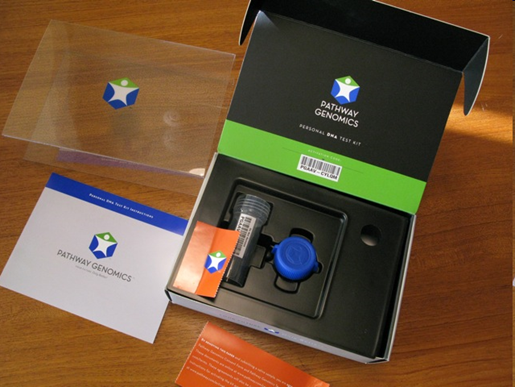
Since many others have discussed the 23andMe kit and the spitting process, I won’t go over that here other than to provide a picture of my actual testing kit:

image

Although the typical processing time is 4 to 6 weeks, my sample took a little longer to process because 23andMe was still working with the New York Department of Health regarding samples collected in New York.  Lucky for me I was very familiar with this situation and had decided to collect my sample outside New York.

Health and Traits

In addition to ancestry, 23andMe’s SNP results are examined for information about over 90 different types of health and traits.  I found the health and traits analysis to be very interesting.  Some of it, based on my own knowledge of my family history, was unsurprising.  As important as genetics may be in the future for predicting predilection for disease, there will always be a place for family health history (and apparently the U.S. Surgeon General agrees).  There were, however, some health and trait results that I did not expect, especially regarding gene variants that can influence genetic disorders in females (and thus might be something to keep in mind if I have a daughter).

Blood Type

Interestingly, 23andMe does not report on ABO blood groups even though the v2 chip collects this data (although 23andMe is planning to do so in the future).  For example, I knew I was Blood Type A, but I didn’t know if I was AA or AO  A member of the 23andMe community – which I’ve spent a great deal of time perusing – provided directions for deciphering blood type.  Turns out I’m AO.

It was also fun to confirm the genetic basis behind some of my physical characteristics.  I have wet earwax, if you were just dying to know.  You can read more about the earwax gene at the NYT and at Gene Expression.  I can also taste bitter, meaning that perhaps I shouldn’t like raw broccoli and brussels sprouts as much as I do!

CCR5

Some time ago I wrote “Are you immune to HIV and smallpox?” about the CCR5 gene.  A certain variant of the CCR5 gene has a 32 base-pair deletion (CCR5-delta32) and has been suggested to provide a measurable degree of protection against certain viruses such as the HIV virus.  Scientists theorize that it might have been selected for during viral plagues in human history.  The CCR5-delta32 allele is nearly absent among Amerindians and East Asians but is found in some African populations. The allele is found in high concentration among Eurasians. Indeed, the average frequency of the allele among European populations is estimated to be as high as 10%.

Since my ancestry is largely European, I thought it was possible that I had at least one copy of the CCR5-delta32 allele.  However, my 23andMe results show that I have two intact versions of CCR5:

image

Type 2 Diabetes

The 23andMe test also examines 9 SNPs believed to be related to Type 2 Diabetes.  As shown below, my results suggest that I might be more prone to Type 2 diabetes than the average European; my estimated incidence is 33.5 out of 100 compared to 21.9 out of 100.  There is diabetes in my family, so this result was not unexpected.  Current understanding is that genetic factors account for only 26% of the risk of diabetes.

So what do these results really mean for me?  Exactly the same thing that a family history of diabetes means – I need to eat healthy and exercise (and so do my children).

image

You might ask yourself why I feel comfortable posting this information online, specifically where an insurance company could find it.  The answer is two-fold; first, for a number of reasons, I believe that the fear of insurance companies using our genetic data against us is overblown; and second, the insurance companies already obtain this information in an slightly more abstract form when they ask about family history.  With the Genetic Information Nondiscrimination Act, however, health insurers will no longer be able to ask about family history, precisely because family history belies genetic information (note that life insurers and other types of insurers WILL still be able to inquire about family history and genetic tests).

Browse Raw Data

Another great feature is the ability to browse your raw SNP data, including the results that have not yet been associated with any disease or trait (which is the vast majority of the SNPs).  The data is broken into 22 pairs of chromosomes, the sex chromosomes (XX or XY), and mtDNA.  The data can be searched by gene or SNP name, or can be browsed randomly.  This feature is useful whenever I come across a new study that suggests a link between SNP(s) and a genetic trait or propensity for a genetic disorder; I can look up my own result for this particular SNP.

Browse Raw Data main view

I can also download all my own data.  I used this option to download my Y chromosome SNPs for Y-Chromosome Genome Comparison, which I’ll discuss more of in a later post.

Conclusion

This post included just a few thoughts about my testing experience, excluding my ancestry results.  Tomorrow’s post will examine that aspect of the testing.

GeneTree Announces Web Site Out Of Beta

image In October 2007, I wrote about the launch of GeneTree (see “Sorenson Genomic’s GeneTree Launches”), a “DNA-enabled family history-sharing Web site.”  Today, GeneTree has announced that it is out of beta and has added advanced features for users.

Press Release

Following is the press release from GeneTree:

SALT LAKE CITY (March 9, 2009)—GeneTree today announced its free family Web site has completed beta testing and now offers those who sign in a simple, intuitive way to regularly communicate with their extended family and to securely share and store family contact information, personal profiles, photos, video and ancestry documents. Advanced features now available through GeneTree’s redesigned graphic interface include GEDCOM file-format import for family tree collaboration, paternal line genetic genealogy and an all-new family tree building tool.

“We are very pleased to provide families with this fun and easy way to regularly connect and stay close to each other regardless of how scattered they may be geographically,” said GeneTree President and COO Matt Cupal. “GeneTree has the most complete set of features available for sharing family stories, but we go further by fully integrating genetic genealogy options for those who would like to use family DNA to search for living relatives and ancestors.”

A new Y-DNA genetic test enables individuals to research paternal line connections of a male relative, and complements GeneTree’s existing maternal line mtDNA test. Y-DNA results show ancestry and connections to DNA cousins within the past few hundred years.

The opportunity to find and connect with “lost” or unknown extended family members through the world’s most extensive correlated genetic genealogy database is a compelling GeneTree feature. “My 82-year-old mother was almost in tears when I told her we had found a branch of our family that we had lost touch with long ago,” said Rosemary Totton, of Auckland, New Zealand. “Now we are back in contact and I’m excited to learn one of my cousins has old family photos to share with us. In the future we may look at our family’s Y-DNA, as well. This has opened a new door for me.”

Another powerful new GeneTree feature promotes collaboration on ancestry information by allowing the upload of GEDCOM files. GEDCOM is the most common genealogy file format used by all major family history Web sites and software applications. The all-new family tree builder allows an individual to choose a preferred layout, create trees of more than 1,000 relatives and to invite others to join the network and view the chart.

Powerful photo- and video-sharing tools organize a family’s digital media into albums and allow them to be seen by others. Family members can collaborate on identifying people in photos and photo tagging allows a person easy tracking of all photos in which they appear. Tagging photos automatically sends out invitations to people named.

A new GeneTree family news feature keeps relatives continuously in the loop. Family members update their own news daily and at the end of the week a digest is automatically emailed to others on their list. A birthday reminder automatically sends out a birthday greeting on the morning of a relative’s birthday. In addition, a feature unique to GeneTree allows users to record a biological relative’s DNA profile as their own for purposes of searching for DNA cousins and to extend their own genealogy chart. Families can divide the cost of testing one member and then share results.

“We believe every family should take advantage of our free Web site,” said Cupal. “This is the best way for relatives to stay connected, share memories, build family trees and securely share and store documents. With GeneTree, it is easier than ever to build a lasting legacy for your own family.”

About GeneTree

GeneTree (www.genetree.com) is a free family Web site enabling relatives to easily communicate on an everyday basis; to securely share contact information, personal profiles, photos, video and other family documents; and to build family trees. GeneTree also provides individuals with the option to integrate industry-leading DNA testing into family history research for a scientific window into their ancestry and to find living relatives for whom no paper records exist. GeneTree users are linked to the world’s most extensive correlated genetic genealogy database.

Interviews with 23andMe Customers

Image representing 23andMe as depicted in Crun...

Image via CrunchBase

DAVIDE at the European Genetics and Anthropology Blog recently posted two interviews (here and here) with customers of 23andMe’s large-scale genome scanning service, one from Finland and one from the U.S.

It’s very interesting to see the responses of these anonymous individuals, particularly since they are from different countries.

For example, both were asked why they decided to purchase the 23andMe test – “Was it to test your ancestry or genetic health risk factors?”  Interestingly, for both individuals ancestry was the motivating factor behind testing.  More support for my conclusion that these companies should strongly promote the ancestral aspects of their products.

Other Questions

Here are a few examples of other questions in the interviews:

Q: How would you rate the accuracy of the scan against what you know about your origins?

Q: Has the information about your ancestry changed how you now identify ethnically or look at certain cultures or world regions? For example, do you now show more interest in Asia knowing that you have some East Asian admixture?

Q: Were you in any way disappointed with the results? For example, were you let down by where you ended up on the genetic maps or who your closest individual matches were?

Q: Looking back, was the experience worth the $399? Will you recommend the test to your family and friends?

If you are thinking about testing at a genome scanning company, be sure to read these interviews to get a feel for the process.

HT: Daniel MacArthur at Genetic Future.

DNAPrint Genomics Ceases Operations

dnaprintgIn February, I received a number of comments and emails which suggested that DNAPrint Genomics was not processing results and could not be reached by telephone.  DNAPrint was one of the first companies to offer ‘large-scale’ autosomal testing, although their tests were unable to compete with the testing currently offered by companies like 23andMe and deCODEme.

Indeed, the company has recently ceased operations.  From the site: “DNAPrint® Genomics, Inc. has regrettably ceased operations. We thank you for your support.”  As I wrote last February, the company was scheduled to be purchased by Nanobac Pharmaceuticals, but the deal fell through shortly thereafter.

GenomeWeb Announces DNAPrint’s Demise

From an announcement today at GenomeWeb – “DNAPrint Genomics Goes Bust”:

NEW YORK (GenomeWeb News) – Genetic testing company DNAPrint Genomics has shut down its operations, according to a notice on its website.

The Sarasota, Fla.-based firm shut down operations sometime during the past month. Its most recent filing with the US Securities and Exchange Commission was on Feb. 9, in which it announced that its President and CEO Richard Gabriel had resigned from the firm as well as its subsidiaries Ellipsis Biotherapeutics and Trace Genetics.

The cash-strapped firm, which had been trading on the Pink Sheets, had inked a deal a year ago to be acquired by Nanobac Pharmaceuticals. However, the deal fell apart after Nanobac was unable to raise additional funds before a deadline on March 31, 2008.

Attempts by GenomeWeb Daily News to reach company officials were unsuccessful.

Family Tree DNA Reaches 500,000 DNA Testing Kits

image In November 2007 I estimated that as of that date 600,000 to 700,000 DNA testing kits had been sold by genetic genealogy companies and that the number was increasing by 80,000 to 100,000 kits per year  (see “How Big is the Genetic Genealogy Market?”).  I ended that article with a prediction:  “As the interest in genetic genealogy grows, I predict that the 1 millionth genetic genealogy customer will push the ‘buy’ button as early as 2009.”

It seems my prediction might not have been too far off.  This week, Family Tree DNA issued a press release stating that the company had recently received an order for the 500,000th testing kit.

FTDNA’s Press Release:

HOUSTON, February 9, 2009 (For Immediate Release) – Family Tree DNA (http://www.familytreedna.com), the world leader in genetic genealogy, announced today that it received its 500,000th DNA test order for genealogy and anthropology purposes.

This number of historic significance includes Family Tree DNA’s own customers as well as the public participation samples in National Geographic and IBM‘s Genographic Project (www.nationalgeographic.com/genographic), which are also processed by Family Tree DNA.

Founded in April 2000, Family Tree DNA was the first company to develop the commercial application of DNA testing for genealogical purposes that had previously been available only for academic and scientific research. Almost a decade later, the Houston-based company continues to establish standards and create new milestones in the increasingly popular and rapidly growing field of genetic genealogy, whereas other companies have came to the market space looking for the business opportunity, but offering tests of lesser value.

Presenting the most popular and wide-ranging DNA-testing service in the field of genetic genealogy, Family Tree DNA prides itself on its commitment to the practice of solid, ethical science. Family Tree DNA is the only company that provides all customers with a guaranteed assignment of ancestral origins and places their records in our secured database – the largest in the world for matching purposes, which in turn means increased chances of finding long lost relatives. In that regard, Family Tree DNA is an important resource for the three million people in the United States who either were adopted or descend from adoptees.

Since its inception, Family Tree DNA has been associated with the Genomics Analysis and Technology Core at the University of Arizona as well as some of the world’s leading authorities in the fields of Genetics and Anthropology. In 2006 Family Tree DNA established the state-of-the-art Genomics Research Center at its headquarters in Houston, Texas, where it currently performs R&D and processes over 200 types of advanced DNA tests for its customers.

Family Tree DNA currently has representative offices in Europe and the Middle East.

23andMe and mondoBIOTECH Announce Partnership

imageimage

23andMe and mondoBIOTECH announced at Davos (the World Economic Forum in Switzerland) today that they will work together to further the study of rare diseases.  According to the press release (below), mondoBIOTECH will identify individuals suffering from certain rare diseases and sponsor their enrollment in the 23andMe Personal Genome Service™.  Researchers will use the information collected to learn more about the potential causes of these rare diseases.

CNBC Video:

Linda Avey appeared on CNBC this morning to discuss the company and the partnership – see “It’s All in the Genes.”

The Press Release:

Davos, Switzerland – January 28th 2009 – 23andMe, Inc., an industry leader in personal genetics, and Mondobiotech AG, a Swiss research company dedicated to the development of treatments for rare diseases, today announced at the World Economic Forum in Davos, Switzerland, that they are collaborating to advance research of rare diseases.

The announcement marks the return of the companies to the World Economic Forum, where they both were recognized as Technology Pioneers in 2008. 23andMe and Mondobiotech will work together to facilitate research of the genetic bases of rare and potentially fatal diseases, such as Pulmonary Arterial Hypertension, Sarcoidosis, and Pulmonary Fibrosis, the genetics of which are poorly understood. Mondobiotech will identify individuals suffering from certain rare diseases and sponsor their enrollment in the 23andMe Personal Genome Serviceâ„¢. Researchers then will be able to study the genetic information collected, along with any phenotypic information provided, in clinical trials, to understand potential causes of these diseases. 23andMe will coordinate genome-wide association studies for Mondobiotech affiliates using its research infrastructure and bioinformatics expertise.

The Illumina (NASDAQ: ILMN) DNA Analysis technology used by 23andMe is the world’s leading technology for genome-wide association studies and has the unique capability to include custom markers. This feature enabled 23andMe to select SNPs (single nucleotide polymorphisms), or variants that provide coverage of genes associated with drug response, information that is proving to be critical for the development of personalized medicine. In addition to having over half a million markers available for disease research, these “pharmacogenetic” indicators included in the 23andMe dataset could provide invaluable information for identifying treatment protocols.

“We are eager to take an active role in advancing research of rare genetic disorders,” said Linda Avey, co-founder of 23andMe. “By partnering with our colleagues at Mondobiotech, a company acutely focused in this area, we’ll be able to leverage the genetics and bioinformatics expertise of our science team toward better understanding of these often devastating conditions.”

“For years, we have been working on behalf of neglected and underserved disease communities to help improve the lives of people with rare and fatal diseases,” said Fabio Cavalli, Chief Executive Officer of Mondobiotech. “When we met the founders of 23andMe last year at Davos and saw what they were doing with genetics, we knew that a collaboration between the two companies could go a long way towards understanding the causes of the diseases we have been researching.”

About 23andMe

23andMe, Inc. is the leading personal genetics company dedicated to helping individuals understand their own genetic information through DNA analysis technologies and web-based interactive tools. The company’s Personal Genome Service™ enables individuals to gain deeper insights into their ancestry and inherited traits. 23andMe, Inc., was founded by Linda Avey and Anne Wojcicki in 2006, and the company is advised by a group of renowned experts in the fields of human genetics, bioinformatics and computer science. Its Series A investors include Genentech, Inc., Google Inc. (NASDAQ: GOOG) and New Enterprise Associates.

More information is available at www.23andme.com.
About Mondobiotech

Mondobiotech is the Swiss open source biotech aiming to improve the health of patients affected by rare diseases. Mondobiotech currently has a product pipeline of more than 300 peptides as treatment options for more than 600 rare diseases. The company licenses out their products to companies, foundations and private persons who are interested in improving the status of affected patients. The company has obtained 6 Orphan Medical Product Designations in Europe and in the US and licensed 7 products to BiogenIdec (NASDAQ: BIIB), InterMune (ITMN), United Therapeutics/LungRx (UTHR). Mondobiotech was selected Technology Pioneer 2008 by the World Economic Forum.

For more details, please visit www.mondobiotech.com.

Colleen Fitzpatrick’s New Website

Last September, I interviewed Colleen Fitzpatrick here at TGG.  Colleen has been very busy since then!  She has launched a new website called Identifinders, which offers a number of forensic genealogy services.

Additionally, Colleen was featured in “Does Publishing Need Genealogists?” by Publisher’s Weekly for her work in researching the circumstances surrounding two recent publishing cases: Misha Defonseca’s Misha: A Memoire of the Holocaust and Herman Rosenblat’s Angel at the Fence. From the article:

Their research uncovered baptismal and school records proving that Defonseca didn’t escape the Holocaust by running with wolves. She didn’t need to; her father was a Nazi collaborator. And if Defonseca had denied the evidence, Fitzpatrick and Sergeant were prepared to use DNA, which, along with photographs and archival records, are a forensic genealogist’s stock in trade. “I almost feel disappointed that Misha confessed,” wrote Fitzpatrick on her IdentiFinders.com Web site. “I was looking forward to identifying her through DNA.”

The Genealogy Market 2009

GenealogyMarket I’ve long been interested in the success and long-term outlook of the genealogy market.  Although altruistic genealogists have done immense amounts of work to transcribe and put records online, one of the strongest forces behind the digitization of genealogical records has been private profit-driven organizations.  And these organizations, of course, rely on the viability of the market.

FTM Media Kit

Randy Seaver at Genea-Musings recently linked to Family Tree Magazine’s 46 page 2009 Media Kit, which contains extensive information about the genealogy market and the Family Tree Magazine audience.  The report is filled with statistics about all facets of genealogy and genealogists, and the author(s) include links to all their primary information.

Genetic Genealogy Market

The report includes the conclusion that 651,600 people have taken a genetic genealogy test, based on my research (see “How Big is the Genetic Genealogy Market?“) from November 2007.  I think that the final number is bigger as of January 2009, probably closer to 750,000-800,000.  Unfortunately, the actual number has become increasingly more difficult to update because genetic genealogy companies are keeping their numbers private (which is probably understandable as the market has changed so much in the past year).  Additionally, I’m not certain how much the 23andMe and deCODEme customers increase my results.

For anyone interested in the genealogy market in general, I highly recommend reading the Media Kit.

Stephen Pinker, The New York Times, and Counsyl

imageAlthough I can hardly hope to introduce or discuss these recent events any better than Daniel MacArthur has already given at Genetic Future, I will at least bring this new information to your attention.

Last Wednesday the New York Times printed “My Genome, My Self”, an article written by Stephen Pinker, one of the Personal Genome Project’s “First 10.”  In the article, Pinker talks about his experience with genome sequencing through the PGP.  It is especially interesting since Pinker analyzes the issue from the point of view of a psychologist.  I highly recommend reading this article if you are at all interested in personalized medicine or genetics.

Much of the article discusses the confusing results that are returned by genome/disease analysis, due to our current lack of understanding in this enormous field:

“It became all the more confusing when I browsed for genes beyond those on the summary page. Both the P.G.P. and the genome browser turned up studies that linked various of my genes to an elevated risk of prostate cancer, deflating my initial relief at the lowered risk. Assessing risks from genomic data is not like using a pregnancy-test kit with its bright blue line. It’s more like writing a term paper on a topic with a huge and chaotic research literature. You are whipsawed by contradictory studies with different sample sizes, ages, sexes, ethnicities, selection criteria and levels of statistical significance. Geneticists working for 23andMe sift through the journals and make their best judgments of which associations are solid. But these judgments are necessarily subjective, and they can quickly become obsolete now that cheap genotyping techniques have opened the floodgates to new studies.”

Pinker and Genetic Genealogy

Pinker, who has had mtDNA and Y-DNA ancestry testing, discusses these results as well:

“It’s thrilling to find yourself so tangibly connected to two millenniums of history. And even this secular, ecumenical Jew experienced a primitive tribal stirring in learning of a deep genealogy that coincides with the handing down of traditions I grew up with. But my blue eyes remind me not to get carried away with delusions about a Semitic essence. Mitochondrial DNA, and the Y chromosome, do not literally tell you about “your ancestry” but only half of your ancestry a generation ago, a quarter two generations ago and so on, shrinking exponentially the further back you go. In fact, since the further back you go the more ancestors you theoretically have (eight great-grandparents, sixteen great-great-grandparents and so on), at some point there aren’t enough ancestors to go around, everyone’s ancestors overlap with everyone else’s, and the very concept of personal ancestry becomes meaningless. I found it just as thrilling to zoom outward in the diagrams of my genetic lineage and see my place in a family tree that embraces all of humanity.”

Counsyl – A New Player in the Field

In the article, Pinker references a new entrant in the field of personalized medicine, Counsyl:

“The genes analyzed by a new company called Counsyl are more actionable, as they say in the trade. Their “universal carrier screen” is meant to tell prospective parents whether they carry genes that put their potential children at risk for more than a hundred serious diseases like cystic fibrosis and alpha thalassemia.”

According to their website, Counsyl plans to offer a saliva-based test for more than 100 serious genetic diseases.  The test will be offered directly to consumers through the website, as well as through medical centers in the U.S.  There is no launch date set.

In addition to the articles at Genetic Future, you can read more reactions to this piece at: