The Genetic Genealogist

Adding DNA to the Genealogist's Toolbox

Archive for the "DNA Books" Category


Finding Family: My Search for Roots and the Secrets in My DNA

This weekend I had the privilege to review an advance copy of “Finding Family: My Search for Roots and the Secrets in My DNA,” a new book by author and genetic genealogist Richard Hill.  The book is currently available at Amazon only in paperback (link here: Finding Family: My Search for Roots and the Secrets in My DNA), although eBook versions will be available soon.

Many genetic genealogists are already familiar with Richard Hill and his website DNA-Testing-Adviser.com, where he shares information about using genetic genealogy to learn about your family, especially for adoptees and birth parents.  You may also be familiar with Mr. Hill through the front-page 2009 Wall Street Journal article detailing his search for his family, or from the 2009 article in the Grand Rapids Press (“Rockford man uses DNA testing, Internet searches to find his birth father“).
Finding Family

Mr. Hill’s fascinating new page-turner describes his 30-year search for his birth patents.  Although he was quickly able to identify his birth mother, the search for his birth father took much, much longer.  As the author writes:

Finding Family: My Search for Roots and the Secrets in My DNA is Richard Hill’s true and intensely personal story of how he pieced together the long-kept secret of his own origins. This highly suspenseful book is a page-turning saga of personal detective work that will appeal to anyone who loves a good mystery.

I found this 260-page book waiting for me in my mailbox on Friday evening after work, and before 24 hours had passed I finished the last page.  I was completely unable to put it down, anxious to discover the conclusion of Mr. Hill’s decades-long search (even though I knew how it ended!).

Highly Recommended!

I highly recommend this book to anyone interested in genealogy, family secrets, genetic genealogy, or mystery in general.  The book is a complete and entertaining saga from A to Z.  Although it was occasionally challenging to follow the considerable cast of characters, I think this serves to emphasize how meticulous Mr. Hill must have been in his research and record-taking.  Without good notes and research ability, it might have taken Mr. Hill much longer to complete his search.

Mr. Hill’s story also shows the power of genetic genealogy, especially for adoptees and birth parents.  However, the story also shows that DNA alone is not a magic tool; as I’ve argued for many years now, DNA is a tool that supplements traditional research.  Genetic genealogy is at its best when combined with a well-researched paper trail.  In the case of adoptees with no hope of a paper trail, DNA might provide clues that will help point you toward the paper trail.

You can get more information about using genetic genealogy to supplement your search by reading Finding Family: My Search for Roots and the Secrets in My DNA, or my visiting Mr. Hill’s great website at DNA-Testing-Adviser.com.

I met Dick in the fall of 2011 at the Family Tree DNA administrator’s meeting, although we had corresponded several times prior to meeting in person.  Dick was warm and inviting, and it clearly shows in his book.  He has connected with innumerable people in his search for family, and by reading his book I now count myself among them.

Disclosure: I received a free copy of Mr. Hill’s book to review for The Genetic Genealogist. However, this review reflects my honest thoughts about the book.

TGG Interview Series VI – Ann Turner

Ann Turner has been a member of the genetic genealogy community since 2000, and during that time she has made great contributions to field (as will become obvious from her interview). According to her brief biography at the Journal of Genetic Genealogy:

Ann Turner is the founder of the GENEALOGY-DNA mailing list at RootsWeb and the co-author (with Megan Smolenyak) of “Trace Your Roots with DNA: Using Genetic Tests to Explore Your Family Tree.” She received her undergraduate degree in biology in 1964 and her M.D. from Stanford University in 1970. In recent years, she developed software for neuropsychological testing and wrote utility programs for the PAF genealogy program. One of these utilities provided a way to split out all people in a database who were related via their mitochondrial DNA, six years before mtDNA tests were commercially available. The inspiration for this feature came from the (then) forward-looking predictions of Dr. Thomas Roderick, now associate editor of JoGG.

As stated in her bio, Ann is the co-author of “Trace Your Roots With DNA”, the premiere book on genetic genealogy (the other co-author, Megan Smolenyak Smolenyak, was featured earlier in this series). Ann continues to contribute frequently to the GENEALOGY-DNA mailing list at Rootsweb, and has been especially active in genetic genealogical analysis of new SNP testing by companies such as 23andMe and deCODEme. Once again, I highly recommend subscribing to the GENEALOGY-DNA mailing list if you are interested in genetic genealogy testing!

In the following interview, Ann discusses her introduction to genetic genealogy, some of her experiences with testing, and the use of large-scale SNP testing for genealogical purposes.

TGG: How long have you been actively involved in genetic genealogy, and how did you become interested in the field?

Ann Turner: I’ve been actively involved since the year 2000, when DNA testing for the ordinary consumer first came to market. I had been waiting for that moment for a long time, though. I was first inspired by an article in the NEHGS magazine by Thomas Roderick, Mary-Claire King, and Robert Charles Anderson. It was the first to point out the potential of tracing long matrilineal lines with mtDNA. That was written clear back in 1992, so it took a while for my dream to become reality. I wanted to have someone to chat with about this new field, so I founded the GENEALOGY-DNA mailing list. Be careful what you wish for! The list now carries thousands of messages per month. But it was also the means by which I “met” Megan Smolenyak, my co-author for “Trace Your Roots with DNA” and countless other wonderful fellow travelers in this strange new land.

TGG: Have you undergone genetic genealogy testing? Were you surprised with the results? Did the results help you break through any of your brick walls or solve a family mystery?

AT: Yes, I’ve experimented with many different types of tests. One of the most satisfying endeavors was learning the real surnname and origins of a great-grandfather, who was orphaned at a young age. There were family legends that he had a half-brother, who was taken in by another family and never heard from again. Through traditional genealogy research, I tracked down a potential descendant and ordered a Y-DNA test for him and a cousin of mine. The result was a perfect match. The next step was to connect this family to a Lancaster County, Pennsylvania line, which traced its origins and an unusual spelling of the surname back to 1740. I simply put out a call for any male named Shreiner, and the respondent was also a perfect match. Again, this technique was combined with traditional genealogical research, which always goes hand-in-hand with DNA testing, but it was the DNA that enabled me to span centuries: 150 years forward to a descendant of the half-brother, and 150 years back to the origins of the surname in the United States.

TGG: I know that you have been analyzing the results of large-scale genome scanning tests by 23andMe and deCODEme, and I was wondering what your thoughts are regarding the applicability of these results to genetic genealogy. Will these SNP tests shed light on the human Y-DNA or mtDNA trees, or should we just wait a few years for full-genome sequencing?

AT: The mtDNA and Y-SNP tests from the genome scans are no substitute for the mtDNA and Y tests offered through the genealogically oriented companies, which offer much greater resolution. I regard those features as fringe benefits of the scans, which provide access to an unprecedented amount of autosomal data. Someday it may be possible to trace small segments of autosomal DNA (“haplotype blocks”) to a common ancestor. That will require massive databases and massive computational power! Sorenson Molecular Genealogy Foundation is pioneering in this new domain.

TGG: Thank you Ann, for a terrific interview!

A Genetic Genealogy Book Review

41bz5d08ghl_aa240_.jpg

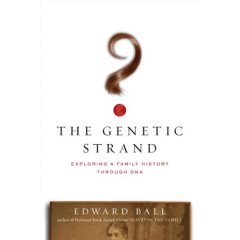
Edward Ball is the author of Slaves in the Family, which won the National Book Award for Nonfiction in 1998. Mr. Ball’s latest book is the subject of this review-by-proxy (I haven’t read it myself, so I’ll be sharing what others have said).

The new book, The Genetic Strand: Exploring a Family History Through DNA, is reported to “intrigue America’s many amateur genealogists and also serve as a cautionary tale.” The book follows Ball’s journey through his family’s genetic genealogy after he discovers locks of hair in an old family desk.

Megan Smolenyak reviewed the book over a week ago at Megan’s Roots World with “The Genetic Strand: Slightly Disappointing.” Megan’s review brings up a number of points, including Ball’s failure to provide some essential information (like his family tree). One of the most interesting critiques, which was also criticized by a review in the New York Post, surrounds the following paragraph:

“Genealogy, a search for family history, is practiced by millions of middle-aged and middle class Americans, for whom it has traditionally been a way to snatch a bit of glory or a helping of a fantasy from the past. It is, after all, the little activities, visiting libraries and surfing Web sites, that allow one to acquire “good genes.” Most people who do family research are white, and most of them look for ancestors with the goal to unearth the whitest, most moneyed forebears they can. That is one definition of good genes.”

That is quite an assertion to make, and one that I have a very difficult time believing. I recommend reading Megan’s review (here), the New York Post review (here), Entertainment Weekly’s review (here), and the Genealogue’s take (here). Megan even suggests another book about genetic genealogy which she found to be very enjoyable. I guess I some reading to do!