The Genetic Genealogist

Adding DNA to the Genealogist's Toolbox

Archive for the "DNA Articles" Category


Interview With Forensic Genealogist Colleen Fitzpatrick, Ph.D.

image

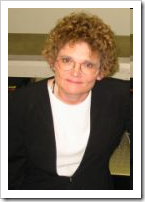
Colleen Fitzpatrick, Ph.D. is one of the most recognizable names in the field of forensic genealogy.  She has authored two books entitled Forensic Genealogy and DNA & Genealogy, and continues to make headlines in this fascinating field.  Here is just an excerpt from her biography, located at her website:

“Colleen Fitzpatrick, Ph.D., is the author of two of the best-selling books in genealogy.  Forensic Genealogy has been widely recognized for its innovative forensic science approach to genealogical research.  She has been featured on NPR’s Talk of the Nation radio program (July 2005), and has written cover articles for Internet Genealogy (June 2006), Family Tree Magazine (April 2006) and Family Chronicle (October 2005).  Colleen writes a regular column for Ancestry magazine.”

Colleen’s work has been very much in the news during the past few weeks as a result of the a project to identify human remains found at the site of a DC-4 airliner that crashed on March 12, 1948.  As a result of this project, the remains were identified as belonging to Francis Joseph Van Zandt, a 36-year-old merchant marine from Roanoke, Virginia.  The story was picked up by hundreds of newspapers – see the Washington Post and Anchorage Daily News stories here, for example.  An MSNBC video is available here.

I recently had the opportunity to interview Colleen about the “Hand in the Snow” project, and about some of the other projects she has or is currently working on, including identifying Titanic remains.

The Genetic Genealogist:  You are the Principal Genealogist for the Armed Forces DNA Identification Laboratory in Rockville, Maryland, and you were recently part of a press conference to discuss efforts to identify remains of a serviceman who died in the crash of Northwest Flight 4422 in 1948. What can you tell us about this work?

clip_image006Colleen Fitzpatrick:  By far, the most meaningful moment of my life was last March when I stood in front of the Conway tombstone in the Mount Pleasant Cemetery, Askeaton, Co. Limerick, Ireland.  It read “Dedicated by John Conway, Mount Pleasant, in honor of his dear father and mother who died in 1853, aged 53 years.  Also his wife Ellen and her children Michael and Lizzie.” Our search for the identity of the remains found in the crash of Northwest Flight 4422 was at an end. It had been a long journey to this moment- almost nine years to discover the link between the Conway family of Askeaton and the frozen hand and arm found in the snow of the plane that crashed in 1948 in a remote area of Alaska.

Our investigation team was composed of the top experts in the field of DNA analysis, fingerprint identification, and forensic genealogy.  The key to our success was that not just that our team members were accomplished scientists and genealogists, but also that we were all dedicated to working together to making an identification. We worked side by side with no rivalry.  Each of us competed only with himself to do his best.  There were many times each of us faced discouragement, but everyone was determined to do everything possible to identify the remains of the serviceman who died in the accident.

As we eliminated one passenger on the plane after the other, through fingerprints, through DNA analysis, or through both, the possibility occurred to me, as it did to each of us, that we might never find a match.  It was possible that there was someone onboard who was not listed on the passenger manifest – perhaps a CIA agent.  Another possibility was that the victim’s female line had died out – that there were no living family members to use for a mitochondrial comparison. If so, a DNA match would be impossible, and if the victim did not have a fingerprint card archived by the military, there would be no fingerprint comparison to fall back on. Still another possibility was that one of the passenger’s family members had not been honest and had submitted a DNA sample from a friend or another relative, producing a non-match where the results should have been otherwise.  In all of these cases, the hand and the arm would probably remain unidentified forever. We all held our breath.

clip_image008Finally on Thanksgiving Day 2008, our search was over. My forty years’ experience with Irish genealogy, combined with a lot of creative thinking and persistence, paid off. We obtained a mitochondrial DNA match between the remains and Maurice Conway, a retired maintenance supervisor I had located in Askeaton, Co. Limerick. Maurice was a distant cousin of Francis Joseph Van Zandt along the exclusively female line of his family. Frank was the second to last passenger we had left to investigate. Even better, Maurice proved to be a double match to the remains – not only did his mtDNA match Frank’s exclusively female line, but his Y-DNA matched that of the descendants of Frank’s maternal uncle from upstate New York. In the meantime, a fingerprint match was made between the hand and Frank’s military records, for a triple confirmation that the remains were those of Van Zandt. This was the best we could have ever hoped for!

The publicity we have received announcing our success has been overwhelming to me. The news of our press conference was published by the Associated Press and was picked up by 300 newspapers worldwide. A video clip of the conference was shown on both MSNBC and CNN. Feature articles are now coming out– two appeared just this week in the Irish Daily Mail and the Irish Independent. There is even a documentary planned for the coming year.

Yet amid all of the excitement, our team has not lost sight of the purpose of our investigation. It had been judged impossible to identify the arm and hand through DNA or fingerprint analysis because they had been embalmed and were severely degraded and contaminated by bacteria. Yet AFDIL devoted much time and effort to developing new techniques for teasing out DNA from the remains, hoping that these techniques could be used to identify nearly 900 embalmed remains of unidentified Korean War veterans buried in the Punchbowl Cemetery in Honolulu. Our fingerprint experts developed new techniques to rehydrate the hand that led to the oldest fingerprint identification ever. In the end, the hard work of our world-class team of DNA analysts, fingerprint experts, and forensic genealogists was rewarded with success. It was thrilling to be part of a team that had accomplished the impossible.

TGG:  Stay Tuned for Part II tomorrow!

Interesting News in the World of Genetic Genealogy

Genetic Genealogy

Technology Review, an MIT publication, has an article entitled “Genealogy Gets More Precise: Rapidly growing databases enable a more complete picture of one’s ancestry.“  The article, which is relatively balanced, discusses some of the benefits and challenges associated with genetic genealogy testing.

Also check out the article and video “Mapping Out a Nascent Market” at boston.com, which is directed towards personal genetic companies such as deCODEme, 23andMe, Navigenics, and Knome.

And lastly, scientists have sequenced and recreated the Neanderthal mtDNA genome.  For more information see john hawks weblog, Genetic Archaeology, Genea-Musings (with a humorous twist), Anthropology.net, and The Spittoon.  The original article is in Cell.  Turns out there are roughly 206 differences between the CRS (the Cambridge Reference Sequence, the mtDNA to which all human mtDNA is compared) and Neanderthal mtDNA; 195 transitions and 11 transversions.

Are Disease-Causing mtDNA Mutations Common?

image Genetic genealogy has the potential to reveal information about your health (for example, DYS464 can reveal infertility and sequencing of the entire mtDNA genome can reveal mutations that are suspected of being associated with certain disorders).  Although I usually don’t consider this possibility to be serious enough to discourage genetic genealogy testing, I do believe that people should be aware of the possibility before being tested.
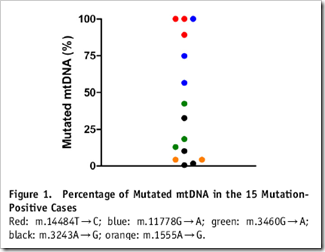
A new study in the American Journal of Human Genetics (available here) examined the frequency of ten (potentially) pathogenic mitochondrial point mutations in 3168 neonatal cord blood samples.  Of these samples, a total of 15 (or 1 in 200) harbored one or more of the mutations.

Interestingly, the mtDNA of 12 of the 15 samples were heteroplasmic, meaning that their cells harbored both mutated and non-mutated mtDNA genomes.  Figure 1 from the paper, above, shows the percentage of mutated mtDNA in each of the 15 samples with mutations, from nearly 0% to the 100% in the three homoplasmic samples.

The abstract:

“Mitochondrial DNA (mtDNA) mutations are a major cause of genetic disease, but their prevalence in the general population is not known. We determined the frequency of ten mitochondrial point mutations in 3168 neonatal-cord-blood samples from sequential live births, analyzing matched maternal-blood samples to estimate the de novo mutation rate. mtDNA mutations were detected in 15 offspring (0.54%, 95% CI = 0.30-0.89%). Of these live births, 0.00107% (95% CI = 0.00087-0.0127) harbored a mutation not detected in the mother’s blood, providing an estimate of the de novo mutation rate. The most common mutation was m.3243A-G. m.14484T-C was only found on sub-branches of mtDNA haplogroup J. In conclusion, at least one in 200 healthy humans harbors a pathogenic mtDNA mutation that potentially causes disease in the offspring of female carriers. The exclusive detection of m.14484T-Con haplogroup J implicates the background mtDNA haplotype in mutagenesis. These findings emphasize the importance of developing new approaches to prevent transmission.”

HT: Dienekes’ Anthropology Blog

TGG Interview Series IX – Ana Oquendo Pabón

image The ninth and final edition of the TGG Interview Series is with Dr. Ana Oquendo Pabón.  Dr. Oquendo Pabón is DNA and Historical advisor to the Lost Colony DNA and Research Group, and is an Administrator or Co-Administrator to numerous DNA projects.  Her bio is can be seen here.

In the following interview, Dr. Oquendo Pabón discusses her introduction to the field of genetic genealogy, her own experiences with genetic testing, and her thoughts about the future of genetic genealogy.  It’s a terrific interview, so read on.

TGG: How long have you been actively involved in genetic genealogy, and how did you become interested in the field?

Ana Oquendo Pabón: I have been involved in genetic genealogy since very early in 2003. My brother and I have been traditional genealogists for about 28 years. Due to the excellent records on the island and hard research, we had long known all of our 64 grandparents except for one and all except 4 or 5 couples of our 128 ancestors. I had been keeping track of the news online concerning the “new science” and unique way of tracing your ancestral roots. I think everyone had heard about the Thomas Jefferson and Sally Hemmings story by that time. I had also read about a particular genealogist named Bennett Greenspan’s own amazing quest to confirm his paternal DNA with an individual in Argentina and how he had started a genetic testing company to help others accomplish what he had done using yDNA. In 2003, I decided to give my brother a DNA kit as a combined birthday and anniversary present. We were among the first ten thousand genetic genealogy pioneers to take advantage of this new way of research. This spurred the idea of helping others in our field of expertise which was the genealogy of Puerto Rico and the Puerto Rican Project (Proyecto ADN de Apellidos Puertorriqueños) was born.

TGG: Have you undergone genetic genealogy testing?

AP: I initially had the mtDNA HVR1 + HVR2 in 2003 as well as the biogeographic test. Since then, I have had the complete mtDNA and all autosomal markers available. My brother has had 67 markers and SNP testing. My son, daughter, grandson and I also have had testing through SMGF.

TGG: Were you surprised with the results?

AP: Yes and no. As an admixed individual of European (mainly Spaniard), Taino and African cultures, I expected to find a tri-cultural diversity in my personal DNA. Yet, where one test did find African heritage, another found none despite a known slave in the fifth generation and in others. The test did however find that I was 24% East Indian which could only mean my indigenous ancestry.  The indigenous fact was definitely not a surprise since my ancestors had been on the island since the colonization but the high percentage was. Without a doubt, DNA can broaden our perspectives as to our ancestral origins and where to look further but it must go hand in hand with the traditional genealogy.

The greatest personal satisfaction to me is that by emphasizing mtDNA which was not even considered relevant to genetic testing as paternal yDNA Surname Projects of that time, we were able to make it an important aspect of our own project from the outset in 2003. Through mtDNA testing, we were able to dispel, one member Native American result after another, any notion of the complete extinction of  the people who first greeted Columbus to the New World. After five years of intense recruiting, we have proven through our project that our Taino and indigenous ancestry is very much present in our people in a very large way. In fact, we have one of the highest frequencies of indigenous ancestry ~62% of Haplogroups A, C, B and D for such a small geographic area. We have also been able to determine the DNA of many of the first Colonos and Criollos, the first Spanish Colonists and their descendants who intermarried with Taíno or indigenous women and of other European colonists and immigrants from the 16th century forward.

TGG: Did the results help you break through any of your brick walls or solve a family mystery?

AP: Through my personal mtDNA or my brother’s yDNA, we have not. Neither of us has any exact high resolution matches. Since our mother was an orphan, and our father lost his father when he was three, our personal quest has been to determine the DNA signatures of our other lines through close relatives. In that way, we have been able to confirm our traditional genealogy and determine many of our other great great plus grandparents’  DNA.  In fact, of the 300 members in our Puerto Rican DNA Project, we are probably related to ~75 % either on the paternal or maternal side due to our island’s geographic isolation during large periods of history and the high level of consanguinity and endogamy.

To date, we have confirmed through both traditional genealogy and DNA, our maternal mtDNA: L1c1a, paternal yDNA: E1b1a*, maternal grandfather: J2, mother’s paternal grandmother: Haplogroup C, another maternal ggg grandmother: Haplogroup A, our 3rd, 4th, 5th, 6th, 7th and 8th maternal great grandfathers: E1b1b1 (E3b1), R1b1b2 (R1b1c), J1, R1b1, T (K2), J2a2 and our paternal great grandfather’s R1b1. However, it takes time, knowledge of the history and connections bewteen families of the period, the genealogy of surnames of the period and not just your own and recruiting the correct individuals who themselves have well documented records.

TGG: You are also a DNA Project administrator.  What projects do you lead?

AP: I am Co  Administrator and Co Founder of the Puerto Rican DNA Project, Co Administrator of the Sepharad in Puerto Rico DNA Project, the Cape Coloured DNA Project and the Flores DNA Project. I am Administrator of the American Indian Q3 Project, Administrator and founder of the The African DNA Project, the Casa de España DNA Project and the Amerind Founder DNA Project. I also administer many yDNA Surname Projects.

TGG: You were recently named to the advisory board of the Lost Colony Center for Science and Research as the advisor for DNA and Historical Research.  Can you tell us a little more about the Center, including its goals and the progress that has been made so far?

AP: Due to a difference in focus and perspective, neither I nor any of the other previous board members are now associated with the Lost Colony Center for Science and Research.

We have formed the new Lost Colony DNA and Research Group and the Lost Colony DNA Project.  I assist on their board as DNA and Historical advisor especially as it pertains to Spanish records and Native American and African mtDNA. Our goal is to not only recruit individuals who may be posible descendants but to educate and help connect families in the Roanoke area by DNA testing. We also make available all sources and documents that will assist those with Lost Colony surnames or who belong to families of interest in their own research. This includes wills, deeds, land grants and any other type of document of that specific time period and forward. To that end, we have also begun making contacts with researchers in England to assist in finding relatives of Lost Colony families acroos the pond to have DNA tesing. This is a project which takes much dedication on the part of volunteers and which will be of considerable duration, requiring intense research and collaboration. We have an excellent group of genetic genealogists and researchers which includes Roberta Estes, Joe Chandler, Anne Poole, Jennifer Sheppard, Janet Crain, Rob Noles, Penny Ferguson, Nelda Percival and myself. We are fortunate to have researchers knowlegeable in archaelogical digs, the history of Roanoke Island and North Carolina in general, the Lumbee and other Native American tribes in the region.

The Lost Colony Site is at:
http://www.rootsweb.ancestry.com/~molcgdrg/rs/sur-coord.htm
and there is an excellent blog at:
http://the-lost-colony.blogspot.com/

TGG: What do you think the future holds for genetic genealogy?

AP: As more and more individuals read through the hype and wean through the misinformation that is sometimes perpetuated in the press, there are increasing numbers of everyday people realizing the value of genetic genealogy to their own traditional genealogical research. However, what is blatantly overlooked by the press is that it is through the diligence and persistence of genetic genealogists that the field is advancing so quickly. Genetic genealogists are from all walks of life but its ranks are also full of PhDs, MDs, biologists, physicists, chemists, sociologists, priests, ministers, rabbis, psychologists and many other disciplines. In other words, we understand the intricacies of explaining a non parental event to someone. We can refer to those who can better explain questions pertinent to a particular discipline. Indisputably, we as genetic genealogists share a common bond and that is to learn and educate while we search for our own ancestral roots. It is time to give credit where it is due. Sensationalism of genetic genealogy may dissuade some individuals from testing but it is through volunteer societies such as the International Society of Genetic Genealogists that individuals will find unbiased facts and obtain education on every aspect of the field.  The best part is that they will receive the information from individuals just like themselves who were once interested in learning what genetic genealogy holds for them and once stood in their shoes not knowing where to turn for answers.

Genetic Genealogists’ own research into their own families has begun to bring invaluable genetic information to the attention of academics. Through the voluntary genetic genealogy testing in the private sector, has come the discovery of new SNPs helpful in reshaping the Y DNA Tree, has come the discovery of new mtDNA sequences and sub clades in mtDNA including the European, African and Native American groups. We, through voluntary testing are building and adding to the largest databases of genetic sequences available. With complete analysis through companies such as DeCode Me and 23 and Me, will come the knowledge and discovery of mutations which will eventually assist in the clues to finding cures to disease or the drugs to fight them. The continued and rising voluntary submission of complete mitochondrial genomes by genetic genealogists to Gen Bank is a boon and a readily accessible resource to population geneticists, medical geneticists, molecular biologists and other academics alike. The processing and analysis of those complete mtDNA genomes were obtained through just as or more stringent protocols as required in academia. Again, it is time to give credit where it is due: We are helping and are PARTNERS in this science. Politically, Genetic Genealogists are a viable, knowledgeable and formidable group who are the strongest advocates against the use of DNA for discrimination of any individual seeking health care or other insurance coverage because of their genetic ancestry.

Many of us, as parents and grandparents, are leaving our own genetic information for our children and grandchildren and to science for research and posterity
The time will come, sooner than later whereby every child will have their genetic makeup known at birth and the knowledge will be available to prevent any disease for which they may be at risk.

This will come through the help of genetic genealogists who one day, curious about their ancestors’ genetic make-up, who their parents were and where they migrated from in more recent and in earlier generations , decided to to take a Q-tip and swab the inside of their cheek to learn how their DNA all came together in one place and time to form you and me.

TGG:  Thank you, Ana, for a wonderful interview!

View every interview in this fascinating series:

And, in conclusion, I would like to extend my appreciation to everyone who participated in this series.  I learned a great deal about the early roots of genetic genealogy, some of the individuals who have been involved from the beginning and along the way, as well as some thoughts about the future of genetic testing.

The Tenth and Final PGP Volunteer is Revealed!

image Thomas Goetz has written another terrific article about genetic testing and the Personal Genome Project.  This article, entitled “The Gene Collector,” appears in Wired Magazine.  The article provides some new information about the PGP, including some of the incredibly detailed phenotype information that will be collected from the next 100,000 volunteers in the project.

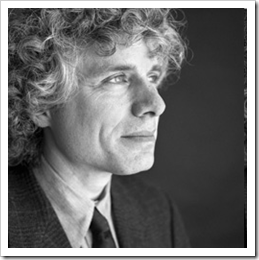
The article also reveals the tenth and final participant of the “First 10″, the original 10 volunteers in the PGP.  I wrote about the first nine volunteers in the PGP almost exactly one year ago and noted that the tenth participant had not yet released his or her name.  The Wired article, however, mentions a number of participants including George Church, Esther Dyson, Rosalynn Gill, John Halamka, and Steven Pinker.  Indeed, a check of the PGP website confirms that Steven Pinker is the last PGP volunteer to be identified.

From the PGP-10 website:

Steven Pinker, Ph.D. is the Johnstone Family Professor of Psychology at Harvard University, and has also taught at Stanford and MIT. His research on visual cognition and the psychology of language has won prizes from the National Academy of Sciences, the Royal Institution of Great Britain, and the American Psychological Association. He has also received five honorary doctorates, several teaching awards, and numerous prizes for his books The Language Instinct, How the Mind Works, and The Blank Slate. He serves on the Usage Panel of the American Heritage Dictionary and many editorial boards, and often writes for Time, The New York Times, The New Republic, and other publications. He has been named Humanist of the Year, and is listed in Foreign Policy and Prospect magazine’s “The World’s Top 100 Public Intellectuals” and in Time magazine’s “The 100 Most Influential People in the World Today.” His latest book is The Stuff of Thought: Language as a Window into Human Nature, published by Penguin books in the fall of 2007.”

There is more information at Dr. Pinker’s Harvard website and at Wikipedia.

A Four-Part Series About Personal Genomics at Condé Nast Portfolio – Are Genetic Tests Really Useful?

iStock_000004876214XSmall Portfolio presents an interesting four-part series by David Ewing Duncan about personal genomics. But before I go on, it is important to realize that this series focuses on personal genomics – analysis of SNPs or sequencing throughout the genome – rather than the much narrower field of genetic genealogy. Although there are some ethical concerns surrounding genetic genealogy, they are not specifically addressed in the series.

Portfolio’s public relations coordinator circulated a summary of the series (I wish I had a PR coordinator!):

In Portfolio.com columnist David Ewing Duncan’s four-part series, “You 2.0,” he assess and compares three major websites recently launched that test a person’s DNA for risk-factors for everything from Alzheimer’s Disease and heart attack to drug addiction, an ability to taste bitterness, and ancestry. Is this information ready for prime time? Can it really predict a healthy person’s medical future? Duncan has been tested by 23andme, deCodeme, and Navigenics, and reports on his sometime contradictory and confusing, sometimes funny, and occasionally enlightening results gleaned from these controversial sites that are attempting to bring genetics directly to the people.

Here are the four parts:

  1. You 2.0: Comparison Shopping For Your Future
  2. You 2.0: I’m Doomed. Or Not.
  3. You 2.0: Recreational DNA and Genetic Voyeurism
  4. You 2.0: Closing the Genetic Gap

Look for David’s Book Later This Summer

According to his website, Duncan is writing a book entitled Experimental Man: One Man’s Intimate Journey Into Himself, Cell by Cell (although I’ve also seen it written as Experimental Man: A Molecular Autobiography) which is due to be available in late summer 2008. The book “describes and assesses a wide-range of leading-edge diagnostic tests that David has taken, from genes and environmental toxins inside him to brain scans assessing everything from his propensity to suffer from Alzheimer’s Disease to the politics of his brain. He is running these tests as an Everyman in an attempt to understand and humanize the often eye-glazing science that is about to change our world.” The Experimental Man Power Point Presentation is already available.

Sounds very interesting!

HT: The Gene Sherpa

The Latest News About 23andMe

image For new readers of The Genetic Genealogist, 23andMe is a personal genomics company that offers a service to examine more than 600,000 SNPs throughout an individual’s genome. The information is then used to analyze ancestry (using Y-DNA and mtDNA) and to estimate propensity for disease. For much more info about 23andMe and similar companies, look under “Personal Genomics” on my Featured Articles page.

A Contest

Today, 23andMe announced on their blog – The Spittoon – the winner of the company’s first ‘Win Your Genome Contest’. The contest was to describe Lilly Mendel, a publicly available but anonymous profile at 23andMe – based upon her genetic information alone. The winner was Mike Cariaso, who previously created a program that analyzes 23andMe SNP data using the growing SNPedia database.

A New Partnership

In another announcement today, 23andMe released details of a partnership between the company and The Parkinson Institute to analyze the genomes of the Institute’s patients. Unlike the typical customer, the Institute’s patients will provide information about their “individual environmental exposures, family history, disease progression and treatment response.” The official press release is here, GenomeWeb News coverage is here, and there is a mention at Simon Lin’s blog Retail Genomics.

A Panel Discussion

Linda Avey, one of the founders of the company, recently participated in a panel discussion at the Cold Spring Harbor Biology of Genomes meeting. She was joined by representatives from two competitors, deCODEme and Navigenics. Daniel Macarthur at Genetic Future provides a fantastic and lengthy review and analysis of the discussion. A mention at Genome Technology Online laments the fact that the panel discussion was civil, even though it was a gathering of three competitors. The site also provides a summary of the meeting (subscription required).

A Controversy

Also in the news are reports that two states, California and New York, are evaluating whether personal genomics services offered by companies such as 23andMe and deCODEme are regulated by state laws, and if so, whether the companies are meeting those regulations. For more information, see “California, New York Officials Probing Gene-Testing Companies” at The Mercury News.

And Everything Else!

And lastly, here are a few newspaper articles or blog posts that mention the latest in personal genomics (note that these articles are provided so that you can perform your own analysis of personal genomic services – unfortunately, I haven’t evaluated these articles for accuracy):

New Videos for Genetic Genealogists

While conducting some online research the other day, I discovered a series of videos about genetic genealogy by Alastair Greenshields, founder of DNA Heritage. The main page contains 6 videos (shown in the list below) that are broken down into 2 to 8 chapters. Since the videos are broken up into chapters, you can can easily skip to the topics that are the most relevant to you.

  1. Genetic Genealogy Terminology
  2. Genetic Genealogy Defined
  3. Tracing My Genetic Heritage
  4. My Past
  5. Giving DNA
  6. Genetic Genealogy Results

There are many other places to find videos about genetic genealogy. Last April I wrote “Ten Videos For Genetic Genealogists“, although only 8 of them are still available. You can also watch videos about DNA here at TGG’s DNA Channel, courtesy of Roots Television. And lastly, Family Tree DNA has videos available on its website.

To give you a preview of the DNA Heritage videos, the first is embedded below:

Accuracy of Large-Scale Genome Scanning Services

Although the genome scanning services offered by companies such as 23andMe, deCODEme, and SeqWright have been front and center in the press the last few weeks, I’m sure that the following information will not be included in any of the reports.

Comparisons

Two different sources have concluded that the scanning service offered by 23andMe and deCODEme, who use different types of Illumina SNP Chips, are highly reproducible. In January 2008, Ann Turner compared the results of testing at deCODEme and 23andMe, and concluded that of the 560,163 SNPs that overlapped and had a “call” (meaning there was a measurable result), they agreed on 560,128 and disagreed on 35. Ann wrote in January:

In all of [the disagreed calls], one company would make a homozygous call while the other company made a heterozygous call – there were no cases where they made a completely discordant call. All in all, I’d say that is pretty impressive.

The second analysis comes from Antonio C B Oliveira at Longa Vista, a new blog that appears to have been created to present these results and related information. Oliveira obtained results from 23andMe and deCODEme and compared the results, which are available here. He concluded that of the 560,299 SNPs that overlapped and had a call, the two scans agreed on 560,276 and disagreed on 23. The 23 disagreed upon SNPs are listed by chromosome. Oliveira writes:

This error rate seems to me to be quite acceptable and I wonder if this is the rate expected in scientific studies using the same technology.

Program to Compare Your Results

Interestingly, Oliveira created a computer program to analyze the results for him, and he has graciously made that program available “as a Windows executable and the source code is provided under the GNU General Public License.”

Conclusions/Thoughts

Note that Oliveira’s results contained 136 more overlapping results, presumably because of fewer no-calls in the data. Is Illumina able to produce more calls as they gain experience with the process, or is this an expected amount of variation from person to person? I would be interested to see more results and comparisons to determine the answer to this question.

HT: Genetic Future. If you’re interested in genome sequencing or personalized genomics, you should be reading Genetic Future. I highly recommend adding the feed to your reader. Genetic Future gave a hat tip about this information to Kevin Kelly at The Quantified Self. There, Kelly points out that none of the SNPs in Oliviera’s analysis are currently associated with any physical phenotype or disease. I hope Kelly plans to do a comparative analysis of his results, as that would be an interesting addition to the information provided by Turner and Oliviera.

Kwäday Dän Ts’ìnchi – "Long-Ago Person Found"

image Around the year 1700, a relatively healthy young hunter was walking along a glacier in land that would one day be British Columbia in Canada. He wore a robe of 95 animal skins, perhaps gopher or squirrel, stitched together with sinew, and carried a walking stick, iron-blade knife, and spear thrower. For some reason, the young man, aged 17 to 22, died on the glacier and was quickly incorporated into the ice. There he remained, frozen, for the next 300 years.

In August 1999, three hikers noticed a walking stick, fur, and bone lying on a melting glacier (60′ N 138′ W). The young hunter, renamed Kwäday Dän Ts’ìnchi in the Southern Tutchone language of the Champagne and Aishihik First Nations, was removed by scientists for analysis (see the NY Times article, and the Journal of Canadian Archaeology article). From an article in the Sydney Morning Herald:

[When scientists were led to the site], they found a torso with the left arm attached. The hand was mummified. The fingernails were missing. The head was missing, too. A few metres away lay the lower body, with thighs and muscle attached. They also found a wooden dart and walking stick, and pieces of fish and scales within the folds of the man’s robe.

Over the next two days the team members carefully lifted the remains. They collected a knife still in its sheath and a leather pouch. They found a woven hat, fragments of clothing and what was later described as the man’s “personal medicine bag”, which was considered sacred, even after more than five centuries. They did not open it.

In 2001, Kwäday Dän Ts’ìnchi’s remains were given back to the Champagne and Aishihik, and in July 2001 he was cremated in a closed ceremony and returned to the glacier. Kwäday Dän Ts’ìnchi’s skull was found in 2003 but was not removed from the site.

Discovery Continues

Even though Kwäday Dän Ts’ìnchi has been cremated, the analysis of his DNA, intestinal contents, and artifacts continues. This past weekend, at the Kwäday Dän Ts’ìnchi Symposium, researchers around the world presented the results of their research:

The conference brings together more than 30 researchers from fields as diverse as archeology, criminology and microbiology. They come from local universities, the Royal B.C. Museum, Vancouver General Hospital, first nations, and institutions as far afield as Indiana and Scotland.

Haplogroup A

One of the research projects involved sequencing of Kwäday Dän Ts’ìnchi’s mtDNA, which revealed that it belonged to Haplogroup A, with the polymorphisms 16111T, 16189C, 16223T, 16290T, 16319A, and 16362C. As part of the study, the researchers collected blood samples from 250 to 300 members of the Champagne and Aishihik First Nations to compare their mtDNA sequence to that of Kwäday Dän Ts’ìnchi’s (more info here and here). At the Symposium, the researchers revealed that 17 people had mtDNA that closely matched that of the subject, suggesting that they are close maternal relatives. 15 of those 17 people belong to the Wolf clan, also suggesting that Kwäday Dän Ts’ìnchi might have belonged to the Wolf clan himself (more info here).

This topic is of particular interest to me, since my mtDNA belongs to Haplogroup A and therefore I am also (very) distantly related to Kwäday Dän Ts’ìnchi. Last year I profiled the Qilakitsoq mummies in Greenland, all of whom belonged to Haplogroup A.

HT: Geneasofts