The Genetic Genealogist

Adding DNA to the Genealogist's Toolbox

Archive for the "DNA Articles" Category


“Can DNA tests help your genealogical inquiries?” in the Asheville Citizen-Times

An article appears in today’s Asheville Citizen-Times (here) about genetic genealogy. Although brief, the article summarizes the sciences behind Y-DNA and mtDNA testing, and focuses on the use of genetic genealogy to explore the “Clark” surname.

With the famous Thomas Jefferson-Sally Hemmings case, folks began to realize that DNA testing techniques could give answers and break down brick walls as never before.  While DNA will never replace standard research and primary documentation, it can be considered a tool to be used hand in hand with standard research.

via citizen-times.com and familybuilder

Posted via web from Blaine Bettinger’s Lifestream

A Critique of Genetic Ancestry Testing in Science Magazine

Gold StandardFive bioethicists have published a paper in today’s issue of Science – The Illusive Gold Standard in Genetic Ancestry Testing (paid subscription required) – calling for government regulation of genetic ancestry testing (aka genetic genealogy). There is an accompanying press release: Stanford Bioethicist and Colleagues Call for Federal Regulation of Genetic Ancestry Testing (another press release is available here).

Overall Thoughts

I highly respect the work of these authors, and I appreciate their efforts to educate the public about these issues. I do, however, wonder why the article was published in Science. The article mostly rehashes arguments found in a number of other articles (including from a very similar 2007 Science article (link) with some of the same authors) without adding any new research or supporting evidence. This is my greatest criticism of this and related articles – much of the hypothesis rests on anecdotal evidence without any corresponding research for support (such as objective social research with genetic ancestry testing customers).

What is different about this article, however, is that it very strongly promotes government regulation of genetic ancestry tests; indeed, this is the overarching purpose of the article. And this is perhaps one of the reasons that the article was accepted for publication: we are presently in a highly-charged atmosphere as a result of the interplay between DTC genetic testing and potential & existing government regulation.

Mutual Responsibility and Accountability

The authors state that one of the issues that emerges long before genetic ancestry tests are available is the collection of DNA samples used to create (and supplement, I suppose) an initial commercial database: “ethical questions about the collection and use of DNA samples must be resolved before researchers are permitted to sample many of the populations needed to approximate the full range of human genetic diversity.”

I agree that it is vital that any and all DNA collection & use from indigenous populations be constrained by clear and well-developed ethical standards. However, while the statement that “incomplete representation of human genetic diversity in existing databases” is a limitation of genetic ancestry testing is entirely accurate, the implication that all testing should await this approximation of completeness is not practical or tenable. Rather, entities doing genetic ancestry testing must continue to inform consumers about this limitation. Imposing a government-imposed definition of “completeness” of a database through regulation is clearly not the solution. Is there anyone on the planet today who can adequately describe what a database that would contain a complete or even approximate representation of human genetic diversity would look like? Certainly not, as research endeavors such as The Genographic Project are still working to describe human genetic diversity.

Finding Common Language

Interestingly, the authors state that “[t]he high stakes of genetic ancestry research require innovative approaches to dialogue, collaboration, and power-sharing between academia, industry, consumers, and community groups.” I think this is a reasonable approach, and one that has been proposed to me in the past by others in the field. The authors go on to state that:

“A first step may be joint creation of a vernacular that characterizes key concepts like probability, association, origin, and ancestry to help minimize variability that exists in how such concepts are understood across fields, communities, and governmental and commercial entities with different vantage points.”

The authors then discuss the term “origin” as an example of a term that is “not transparently or consistently defined.” Creating and enforcing any definition of this term could be problematic, a symptom of the very field in which it will be used. Terms such as “origin,” “ancestry,” “heritage,” and “genealogy” mean something different to each person. Indeed, a recent study has suggested that many customers of genetic ancestry testing adapt the results of the tests into their pre-established sense of self (which includes their personal definitions of origin, ancestry, and heritage). Again, the solution here (as the authors do seem to be suggesting) is education; each entity offering genetic ancestry testing should make the benefits and limitations of genetic genealogy clear.

Government Regulation

As I stated before, this article is the strongest proponent yet of increased governmental regulation of genetic ancestry testing. Yet, as I have previously argued it is education, not government regulation, that can most adequately address the issues the authors raise. For me, the “gold standard” of genetic ancestry testing is and always will be the education of consumers, not the regulation of testing companies. In furtherance of this belief, I have spent the last two years building this blog and associated works in order to help educate these consumers.

The authors conclude that government agencies are best suited to “discover common language and to identify best practices for presenting the limitations of current genomic technologies and the risks associated with over-extrapolating or misinterpreting genetic ancestry results.” The perceived need for regulation in this area necessarily relies on genetic exceptionalism, which holds that genetic information is fundamentally different from all other information about an individual. I’ve never been a believer of genetic exceptionalism, however. I suggest that the argument relies on genetic exceptionalism because the authors promote regulation of genetic ancestry testing, not of all genealogical research. Indeed, almost any type of genealogical research – including traditional paper record research and family interviews – inherently has “limitations” and suffers from the possibility of “over-extrapolation” or “misinterpretation.” Yet the answer here is clearly education, not government regulation of how the limitations of the supposed “facts” in great-great-aunt Maude’s birth certificate can be communicated to the public.

Instead of spending precious time enacting regulations that will do little to educate the public about genetic ancestry testing, let’s work together to increase the education of customers. Middle school and high school students need a stronger education in genetics in order to face the inevitable Genetic Future (see, for instance, the fantastic work of Harvard’s Personal Genetics Education Project), and adults require easily understandable resources available at their fingertips. This, not remote government regulation, will directly benefit consumers.

The Havasupai

The article also mentions researchers’ use of DNA samples from the Havasupai Tribe for various research projects despite the fact that individuals only consented to a study regarding diabetes (more info here). Although I am not familiar with either the law or the facts of this case, it is clear that there should be bright ethical guidelines for researchers to follow in order to prevent what the Tribe (and undoubtedly many others) obviously believes is a misuse of the samples.

However, with all due respect I question the inclusion of this issue in the article. The purpose of the article is to promote the use of government agencies to set industry guidelines (to “identify best practices for presenting the limitations of current genomic technologies and the risks associated with over-extrapolating or misinterpreting genetic ancestry results”). The Havasupai controversy, on the other hand, regards the collection and use of biological samples for research purposes. However, most if not all genetic ancestry testing companies either already have well-established proprietary databases or never engaged in the collection of biological samples from non-customers (instead forming a database from published data); other than The Genographic Project, I am unable to name a single genetic ancestry testing company that is or plans to obtain biological samples from non-customers for research (or any other) purposes. Indeed, even if government regulation of genetic ancestry companies had been established 10 years ago, I don’t think the Havasupai controversy would have been avoided.

Yet, tellingly, almost a third (30.7%) of the news release – about this paper discussing increased regulation of genetic ancestry testing – specifically highlights the very charged Havasupai issue. The issue feels out of place as the article is read, and while it is an example of the need for increased ethical guidelines regarding the collection of biological samples for research purposes, the fact that it does not support or even address the conclusion of the article leads me to question its inclusion.

Conclusion

As I wrote when the ASHG statement was released last year, government regulation in this field will not solve the issues raised by these ethicists (for the reasons stated above, among others).  The answer is consumer education, something that is the responsibility of both the consumer and the testing company.  Indeed, companies should continue to review and revise their customer education policies to ensure that the potential benefit and limitations of genetic ancestry testing are clearly understood by consumers before they purchase a test kit.

Genome Hacking at The New Scientist

Journalists Peter Aldhous and Michael Reilly write about using DNA obtained from a drinking glass and other sources to “hack” someone’s genome.

In “Special investigation: How my genome was hacked,” the authors use a variety of consumer-available DNA services to prepare and amplify genomic DNA in order to send it away for analysis by deCODEme.  They used deCODEme, it appears, because 23andMe and Navigenics use saliva collection, and “it would be hard to convert [the] amplified DNA sample into a form that closely mimicked saliva.”  They did use 23andMe, however, as a control.  Interestingly, the cost of the entire process was about $1,700 for lab services (preparation and amplification) and $985 for deCODEme’s service.

From the article:

Intimate secrets hidden in your DNA could be stolen without you even realizing. By taking a glass from which you have drunk, a “genome hacker” could obtain a comprehensive scan of your genome, revealing DNA variants that help determine your susceptibility to a wide range of diseases, from a common form of blindness to Alzheimer’s disease.

This could, the authors argue, suggest that similar services could be used to obtain genetic information about anyone:

For people who are not politicians or celebrities, the most obvious threat comes from unscrupulous employers or insurers – and many countries have already restricted their use of genetic information. But private citizens may also have motives to pry into one another’s DNA. A newly engaged person might want to know whether their future spouse carries genes making them vulnerable to dementia, for example. Or a childless couple could simply wipe a dribbling baby’s mouth to investigate the child’s genetic heritage and traits before deciding whether to adopt.

They also go into the different interpretations they received from each company, but there’s nothing new there; by now we know that there are different ways to interpret genetic probabilities in the current stage of knowledge.

What are your thoughts?

Stephen Pinker, The New York Times, and Counsyl

imageAlthough I can hardly hope to introduce or discuss these recent events any better than Daniel MacArthur has already given at Genetic Future, I will at least bring this new information to your attention.

Last Wednesday the New York Times printed “My Genome, My Self”, an article written by Stephen Pinker, one of the Personal Genome Project’s “First 10.”  In the article, Pinker talks about his experience with genome sequencing through the PGP.  It is especially interesting since Pinker analyzes the issue from the point of view of a psychologist.  I highly recommend reading this article if you are at all interested in personalized medicine or genetics.

Much of the article discusses the confusing results that are returned by genome/disease analysis, due to our current lack of understanding in this enormous field:

“It became all the more confusing when I browsed for genes beyond those on the summary page. Both the P.G.P. and the genome browser turned up studies that linked various of my genes to an elevated risk of prostate cancer, deflating my initial relief at the lowered risk. Assessing risks from genomic data is not like using a pregnancy-test kit with its bright blue line. It’s more like writing a term paper on a topic with a huge and chaotic research literature. You are whipsawed by contradictory studies with different sample sizes, ages, sexes, ethnicities, selection criteria and levels of statistical significance. Geneticists working for 23andMe sift through the journals and make their best judgments of which associations are solid. But these judgments are necessarily subjective, and they can quickly become obsolete now that cheap genotyping techniques have opened the floodgates to new studies.”

Pinker and Genetic Genealogy

Pinker, who has had mtDNA and Y-DNA ancestry testing, discusses these results as well:

“It’s thrilling to find yourself so tangibly connected to two millenniums of history. And even this secular, ecumenical Jew experienced a primitive tribal stirring in learning of a deep genealogy that coincides with the handing down of traditions I grew up with. But my blue eyes remind me not to get carried away with delusions about a Semitic essence. Mitochondrial DNA, and the Y chromosome, do not literally tell you about “your ancestry” but only half of your ancestry a generation ago, a quarter two generations ago and so on, shrinking exponentially the further back you go. In fact, since the further back you go the more ancestors you theoretically have (eight great-grandparents, sixteen great-great-grandparents and so on), at some point there aren’t enough ancestors to go around, everyone’s ancestors overlap with everyone else’s, and the very concept of personal ancestry becomes meaningless. I found it just as thrilling to zoom outward in the diagrams of my genetic lineage and see my place in a family tree that embraces all of humanity.”

Counsyl – A New Player in the Field

In the article, Pinker references a new entrant in the field of personalized medicine, Counsyl:

“The genes analyzed by a new company called Counsyl are more actionable, as they say in the trade. Their “universal carrier screen” is meant to tell prospective parents whether they carry genes that put their potential children at risk for more than a hundred serious diseases like cystic fibrosis and alpha thalassemia.”

According to their website, Counsyl plans to offer a saliva-based test for more than 100 serious genetic diseases.  The test will be offered directly to consumers through the website, as well as through medical centers in the U.S.  There is no launch date set.

In addition to the articles at Genetic Future, you can read more reactions to this piece at:

Humans Entered the Americas in More Than One Wave

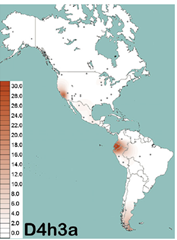
image An international team of researchers have concluded that humans entered the Americas from Asia along at least two different paths.  By studying two rare mtDNA haplogroups found in Native Americans – D4h3 and X2a – the researchers conclude that D4h3 spread into the Americans along the Pacific coast while X2a entered through the ice-free corridor between the Laurentide and Cordilleran ice sheets.

From the Press Release:  “Six major genetic lineages account for 95 percent of Native American mtDNA and are distributed everywhere in the Americas,” said first author Ugo Perego, director of operations at SMGF. “So we chose to analyze two rare genetic groups and eliminate that ‘statistical background noise.’ In this way, we found patterns that correspond to two separate migration routes.”

To conduct the study, the scientists searched the Sorenson database for Native American mtDNA and then sequenced the entire mtDNA genome of some of the samples.

There is more coverage at Dienekes’ Anthropology Blog and The Spittoon.

The entire Press Release:

SALT LAKE CITY and PAVIA, Italy (Jan. 8, 2009)—Genetic researchers from the Sorenson Molecular Genealogy Foundation (SMGF) in Salt Lake City working with scientists from the University of Pavia in Italy today published a study shedding new light on the puzzling question of why Native Americans exhibited such extraordinary linguistic and cultural diversity when the first Europeans arrived in 1492.

Featured on the cover of Current Biology journal, the striking finding by an international team of researchers challenges the traditional idea that the first groups of humans to colonize the Americas came from a single population source, which would imply one language family, technology and culture, when they crossed an Ice Age land bridge connected to Asia 15-17,000 years ago.

By analyzing for the first time at the highest level of molecular resolution two rare lineages of the maternally inherited mitochondrial DNA (mtDNA) from modern Native Americans, geneticists identified separate migratory paths that marked the initial stages of human colonization. Traveling concurrently, one genetic group of Paleo-Indians followed the Pacific coastline route and arrived at the southern tip of South America, while the second group followed an ice-free corridor east of the Rocky Mountains and settled in the Great Plains and Great Lakes regions.

The evidence that separate groups of people with distinctive genetic roots entered the Americas independently at the same time strongly implies linguistic and cultural differences between them. “The origin of the first Americans is very controversial to archaeologists and even more so to linguists,” said study corresponding author Professor Antonio Torroni, heading the University of Pavia group. “Our genetic study reveals a scenario in which more than one language family could have arrived in the Americas with the earliest Paleo-Indians.” Torroni is a world-renowned population geneticist in the field of mtDNA research and the first to identify the major genetic groups to which 95 percent of Native Americans belong.

In March 2008, the same research team published a study that was the first to compile all known Native American mtDNA sequences into a single genetic tree with branches dated. Results showed almost all modern Native Americans descended from six ancestral founding mothers. They used the built-in molecular clock of DNA to establish the time the first humans moved into the Western Hemisphere, finding a narrow window between 15-17,000 years ago.

For both studies researchers combed the Sorenson database—the world’s largest collection of correlated genetic genealogy information containing DNA collected in more than 170 countries—for mtDNA belonging to Native American lineages. Then, using techniques developed at the University of Pavia, the samples were analyzed using a complete-mtDNA genome approach for the first time.

“Six major genetic lineages account for 95 percent of Native American mtDNA and are distributed everywhere in the Americas,” said first author Ugo Perego, director of operations at SMGF. “So we chose to analyze two rare genetic groups and eliminate that ‘statistical background noise.’ In this way, we found patterns that correspond to two separate migration routes.”

Today’s study analyzed two rare genetic groups. D4h3 spread into the Americas along the Pacific coast and, at the same time, X2a migrated inland through an ice-free corridor between the Cordilleran and the Laurentide glaciers. The D4h3 group is rare today in North America, while X2a is found exclusively in the U.S. and Canada, mainly in the Great Lakes and Great Plains regions. The six most common Native American mtDNA lineages are A2, B2, C1b, C1c, C1d and D1.

“This study does not end the debate,” said co-author Dr. Alessandro Achilli, researcher at the University of Pavia and assistant professor at the University of Perugia, “but the implications of our findings are significant. The distinct industries and technologies observed in North American archeological sites might be related to separate genetic groups using different migratory routes rather than being the result of in situ differentiation. Future research will dissect common pan-American lineages into sub-branches, and we do expect distribution of some of these subgroups will parallel that of D4h3 and X2a.”

The study, “Distinctive Paleo-Indian Migration Routes from Beringia Marked by Two Rare MtDNA Haplogroups,” was published online today by Current Biology and will be the cover story for the print version on Jan. 13, 2009.

Genetic Genealogy Links for December 12 2008

Positions of the different countries and terri...

Image via Wikipedia

I’m currently in the middle of third-year law school exams, so I thought I’d do a round-up of all the interesting stories I’ve seen over the past week or two.

Holiday Specials on DNA Testing

First, it appears that most of the major genetic genealogy companies are offering special deals for the holidays:

Family Tree DNA announces a holiday sale – FTDNA is offering reducing pricing for customers who are part of or join a DNA project.  For example, a 37-marker Y-DNA test is reduced to $119, down from $149.

Ancestry.com announces holiday sale – buy a DNA test between now and December 31st, and you’ll receive 40% off.  For example, a 33-marker Y-DNA test is $89.40 (usually $149) and their mtDNA test is $107.40 (usually $179).

African Ancestry announces a holiday sale – their MatriClan and PatriClan tests, which are normally $349, are on sale for $275.

Genetree offers a special first birthday sale – I’m not sure if this sale is open to everyone or only to those who have already tested, but the relatively new company Genetree is offering $30 off the purchase of a testing kit.  I covered the launch of Genetree back in October 2007.

23andMe Announces Holiday Season Multi-Pack Discount – Customers who purchase three or more kits in a single order will save $200 on the first three kits and $70 for every additional kit.

As always, before buying a genetic genealogy test it is important to do the proper research to understand what you are buying and what the results could mean.

Genetic Genealogy Research Articles

A newly discovered mutation in AP1S1 gene, involved in the development of the central nervous system, has been traced to a group of families from the Kamouraska region in eastern Quebec.  The researchers used a massive genealogy database of Quebec families to trace the gene.  See more at Canada.com.

Using genetic variation to map the ancestry of Finns.  See Genetic Future’s posts here and here.

PLoS Genetics article examines the gene expression of African Americans to estimate how much of the difference in gene expression levels is due to ancestry and how much is due to something else (such as environment, etc.).  See Gene Expression, Popgen Ramblings, Dienekes’ Anthropology Blog, and Genetic Future.

A new paper that examines “The Genetic Legacy of Religious Diversity and Intolerance: Paternal Lineages of Christians, Jews, and Muslims in the Iberian Peninsula.”  To explore the rich diversity of the Iberian Peninsula, the researchers analyzed the Y-DNA of 1140 males from this region.  See more at Tracing the Tribe and Dienekes’ Anthropology Blog.

Re-creation of the genetic composition of a founder population.”  There will be many more of these types of papers in the future as genetic genealogists try to recreate the genomes of their ancestors (yes we will, believe it or not!).  HT: Yann Klimentidis’ Weblog.

Genetic Genealogy in the News

News from GeneaNet that “The Bodies Of Australian And British Soldiers Buried In A Mass Grave In Northern France During World War I Are To Be DNA Tested.

New Genetic Genealogy Article at Ancestry Magazine

A new article in Ancestry Magazine, “Meeting My New Family,” details a recent meeting of genetic relatives in Chicago.  The author is Howard Wolinsky, who has written other articles in the field of genetic genealogy (see, for example, an article in EMBO about 2 years ago).  As Howard describes, the meeting wasn’t a traditional family reunion:

“We are a new kind of cousin. Until a few days ago, we were strangers who just happened to have had our DNA analyzed. Then we discovered we matched one another to varying degrees. Most of us have common Jewish connections. And we learned that we come from relatively rare branches of the human DNA tree. Our mothers’ mothers came from the HV branch. Our fathers’ fathers came from the G group.”

The full text of the article is here.

The ASHG Ancestry Testing Statement and Recommendations

Edited (June 6, 2011): FINAL version of the paper available here.

Today at 1:15PM, the American Society of Human Genetics released the “ASHG Ancestry Testing Statement and Recommendations (pdf)” during a press briefing session entitled “ASHG Ancestry Testing Statement and Recommendations: Guidelines for Understanding the Issues and Implications Involved.  The briefing session, held from 1:15PM to 2:15PM, is part of the 58th annual ASHG meeting in Philadelphia.  The paper was drafted by the recently-appointed ASHG Ancestry Testing Task Force Committee.

Let me start my analysis by clearly pointing out my personal positions:

  • After years of experience in this field, I am a proponent of genetic genealogy testing, a scientific endeavor that has been utilized by as many as 500,000 to 800,000 customers.
  • I believe that education, not more government regulation, is the most efficient and appropriate answer to the issues raised by the authors of the paper.
  • I believe that autosomal genetic genealogy testing is in its infancy and should only be used with the understanding that the results are only extremely rough estimates that are subject to change as the field develops.

General Concerns:

With those personal positions in mind, and after reviewing the paper, I have a number of general concerns with the paper’s conclusions:

  • There are statements in the paper about psychological reactions to testing results, including the conclusion that “[t]he occurrence of or potential for emotional distress in people and groups following receipt of conflicting information about their ancestry has been well documented.”  Unfortunately, the statements are based on anecdotal stories or isolated examples rather than any systematic or scientific investigation of the reactions of individuals to the results of genetic genealogy testing.  I am unaware of any systematic objective study that looks at the reactions of individual to genetic genealogy testing results (outside of the paternity test or health testing arenas).  Indeed, a prior policy paper from the ASHG cites only a BBC documentary that examined the ancestry of three individuals of African descent and a newspaper article to support their conclusion that “[t]est-takers may…suffer emotional distress if test results are unexpected or undesired.”  I would suggest that the Task Force, rather than assume that this “emotional distress” response to genetic genealogy test results has been well documented, conduct an objective study specifically tailored to analyze genetic genealogy testing. The difference between the results of genetic genealogy testing and the results of health or medical testing is so vast that drawing comparisons between the two is extremely problematic and potentially inaccurate.
  • The paper muddles the distinction between Y-DNA/mtDNA testing and autosomal testing, even though the differences are huge.  The results of Y-DNA and mtDNA tests are STR numbers, SNP designations, or differences from the CRS which are then used to estimate a haplogroup or compare with another’s results.  Given the extensive data regarding haplogroup designation, the estimates are highly accurate.  Additionally, a haplogroup designation implies only a very broad geographical origin many thousands of years ago; it is not an estimation of genetic ancestry, as the authors of the policy paper imply.  Haplogroup designations have existed for more than 20 years and continue to be used by population geneticists and anthropologists.  The results of autosomal testing, however, are estimations of genetic ancestry.  These autosomal tests look at anywhere from 13 to 500,000 locations – out of billions – on the human genome and return percentages of ancestry based on those markers.  Autosomal testing can be confusing to test-takers because customer often assumes that the percentages are final and represent an accurate picture of their entire genome.
  • The authors mix the issues associated with the everyday genetic genealogy test-taker with the issues faced by very specific groups of test-takers.  For example, Native American groups are concerned about the effects that genetic genealogy will have on group identity and membership.  These same concerns have also been raised by lineage societies such as the SAR and the Mayflower SocietyAny regulations that a group believes it needs should be at the level of the group, not at the level of the testing! Groups that have these concerns should themselves decide whether and how to use genetic genealogy results for membership and group identity (such as the DAR and Mayflower Society are doing); regulating genetic genealogy at the testing level is not the most efficient or appropriate way for these groups resolve the ethical and social concerns.
  • There is mixing of the controversial phrase “direct-to-consumer” with genetic genealogy.  Of course it’s direct-to-consumer, who else would the results go to?  Surely the authors of the paper aren’t suggesting that genetic genealogy tests should be ordered and reviewed by a doctor or genetic counselor.  That would be a ridiculous restriction.
  • Although I am unaware of the composition of the ASHG Task Force, I hope that it is made up of a diverse group. Additionally, I hope that the Task Force is actively conversing with people outside the committee, including commercial testing entities, researchers, and customers of genetic genealogy in order to obtain a well-rounded view of the field.

Specific Concerns:

Now, onto a few specific criticisms of the paper:

Limited Scope:

“Many people pursue genetic ancestry testing because they wish to find out more information about either the local populations or broad geographical regions in which their ancestors lived. However, the power of commercial genetic tests to answer such questions is limited, and the precision of the answer is often limited by the imprecision of the question. The limitations arise from the fact that every person has hundreds of ancestors going back even a few centuries and thousands of ancestors in just a millennium. There is thus enormous non-deterministic variation to the portion of the genome retained in a descendant from a given ancestor, with a rough expectation that it halves every generation. Consequently, genetic tests can access only a fraction of these ancestral contributions. The genomic segments contributed by a particular ancestor are far from all being uniquely identifiable, so even if one’s genome has those specific genome contributions, identification of particular ancestry is always uncertain and statistical. It is also unclear how well-inferred ancestry serves to predict the tested individual’s genotypes at untested loci.”

This paragraph largely deals with autosomal testing, but there is no clear distinction made.  The questions that can be answered by genetic genealogy depend on the type of testing that is done.  Additionally, there is no way to know for sure, short of testing, which ancestors contributed to your autosomal DNA (and even current testing is unable to do this, although it likely will be able to do so in the future).  However, it is clear who contributed your Y-DNA and/or mtDNA (your father’s father’s father’s father contributed your Y-DNA, for example, even if their names are unknown).

Accuracy:

“A major concern about the DTC ancestry testing business is that there is no quality assurance guarantee, and there is not even a mechanism to couple market performance with anything relating to accuracy. Cost pressures and market competition will likely drive costs down, and lower costs for ancestry testing services will probably be tolerated in this environment even if the accuracy suffers.”

I believe that the Task Force is aware of the GENEALOGY-DNA Mailing list, but I wonder if they are similarly aware that genetic genealogists often test the same markers with multiple companies. For example, test-takers were recently able to compare their results to the SNP results provided by new large-scale chip testing from 23andMe or deCODEme.  Similarly, test-takers have also compared the results of SNP testing by 23andMe and deCODEme and found that the results were almost identical (see here).  Many genetic genealogists, especially those associated with the GENEALOGY-DNA mailing list, are aware of and continue to explore accuracy issues. As a result, these individuals provide a market regulation mechanism that is much more robust that the authors imply, especially since some testing companies monitor and interact with these lists to address the concerns of customers.

Group Identity:

“For some groups (some Native American tribes, for example), a major concern about scientific efforts to explain origins is the apparent diminished regard for important cultural, religious, social, historical and political processes that also inform group origin, membership, and identity, and access to group rights. Some related issues include the use of genetic ancestry information as the basis for: changing one’s identity on various government forms; making claims to certain group rights or benefits; and immigration purposes, such as seeking dual citizenship.”

Since I already discussed this above, I won’t add much here.  Again I argue that any needed regulations should be established at the level of the group or organization rather than at the level of testing.  The government should establish guidelines about how to use DNA testing results when filling out identity on government forms, and groups should determine how to use DNA testing results when addressing group rights or benefits.  This is the most efficient and appropriate way to regulate these concerns.

Emotional Distress:

“Knowledge about genetic ancestry – if undesirable and unexpected – can elicit a range of psychological responses including shock, disbelief, denial, anxiety, anger, fear and other well-known reactions to unwanted news. It can also lead to the reshaping of individual or group identity. The occurrence of or potential for emotional distress in people and groups following receipt of conflicting information about their ancestry has been well documented.”

I discussed this concern above, but I wanted to raise one more issue.  While researching the ancestry of my great-grandmother, I discovered on a census return that she was ‘adopted’ as a child, and in fact I still don’t know the identity of her birth parents.  Finding this unexpected result in this document caused a number of emotional responses over the ensuing years, including some anger and frustration.  Should the government regulate access to census records, published family histories, or town records since finding unexpected results in these research sources can elicit emotional responses?  Should I have to use the services of a professional genealogy counselor to share the results of the research with me?  Based on my own anecdotal experience during 20+ years of traditional genealogy, I would argue that far more emotional distress is elicited by traditional genealogy than is elicited by genetic genealogy!  Note, however, that I claim this information is anecdotal, not “well-documented.”

Conclusion:

If nothing else, I hope that his policy paper incites thoughtful conversation about these issues.  I am genuinely interested in your thoughts and comments about both the paper and my response.  This is a very important time for genetic genealogy, and I encourage you to join the conversation by leaving a comment here at TGG.

And finally, in case you think that I am in complete disagreement with the paper, let me leave you with the group’s first recommendation which I consider to be sage advice:

“Because the science of ancestry determination has limitations, greater efforts are needed on the part of both industry and academia to make the limitations of ancestry estimation clearer to consumers, the scientific community, and the public at large. In turn, the public has the responsibility to avail themselves of information regarding ancestry testing and strive to better understand the implications and limitations of these assessments.”

Genetic Genealogy at the ASHG Meeting in Philadelphia

The 58th annual meeting of the American Society of Human Genetics is currently being held in Philadelphia.  Today at 10:00AM there will be a session specifically about genetic genealogy entitled “The Social, Ethical, and Biomedical Implications of Ancestry Testing: Exploring New Terrain.”  From the abstract:

“What is genetic ancestry and how does it relate to race and ethnicity? The development of increasingly cost effective genomic sequencing technologies and public interest in genetic ancestry has led to a dramatic flourishing of direct-to-consumer products and new approaches to biomedical research. In this session, panelists define the contours of this emerging landscape and explore the commercial, biomedical, social and ethical implications of this burgeoning category of genomic application. Panelists consider the following questions: What genetic ancestry information is available to consumers? How is genetic ancestry used in biomedical research? What implications do genetic approaches to ancestry have on social identity? What ethical and policy issues must be addressed in this changing landscape? Panelists provide perspectives from industry, medicine, cultural studies, and bioethics.”

The moderator of this session is Sandra Soo-Jin Lee of Stanford University.  The panelists include Joanna Mountain who will talk about ‘New dimensions for direct-to-consumer genetic ancestry testing’; Kimberly Tallbear who will talk about ‘The genetic construction of indigeneity’; and Esteban González Burchard who will talk about ‘The importance of ancestry testing and genetics in biomedical research’.  Additionally, the moderator will discuss ‘Racing forward: The ethics of ancestry testing.’

Comments:

I don’t like the mixing of the controversial phrase “direct-to-consumer” with genetic genealogy.  Of course it’s direct-to-consumer, who else would the results go to?  Should your doctor or genetic counselor review your genetic genealogy results?  That would be a ridiculous restriction.

The panelists will also be discussing the “ethical and policy issues” in this changing landscape.  As always, I believe that education, not more government regulation, is the answer to these ethical and policy issues.

Nature Focuses on Personal Genomics

Nature has a brand new web focus on personal genomics (as of November 5th, 2008).  And best of all, most of the articles are entirely free to access, download, and read!  From the site:

“As the number of human beings with their genomes fully sequenced ticks higher and direct-to-consumer gene profiling companies push the limits of what medical genetics can do, the once fantastical notion that any given human can walk into a doctor’s office with his or her genome on a hard drive looks more and more like a reality. Still the question remains to be answered: how do we use this wealth information? In this Nature web focus we proudly present the challenges this approaching reality poses for technology, the legal and ethical confines of research, and the ability of genomics to translate into clinical utility.”

Here are just a few of the interesting news & opinion articles:

And unlike other bloggers who will undoubtedly mention these articles, I recommend that you read or peruse all the articles, not just the ones I happen to agree with!

In addition to the articles, Nature has a podcast (mp3) of special features on personal human genomes.  And lastly, follow along as Nature blogs from the 58th Annual Meeting of the American Society of Human Genetics in Philadelphia from November 11-15.  It looks like this is going to be quite a meeting.

HT: tweet from attilacsordas – are you tweeting yet?  Join me there.