The Genetic Genealogist

Adding DNA to the Genealogist's Toolbox

Archive for the "Ancient DNA" Category


Humans Entered the Americas in More Than One Wave

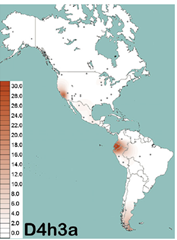
image An international team of researchers have concluded that humans entered the Americas from Asia along at least two different paths.  By studying two rare mtDNA haplogroups found in Native Americans – D4h3 and X2a – the researchers conclude that D4h3 spread into the Americans along the Pacific coast while X2a entered through the ice-free corridor between the Laurentide and Cordilleran ice sheets.

From the Press Release:  “Six major genetic lineages account for 95 percent of Native American mtDNA and are distributed everywhere in the Americas,” said first author Ugo Perego, director of operations at SMGF. “So we chose to analyze two rare genetic groups and eliminate that ‘statistical background noise.’ In this way, we found patterns that correspond to two separate migration routes.”

To conduct the study, the scientists searched the Sorenson database for Native American mtDNA and then sequenced the entire mtDNA genome of some of the samples.

There is more coverage at Dienekes’ Anthropology Blog and The Spittoon.

The entire Press Release:

SALT LAKE CITY and PAVIA, Italy (Jan. 8, 2009)—Genetic researchers from the Sorenson Molecular Genealogy Foundation (SMGF) in Salt Lake City working with scientists from the University of Pavia in Italy today published a study shedding new light on the puzzling question of why Native Americans exhibited such extraordinary linguistic and cultural diversity when the first Europeans arrived in 1492.

Featured on the cover of Current Biology journal, the striking finding by an international team of researchers challenges the traditional idea that the first groups of humans to colonize the Americas came from a single population source, which would imply one language family, technology and culture, when they crossed an Ice Age land bridge connected to Asia 15-17,000 years ago.

By analyzing for the first time at the highest level of molecular resolution two rare lineages of the maternally inherited mitochondrial DNA (mtDNA) from modern Native Americans, geneticists identified separate migratory paths that marked the initial stages of human colonization. Traveling concurrently, one genetic group of Paleo-Indians followed the Pacific coastline route and arrived at the southern tip of South America, while the second group followed an ice-free corridor east of the Rocky Mountains and settled in the Great Plains and Great Lakes regions.

The evidence that separate groups of people with distinctive genetic roots entered the Americas independently at the same time strongly implies linguistic and cultural differences between them. “The origin of the first Americans is very controversial to archaeologists and even more so to linguists,” said study corresponding author Professor Antonio Torroni, heading the University of Pavia group. “Our genetic study reveals a scenario in which more than one language family could have arrived in the Americas with the earliest Paleo-Indians.” Torroni is a world-renowned population geneticist in the field of mtDNA research and the first to identify the major genetic groups to which 95 percent of Native Americans belong.

In March 2008, the same research team published a study that was the first to compile all known Native American mtDNA sequences into a single genetic tree with branches dated. Results showed almost all modern Native Americans descended from six ancestral founding mothers. They used the built-in molecular clock of DNA to establish the time the first humans moved into the Western Hemisphere, finding a narrow window between 15-17,000 years ago.

For both studies researchers combed the Sorenson database—the world’s largest collection of correlated genetic genealogy information containing DNA collected in more than 170 countries—for mtDNA belonging to Native American lineages. Then, using techniques developed at the University of Pavia, the samples were analyzed using a complete-mtDNA genome approach for the first time.

“Six major genetic lineages account for 95 percent of Native American mtDNA and are distributed everywhere in the Americas,” said first author Ugo Perego, director of operations at SMGF. “So we chose to analyze two rare genetic groups and eliminate that ‘statistical background noise.’ In this way, we found patterns that correspond to two separate migration routes.”

Today’s study analyzed two rare genetic groups. D4h3 spread into the Americas along the Pacific coast and, at the same time, X2a migrated inland through an ice-free corridor between the Cordilleran and the Laurentide glaciers. The D4h3 group is rare today in North America, while X2a is found exclusively in the U.S. and Canada, mainly in the Great Lakes and Great Plains regions. The six most common Native American mtDNA lineages are A2, B2, C1b, C1c, C1d and D1.

“This study does not end the debate,” said co-author Dr. Alessandro Achilli, researcher at the University of Pavia and assistant professor at the University of Perugia, “but the implications of our findings are significant. The distinct industries and technologies observed in North American archeological sites might be related to separate genetic groups using different migratory routes rather than being the result of in situ differentiation. Future research will dissect common pan-American lineages into sub-branches, and we do expect distribution of some of these subgroups will parallel that of D4h3 and X2a.”

The study, “Distinctive Paleo-Indian Migration Routes from Beringia Marked by Two Rare MtDNA Haplogroups,” was published online today by Current Biology and will be the cover story for the print version on Jan. 13, 2009.

Y-chromosomal evidence of the cultural diffusion of agriculture in southeast Europe

Wheat farm

Image via Wikipedia

I received the following press release today from SMGF:

SALT LAKE CITY (Dec. 30, 2008)—Genetic research by the Sorenson Molecular Genealogy Foundation (SMGF) and scientists from ten organizations in Europe and the U.S. shows human groups with the deepest roots in southeastern Europe were not pushed out by an incoming wave of farmer-colonists as agriculture first spread into Europe. Instead, indigenous Europeans with a hunting and gathering lifestyle adopted agriculture when it was introduced by settlers from the Middle East. The study was published in the Dec. 24, 2008 online issue of European Journal of Human Genetics.

Scientists have long debated the question of how agriculture spread into Europe from its birthplace in the Fertile Crescent region of the Middle East. But the evidence—primarily archaeological—is inconclusive.

Applying molecular genetics to the question, an international team of researchers studied the Y-chromosomes, or paternally inherited DNA, of 1,200 men living in southeastern Europe where evidence of farming in Europe first occurs. If agriculture had spread there by Middle Eastern colonizers replacing an indigenous population, most of today’s southeastern Europeans should have Middle Eastern genetic roots.

But researchers found a large majority of southeastern European males are descended from genetic groups with roots in Europe that predate the change to an agricultural lifestyle. The strong inference is that farming spread culturally as local people adopted the technology.

Settlers from the Middle East were Europe’s first farmers. “Middle Eastern agriculturalists initially brought farming into southeastern Europe,” said Natalie Myres, study co-author and director of research and development for SMGF. “However, descendents of those first farmers do not dominate today’s gene pool. Most of the men in the study descend from people who lived in southeastern Europe well before the advent of farming.”

Genetic scientists can test theories about ancient human history developed primarily by other disciplines by studying the DNA of people living today. Certain DNA markers found in today’s populations originated in ancient ancestors and have been passed through the generations essentially intact, and because DNA has a built-in molecular clock, scientists can estimate the timing and geography associated with our ancient ancestors’ movements.

This study found three major groups of interest. First, the European DNA groups, haplogroups I and R, make up about 60 percent of today’s population in southeastern Europe and represent some of the earliest modern humans to have occupied Europe, stretching back into Paleolithic times. Second, haplogroup E entered southern Europe from Africa’s eastern Sahara and became established in the region roughly 10,000 years ago. Third, haplogroup J is Middle Eastern and likely introduced agriculture into southeast Europe around 8,500 years ago.

Both of the two later-arriving lineages, haplogroups E and J each make up 20 percent or less of the region’s population. Lineages E and J are found predominately in the southern part of the Balkans, the region where Middle Eastern immigrants would have entered the area and where the first pottery associated with a farming society in the region is also observed. The study proposes that the haplogroup J lineage introduced farming to the inhabitants of the southern Balkans represented by haplogroup E. Members of haplogroup E subsequently transmitted the farming technology along the Adriatic where it was readily adopted by indigenous Europeans represented by haplogroup I.

“The central finding of this study is important because it illuminates our past, showing us how we became who we are today,” said Myres. “When these different ancient population groups met—Mesolithic foragers and Neolithic farmers—the outcome was productive and positive.” But Myres said the way agriculture spread to the rest of Europe can’t be generalized from this study since other regions in Europe appear to have followed a different model.

“We are gaining powerful insights into the deep history of the human family by correlating evidence from molecular genetics with research from other disciplines,” said Dr. Scott Woodward, executive director of SMGF and a prominent genetic researcher. “This study points the way for future investigations using the same methods in other regions.”

Scientists for the study came from the University of Pavia, Italy; Stanford University; University of Tartu, Estonia; Universities of Sarajevo and Banja Luka, Bosnia and Herzegovina; Split and Osijek Universities and Genus doo, Croatia; Forensic Laboratory and Research Center, Slovenia; and University of Tetovo, the former Yugoslavia Republic of Macedonia. The study entitled, “Y-chromosomal Evidence of the Cultural Diffusion of Agriculture in Southeast Europe,” is now available online to subscribers at http://www.nature.com/ejhg/ and will be published in an upcoming print issue of European Journal of Human Genetics.

About Sorenson Molecular Genealogy Foundation

The Sorenson Molecular Genealogy Foundation (SMGF; www.smgf.org) is a non-profit research organization that has created the world’s largest repository of correlated genetic and genealogical information. The SMGF database currently contains information about more than seven million ancestors through linked DNA samples and pedigree charts from more than 170 countries, or approximately 90 percent of the nations of the world. The foundation’s purpose is to foster a greater sense of identity, connection and belonging among all people by showing how closely we are connected as members of a single human family. For more information about the foundation’s free, publicly available database, visit www.smgf.org.

A Lecture by Spencer Wells

image Last week I had the opportunity to attend a lecture by Spencer Wells, director of the Genographic Project from National Geographic and IBM.

The talk was a Syracuse Symposium event, and the first big event ever to be held in Syracuse University’s new $110 million Life Sciences Center.  I thought it was fitting that the first event to celebrate the future of the new life sciences building was a lecture that examined the collective genetic journey of mankind.

Dr. Wells began by giving the audience a very brief introduction about DNA and genetic genealogy.  He included a great quote that “The question of origin is actually a question about genealogy.”  For those that are not familiar with the Genographic Project, it was launched in 2005 and includes three primary missions:

  1. Global DNA sampling from indigenous and traditional cultures which retain a geographic link with their current location;
  2. Public participation; and
  3. The legacy fund, which is funded by the public participation aspect of the project and aims to “empower indigenous and traditional peoples by supporting locally-led efforts.”

Dr. Wells is a great speaker and the hour-long lecture went by extremely quickly.  Some of the more interesting information he shared is not readily available on the Genographic Project’s website:

  • According to current projections, the project is about halfway finished and is predicted to end in 2011.
  • So far, 41,000 samples have been collected from indigenous populations, and 270,000 kits have been purchased by public participants in 130 countries (currently at about 800 kits ordered per week!).
  • The indigenous DNA samples are stored for future analysis – this will undoubtedly be an irreplaceable asset as indigenous populations continue to decline (although it does raise issues of informed consent; do indigenous people really understand the information?).
  • Eventually, the Genographic Project’s database will be searchable.

Valuable Research

He also highlighted the previous papers that resulted in party from the Genographic Project, including:

A new paper, soon to be released, will examine the genetic ancestry of the Toubou people indigenous to northern Chad in Saharan Africa.  The Toubou people have a rich and interesting history, but their actual genetic roots are unclear.  According to Sougoui, a Toubou:

“The Genographic Project is a great opportunity for us, the Toubou, because we are a people who are extremely interested in our origins… According to Toubou legend, we are a people who came from different places. This is a question that we continually talk about. We are anxiously waiting for the results of this study to answer this question for us. It is important for us as Toubou to know where we came from, how we got separated from other peoples, and how we actually fit into the world God created.”

Dr. Wells showed a short clip of a new documentary that is being made about the Genographic Project.  In the clip, we were shown the challenges of collecting DNA from the Toubou; looks like it will be another very interesting documentary.  See more about the Toubou project here and here.

The Q&A Session

During the Q&A session, someone asked what regions are missing from the database.  Perhaps unsurprisingly, the answer was the Americas and Australia.  Apparently the Project has had a very difficult time getting permission to take samples from these populations.

Many of the questions reflected the fact that many people are confused about the inheritance of Y-DNA and mtDNA.  Half the them were about whether a child or a sibling would have the same or different Y-DNA or mtDNA.

Conclusion

Dr. Wells is a great lecturer, and I highly recommend watching him speak if you are ever able to do so.  I learned a great deal about the Genographic Project, and I look forward to the information that will continue to be released from this valuable endeavor.

The Full mtDNA Genome of Ötzi is Sequenced (Twice?)

Großglockner seen from the southwest. The Groß...

Image via Wikipedia

Ötzi the Iceman is the popular name for a 5,000 year-old mummy discovered frozen in the ice of the Alps in 1991.  Studies of the Iceman has revealed an immense amount of information about him, including details of his life, his death, and his culture. 

Although Ötzi’s mtDNA has previously been studied, researchers had only examined short segments which suggested that his mtDNA belonged to Haplogroup K.  A new paper in Current Biology (subscription only darn it) details Ötzi’s full mtDNA genome for the first time:

"Using a mixed sequencing procedure based on PCR amplification and 454 sequencing of pooled amplification products, we have retrieved the first complete mitochondrial-genome sequence of a prehistoric European. We have then compared it with 115 related extant lineages from mitochondrial haplogroup K. We found that the Iceman belonged to a branch of mitochondrial haplogroup K1 that has not yet been identified in modern European populations."

The full sequence (which has been deposited in GenBank with accession number EU810403) was then compared to 115 published full mtDNA Haplogroup K sequences.  The comparison suggests that Ötzi belonged to a previously uncharacterized subclade of Haplogroup K, now termed K1ö.

Strange Conclusions – Otzi has NO living relatives?

Now, as any genetic genealogist knows, when your mtDNA doesn’t match anyone you conclude that you have to wait until more people get tested.  This is especially true if you believe that your relatives would be in continental Europe – for some reason those continental Europeans have very little interest in genetic genealogy.  The authors point out that Ötzi’s mtDNA line might have died out in the past 5,000 years, but they also acknowledge that the comparison database was small and further testing in Europe might reveal more examples of this new subclade.

As Kambiz points out in the comments to his post on this new paper, the media isn’t quite as careful as the authors of the paper.  See "Iceman May Have No Living Relatives" by National Geographic, for example.  Although they do a decent job of discussing the article and all the aspects I mention, the title is so bad that it makes my teeth hurt.

Or Does he?

But see this article: "DNA shows Otzi the Iceman has kin."  According to the article, Alan Cooper – head of the University of Adelaide’s Australian Center for Ancient DNA – has also sequenced Otzi’s mtDNA and stated that "We have found someone very, very closely related."  I’m looking forward to comparing the mtDNA genome obtained by the two research groups.  Will they be the same?

A few points to remember:

  • Ötzi’s mtDNA belongs to a previously undiscovered subclade of Haplogroup K, but there is currently no data to suggest that this subclade has died out in present-day humans.  115 mtDNA genomes barely constitutes a database!
  • Remember that this is only mtDNA testing, which passes only from mother to child.  Even if there is no living person with mtDNA belonging to the K1ö subclade, Ötzi could still have 2 billion direct descendants!

The Paper:  Luca Ermini, Cristina Olivieri, Ermanno Rizzi, Giorgio Corti, Raoul Bonnal, Pedro Soares, Stefania Luciani, Isolina Marota, Gianluca De Bellis, Martin B. Richards, Franco Rollo (2008). “Complete Mitochondrial Genome Sequence of the Tyrolean Iceman” Current Biology, DOI: 10.1016/j.cub.2008.09.028.

HT: Anthropology.net.

Ancestral GPS – Pinpointing the Geographic Origin of Autosomal DNA Sequences

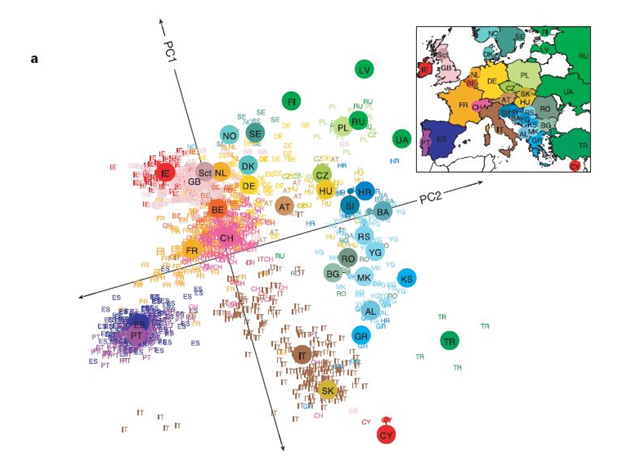
image I’ve been meaning to write about recent two papers, one in Current Biology and one in Nature, that attempt to identify and characterize a relationship between genetic sequence or SNP and geography.  Amazingly, both papers found a very strong correlation between genetics and geography.

From a news article regarding the paper in Nature (note that I haven’t verified that the paper supports the statement; HT: Yann Klimentidis’ Weblog):

"The map was so accurate that when Novembre’s team placed a geopolitical map over their genetic "map", half of the genomes landed within 310 kilometres of their country of origin, while 90% fell within 700 km."

Although there are some caveats, for example in one of the papers all of an individual’s grandparents had to have similar geographic origins in order for the method to identify ancestry, these types of studies will continue to discover and refine the methods and findings.  As Kambiz stated at Anthropology.net, "With higher resolution GeneChips, ideally full genomes, and larger samples, we’ll be able see much more accurate genetic-geographic separations of populations."

There has been much discussion of these papers in the blogosphere, including at the Spittoon (here and here), john hawks weblog, and Dienekes’ Anthropology Blog (here and here), just to name a few.

There is also a short but very interesting video associated with the Nature paper (HT: ScienceRoll – you were right Berci!).  From the video:

“If your ancestors came through Ellis Island you probably know their ethnicity but might have only a vague idea of exactly where they’re from. Now this amazing genetic map of Europe shows it is possible to pinpoint a person’s geographic origins to within a couple hundred miles with a simple DNA sample.”

The Confucius Genealogy Compilation Committee Rejects DNA Testing

iStock_000002679865XSmallSee the new article at Seed Magazine “Inheriting Confucius,” which discusses efforts to generate a family tree containing the 2 million+ descendants of Confucius.

Kong De-Yong, a 77th(!) generation descendant of Confucius, has been compiling the tree for the last 10 years.  Although the Committee is accepting submissions from women and other previously excluded groups, it is not accepting DNA contributions.  According to the article, this “hints at the limits of Chinese engagement with the age of genomics, and demonstrates how high cultural stakes can constrain science.”  Unfortunately, as the author of the article suggests, many people might be afraid of the results of such DNA testing: “Given the potential implications of genetic knowledge for long-presumed members of the [Confucius] family, they think it better not to know.”

However, there is of course no need for the Committee’s participation in order to learn more about Confucius’ DNA or Confucuis’ descendants (although it would be nice, of course).  A Confucius DNA Project has already been initiated by the Beijing Institute of Genomics, and Confucius descendants can submit a sample for analysis for the price of $125.

Complete Neanderthal Genome Sequenced – Differs from CRS at 133 Positions

iStock_000003743546XSmall GenomeWeb Daily News published a story on Friday entitled “En route to Neandertal Genome, Researchers Analyze Its Complete Mitochondrial Genome” which revealed the results of recent Neanderthal mtDNA analysis.

On Thursday May 9th, Svante Pääbo spoke at the Biology of Genomes meeting at Cold Spring Harbor Laboratory. Pääbo’s group, along with 454 Life Sciences, is currently engaged in a project to sequence the Neanderthal genome. The researchers have been able to sequence the complete Neanderthal mtDNA genome with 35-fold coverage. The genome is approximately 16 kilobases long and differs from the CRS at 133 positions. From what I’ve been able to find online, it doesn’t appear that the actual sequencing results have been released to the public. Given current estimates of mtDNA mutation rates, the number of differences between human and Neanderthal mtDNA suggests that the branches diverged approximately 600,000 years ago.

Although there have been accusations that Neanderthal sequencing is often contaminated by human DNA, the concerns have been addressed by Pääbo’s group. From the article:

Pääbo mentioned that about 10 percent of the DNA library they initially sequenced – data they published in late 2006 – consisted of modern human DNA. But over the last two years, they have been guarding against contamination by generating DNA libraries in a clean room and by barcoding the Neandertal DNA.

The ISOGG has a page devoted to Neanderthal DNA for more information.

Kwäday Dän Ts’ìnchi – "Long-Ago Person Found"

image Around the year 1700, a relatively healthy young hunter was walking along a glacier in land that would one day be British Columbia in Canada. He wore a robe of 95 animal skins, perhaps gopher or squirrel, stitched together with sinew, and carried a walking stick, iron-blade knife, and spear thrower. For some reason, the young man, aged 17 to 22, died on the glacier and was quickly incorporated into the ice. There he remained, frozen, for the next 300 years.

In August 1999, three hikers noticed a walking stick, fur, and bone lying on a melting glacier (60′ N 138′ W). The young hunter, renamed Kwäday Dän Ts’ìnchi in the Southern Tutchone language of the Champagne and Aishihik First Nations, was removed by scientists for analysis (see the NY Times article, and the Journal of Canadian Archaeology article). From an article in the Sydney Morning Herald:

[When scientists were led to the site], they found a torso with the left arm attached. The hand was mummified. The fingernails were missing. The head was missing, too. A few metres away lay the lower body, with thighs and muscle attached. They also found a wooden dart and walking stick, and pieces of fish and scales within the folds of the man’s robe.

Over the next two days the team members carefully lifted the remains. They collected a knife still in its sheath and a leather pouch. They found a woven hat, fragments of clothing and what was later described as the man’s “personal medicine bag”, which was considered sacred, even after more than five centuries. They did not open it.

In 2001, Kwäday Dän Ts’ìnchi’s remains were given back to the Champagne and Aishihik, and in July 2001 he was cremated in a closed ceremony and returned to the glacier. Kwäday Dän Ts’ìnchi’s skull was found in 2003 but was not removed from the site.

Discovery Continues

Even though Kwäday Dän Ts’ìnchi has been cremated, the analysis of his DNA, intestinal contents, and artifacts continues. This past weekend, at the Kwäday Dän Ts’ìnchi Symposium, researchers around the world presented the results of their research:

The conference brings together more than 30 researchers from fields as diverse as archeology, criminology and microbiology. They come from local universities, the Royal B.C. Museum, Vancouver General Hospital, first nations, and institutions as far afield as Indiana and Scotland.

Haplogroup A

One of the research projects involved sequencing of Kwäday Dän Ts’ìnchi’s mtDNA, which revealed that it belonged to Haplogroup A, with the polymorphisms 16111T, 16189C, 16223T, 16290T, 16319A, and 16362C. As part of the study, the researchers collected blood samples from 250 to 300 members of the Champagne and Aishihik First Nations to compare their mtDNA sequence to that of Kwäday Dän Ts’ìnchi’s (more info here and here). At the Symposium, the researchers revealed that 17 people had mtDNA that closely matched that of the subject, suggesting that they are close maternal relatives. 15 of those 17 people belong to the Wolf clan, also suggesting that Kwäday Dän Ts’ìnchi might have belonged to the Wolf clan himself (more info here).

This topic is of particular interest to me, since my mtDNA belongs to Haplogroup A and therefore I am also (very) distantly related to Kwäday Dän Ts’ìnchi. Last year I profiled the Qilakitsoq mummies in Greenland, all of whom belonged to Haplogroup A.

HT: Geneasofts

Human mtDNA Diversity Before Migration Out of Africa

image Yesterday, a very interesting paper was published in the American Journal of Human Genetics by the Genographic Project Consortium entitled “The Dawn of Human Matrilineal Diversity.” The results of the study, which examined the 624 mtDNA genomes from sub-saharan Haplogroup L lineages, suggests that humanity once split into two small groups with one group in eastern Africa and the other in southern Africa, and that humanity bottlenecked into a relatively small number of individuals (as few as 2,000 based on results from a previous study). Note, as always, that these are hypotheses based upon the results of this and other studies, and will require further research to support or refute.

Two mtDNA Branches

The human mtDNA tree has two main branches, the L0 branch which includes individuals concentrated in southern and eastern Africa, and the L1’2’3’4’5’6′ branch (aka the L1’5 branch), which includes the entire remainder of humanity including non-Africans (see the figure to the left). Based upon the analysis of the 624 genomes, the researchers hypothesized that the L0 and L1’5 branches diverged into two small populations around 140,000 to 210,000 years ago, with one group settling in eastern Africa (the L1’5 branch) and the other settling in southern Africa (the L0 branch). Interestingly, the results also suggest that there was little to no intermingling of these branches for the next 50,000 to 100,000 years!

The L0 branch comprises 60% of the Khoisan people (two ethnic groups named the Khoi and the San) of Southern Africa. The L1’5 branch comprises all other branches of the mtDNA tree, which includes the N and M matrilines that eventually spread out from Africa.

Population Bottleneck

The results of the study also suggest that humanity was once comprised of a relatively small number of individuals (as few as 2,000, according to another study cited by the researchers). This was suggested because there are very few matrilineal lineages present today that split during the first 100,000 years of our species’ history, likely because they they died out or never developed in the first place. If there had been many more individuals alive at that time (with descendants alive today), scientists would expect to see more different types of lineages in Africa. This is what happened during the second 100,000 years of human history, with as many as 40 different matrilines at the time that humans left Africa to spread to the remainder of the world. As many of us know now, there is a multitude of current matrilines because of our enormous population explosion in the past few thousand years. Note, however, that this hypothesis may change if researchers suddenly discover large amounts of new matrilines present in Africa which split from the main line in the first 100,000 years.

An article in the Economist did a very good job of making the article understandable. Here is a quote from this terrific article in the Economist, which I suggest you read for yourself:

Comparing Khoi and San DNA with that of other Africans shows that the first big split in Homo sapiens happened shortly after the species emerged, 200,000 years ago. Most people now alive are on one side of that split. Most bushmen are on the other. The consortium’s analysis of which DNA “matrilines” are found where suggests that for much of its history the species was divided into two isolated populations, one in eastern Africa and one in the south of the continent, that were defined by this split. However, few other matrilineal splits from the first 100,000 years of the species’s history have survived to the present day.

This suggests the early human population was tiny (so the opportunities for new matrilines to evolve in the first place were limited) and reinforces the idea that Homo sapiens may have come close to extinction (eliminating some matrilines that did previously exist). Indeed, there may, at one point, have been as few as 2,000 people left to carry humanity forward.

This shrinkage coincides with a period of prolonged drought in eastern Africa, and was probably caused by it. The end of the drought, however, was followed by the appearance of many new matrilines that survive to the present day. The researchers estimate that by 60,000-70,000 years ago, the period when the exodus that populated the rest of the world happened, as many as 40 such groups were flourishing in Africa—though that migration involved only two of these groups.

For more information, check out the following sources:

Famous DNA Review, Part III – Niall of the Nine Hostages

ireland2.jpgAs many as 3 million men worldwide might be directly descended from a single Irish warlord named Niall of the Nine Hostages who was the High King at Tara from 379 to 405.

In February 2006, researchers at Trinity College in Dublin released a paper that studied that Y chromosome signature of men throughout Ireland. They found that 8% of men sampled had the same Y chromosome, with a cluster in the northwest where fully 21% of men carried the signature chromosome (which fell into Haplogroup R1b1c7). The article appeared in The American Journal of Human Genetics and was titled “A Y-Chromosome Signature of Hegemony in Gaelic Ireland.”

The researchers looked at 17 STR markers on Irish Y chromosomes to determine the relatedness of samples they had obtained. They found that there was a strong association between the most common signature and surnames that were related to the most significant dynasty of early medieval Ireland – the Uí Néill. Some of the surnames included (O’)Gallacher, Boyle, O Doherty, O’Connor, Cannon, Bradley, O’Reilly, Flynn, (Mc)Kee, Devlin, Donnelly, Egan, Gormley, Hynes, McCaul, McGovern, McLoughlin, McManus, McMenamin, Molloy, O’Kane, O’Rourke and Quinn (list from Oxford Ancestors). Of course there were no surnames at the time of the earliest Uí Néill dynasty, but when the Irish took surnames around 1,000 A.D., many chose names that were associated with Uí Néill dynasties.

This association suggests that men with the signature Y chromosome are descended from the founder of the dynasty Uí Néill, Niall of the Nine Hostages. Niall of the Nine Hostages, who was the High King at Tara from 379 to 405, founded the dynasty Uí Néill, which ruled until the 11th century. According to the legend, Niall had 12 sons, many of which were rulers after Niall’s death.

The biggest caveat of this research is that without testing DNA from Niall’s remains, it is impossible to say with 100% certainty that Niall is the ancestor (and some argue that there never was a real Niall). For instance, Mrs. Niall could have only reproduced with the friendly neighbor, or a large fraction of the men with the signature Y chromosome could be descended from Niall’s promiscuous uncle George (I don’t know if there was an uncle, or if his name was George – it’s just an example).

As the authors of the study pointed out:

“The fact that about one in five males sampled in northwestern Ireland is likely a patrilineal descendent of a single early medieval ancestor is a powerful illustration of the potential link between prolificacy and power and of how Y-chromosome phylogeography can be influenced by social selection.”

Not surprisingly, the signature Y chromosome has also spread around the world, suggesting that there may be as many as 3 million people who carry it. Using international DNA databases, the chromosome was found in roughly 1 in 10 men in Scotland, and in about 2% of European-American New Yorkers.

For more information, see Times Online, NY Times, Family Tree DNA, Oxford Ancestors, and Wikipedia (for info about the life of Niall of the Nine Hostages, including the source of the name).

Other Posts in the Famous DNA Series: