The Genetic Genealogist

Adding DNA to the Genealogist's Toolbox

Author Archive


My Genome Online – A Challenge To You

As you may have heard, I recently made my 23andMe and Family Tree DNA autosomal testing results available for download online at “mygenotype,” and dedicated the information to the public domain (if dedicating DNA sequence to the public domain is even possible – I’m currently doing some research in this area and expect to write more in the future).

At “mygenotype” you can download the following:

My Family Tree DNA Results:

  1. Affymetrix Autosomal DNA Results (2010)
  2. Affymetrix X-Chromosome DNA Results (2010)
  3. Illumina Autosomal DNA Results (2011)
  4. Illumina X-Chromosome DNA Results (2011)

My 23andMe Results:

  1. V2 Results (2008)
  2. V3 Results (2010)
  3. Y-DNA Results (2010)
  4. mtDNA Results (2010)

You can also find my SNPedia Promethease reports:

In addition to my genome, Razib Khan of Gene Expression has a spreadsheet of approximately 48 other genomes that are available for download online.

A Challenge To YOU

Now that the information is out there, available to anyone who might be interested, it remains to be seen who might be interested in the information.

Indeed, as evidenced by Razib’s spreadsheet, while dedicating a genome to the public domain has only been done by a small handful of people worldwide, it isn’t as novel as it was just a few months ago.

So, I’m challenging everyone who reads this to download my data and analyze it to find the most interesting or surprising results.  For example, you could use my most recent 23andMe V3 data.

I’ve already done a fair amount of analysis myself, including the Promethease reports above (and see here), and a recent blog post about my vastly increased Type 2 Diabetes riskHowever, perhaps there’s a recent but relatively study that applies, or perhaps there’s a story you can weave with a handful of SNPs. Or, even better, what can you tell me about my ancestry other than mtDNA and Y-DNA haplogroups? Don’t worry about the strength of the study, reproducibility, etc. – I’m aware of the uncertainties associated with this type of research, and my goal here is to make people aware of possibilities.

Please post your findings in the comments below, and in two weeks I’ll pick the most surprising or interesting findings and make them the focus of a new blog post.

Can you surprise me with my own genome?

Using Autsomal DNA Testing to Identify An Adoptee’s Roots

The Mystery

Helen Marley Johnson, my great-grandmother, was born to unidentified parents on March 3, 1889, in Oswego County, New York.  Although I didn’t really know Marley, I remember meeting her when I was very, very young, just before she died in 1983.

Copyright Blaine T. BettingerMarley lived in Oswego and Jefferson counties for all her long life.  She was married twice, had two children, and today has numerous descendants located throughout the United States and the world.  However, by the time Marley was 13 years old, she had been adopted by at least three different families, eventually marrying into the last family that adopted her.

Since I began my genealogical research more than 20 years ago, I’ve worked to find the parents of Marley Johnson, without much success.  I have a plethora of data about the entire remainder of her life, but almost nothing about her ancestry.  For example, although I’ve found her birth certificate, it lists her mother as Minerva Johnson (a name that may or may not be real, and which I’ve found nothing on) and lists her father as “unknown.”

Autosomal DNA

Autosomal DNA testing presents the most promising new avenue of researching into Marley’s ancestry.  Copyright Blaine T. BettingerUnfortunately, both of Marley’s children have been dead for more than 30 years.  However, Marley has several living grandchildren, including my father and a first cousin named Edgar (name changed for privacy reasons).  By comparing autosomal results my father with his first cousin, it is possible to identify stretches of their DNA that they inherited from Marley and her husband Frank Bettinger.  Here’s why:

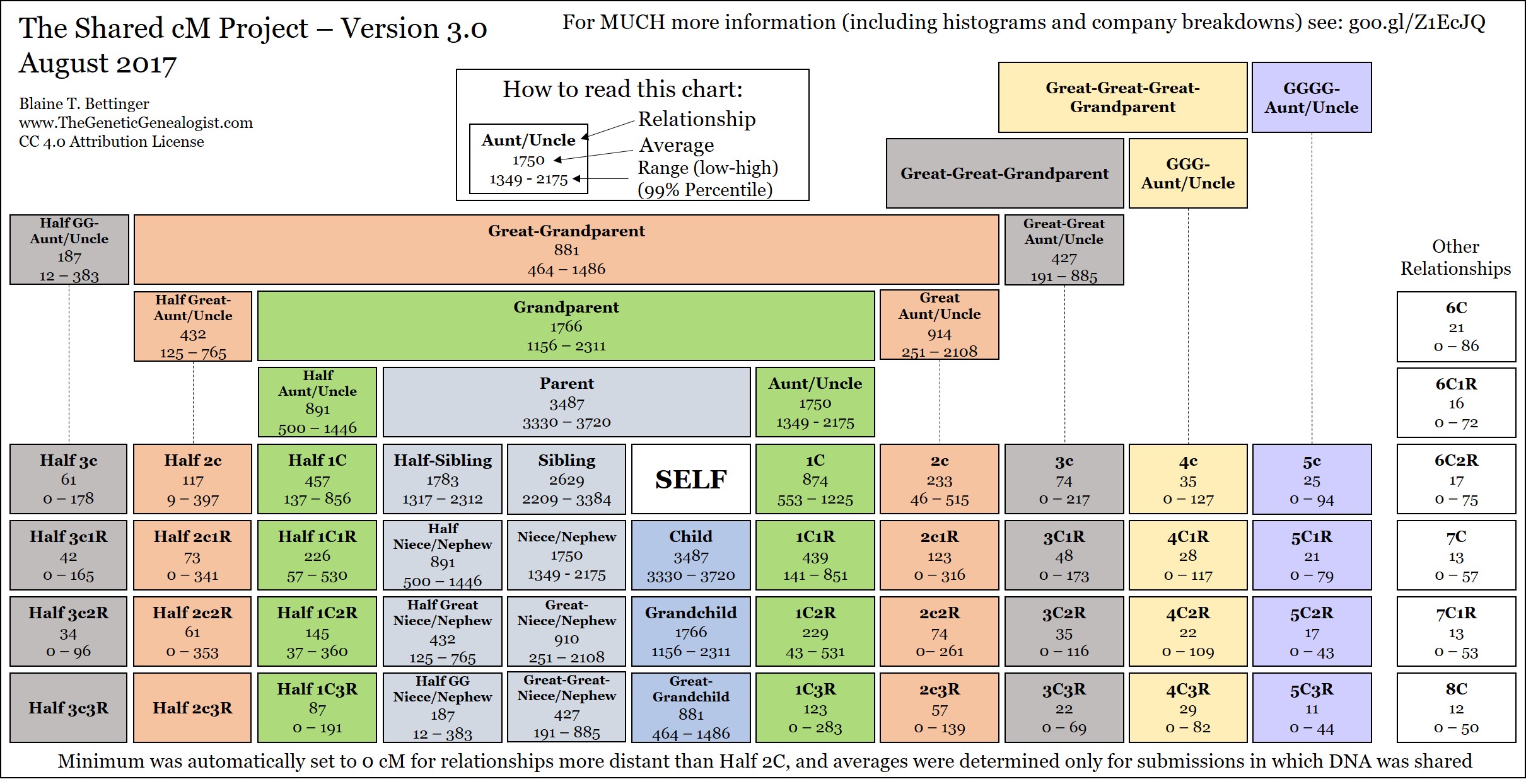
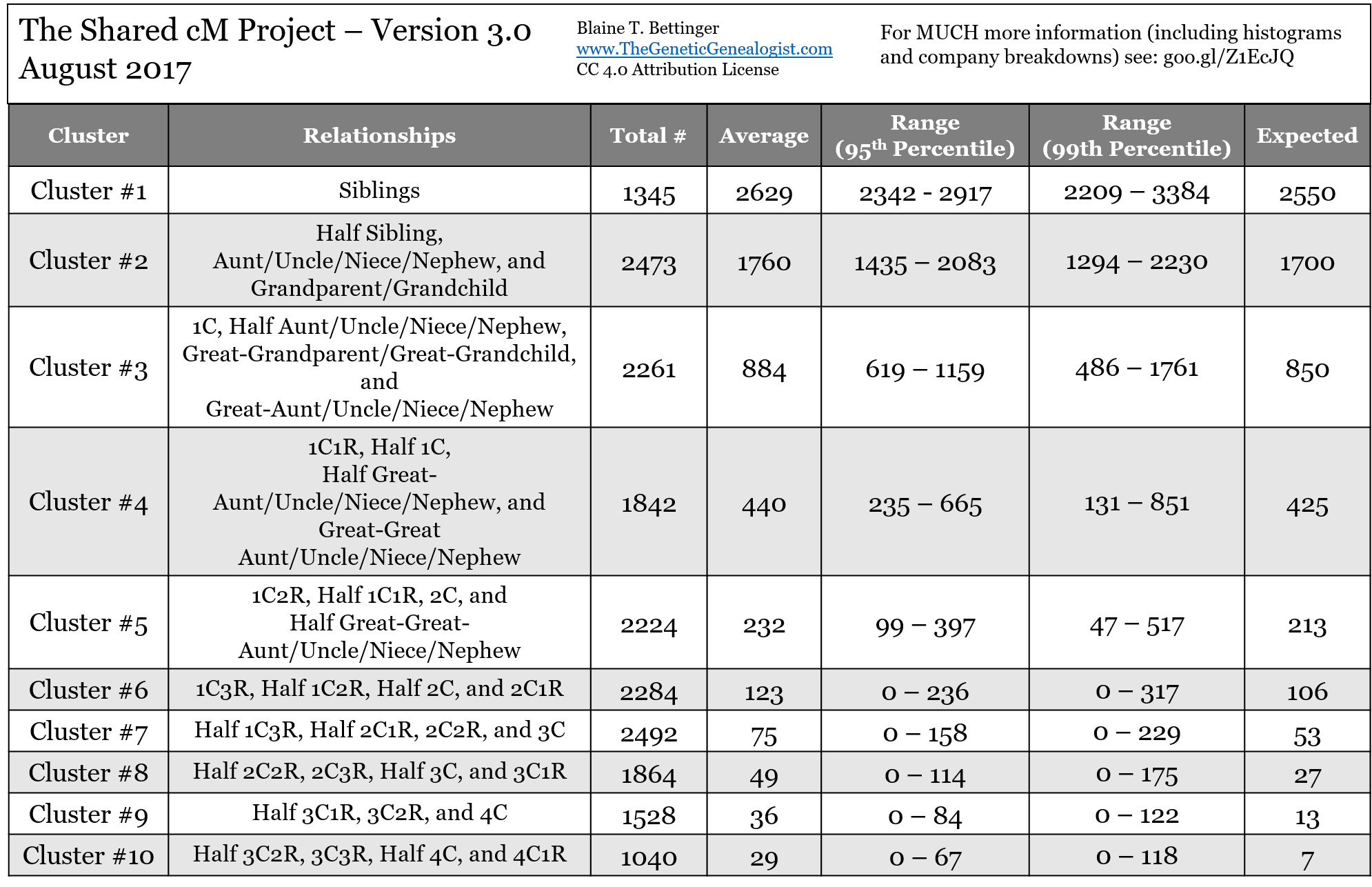
Both my father and Edgar are grandchildren of Marley and Frank, or children of Marley’s children. My father is the son of Marley & Frank’s son, and Edgar is the son of Marley & Frank’s daughter.  Approximately 25% of my father’s DNA comes from Marley, and approximately 25% of Edgar’s DNA comes from Marley.  Although it is not the same 25% in both cousins (because the children inherited random pieces of Marley’s DNA and then passed on random pieces of that DNA to their children), it is statistically nearly certain that they will share some of Marley’s DNA.  Indeed, first cousins are predicted to share 12.5% of their DNA, with about half each from the shared grandparents (6.25% of their shared DNA from Marley, and 6.25% of their shared DNA from Frank).  Both will have much more DNA from these ancestors, but it won’t be shared between them.

By comparing the autosomal DNA testing results of my father with Edgar, it will be possible to identify the DNA that they have in common.  Because they only share Marley and her husband Frank as ancestors (an important assumption here), then any DNA they have in common must be DNA that they inherited from Frank and Marley.

Of course, this is dependent upon Edgar and me not sharing any DNA from other ancestors, for example on my maternal side.  If we shared other ancestors, it would be much more difficult (but not impossible) to identify which DNA came from which ancestors.  However, given Edgar’s paternal ancestry – the side which does not involve Frank and Marley – this is exceedingly unlikely (but will be kept in mind during future analysis).

Results

I now have autosomal DNA results for Edgar and myself using Family Tree DNA’s Family Finder, and more specifically using their new Illumina OmniExpress chip.  The figure below highlights the regions of our genomes where we share at least 3cM stretches of DNA.

Note that I’ve used my DNA for this test, rather than my father, simply because have yet to test my father.  The numbers change slightly, as I’m predicted to share 6.25% of my DNA with Edgar, my first cousin once removed.  We share about 333 cMs (268 million base pairs), which I’ve calculated to be about 4.4% of our genomes (please chime in if you think this estimate is incorrect, as I haven’t had sufficient time to explore it).

With this map and the data that comes from it, I’ve identified portions of my genome (and Edgar’s) that come from Marley and Frank.  Although I don’t know which portions came from who, I have a wealth of information I can now use to explore our shared ancestry.

Now What?

So now what?  Now, I wait for matches shared by Edgar and I, people who share one or more of these stretches of DNA.  Currently, we do not share any individuals.  If another individual shares a piece of the identified DNA, it is likely that they are related through Frank and Marley.  As I have a great deal of information about Frank’s ancestry, I can try to narrow down the matches to Marley’s ancestry.  This, of course, presents one of the biggest challenges of this approach.

Further, identifying relatives is only the very first – and the easiest – step.  Once I have identified someone who might be Marley’s biological relative, I have to obtain as much of their genealogical tree as they are willing to share in order to mine it for information.  I will be looking for families that lived in or migrated through the Upstate New York area in the early 1880′s.  Of course, I must consider all the descendants of any potential relatives as well.

Yes, it’s a great deal of work, and there is no guarantee that I will ever identify a link.  For example, what if John Doe, Marley’s father, took an undocumented vacation in Upstate New York to visit his best friend and had a fling with Marley’s mother?  I may not be able to uncover that connection either in paper records or in DNA, at least for now.

My best bet is to accumulate as much information as possible – paper records, DNA, gedcoms, family trees, etc. – and slowly create a web of paper and DNA.  This web will undoubtedly slowly reveal overlapping information that hints at Marley’s ancestry.  For example, there may only be one potential male individual who possesses DNA from family X, DNA from family Y, and DNA from family Z, all of which Marley inherited and of which Edgar and I share.  A needle in a haystack, but an exciting possibility nonetheless.

The Future

In the future, I can attempt to mine existing genomes for more data.  For example, by comparing my father’s siblings with Edgar’s DNA.  Statistically, they will share different portions of their genome with Edgar, allowing me to more completely identify the DNA in Edgar’s genome that came from Frank and Marley.  Since Edgar is the extent of the other line, and Marley’s children are dead, this is the best I can currently do (until I can sequence Marley’s DNA directly from the stamps and letters she licked and I’ve saved).

Conclusion

Essentially, using autosomal DNA testing and the approach described above, I have re-created portions of my great-grandparent’s genomes by identifying bits and pieces of their DNA in living individuals. What an exciting time to be a genealogist.

Now let me know, do you have any tips or suggestions for me as I continue my hunt for Marley’s parents?  If so, please share them below.

DNA Heritage Ceases Operations and Transfers Database to Family Tree DNA

DNA Heritage, a popular genetic genealogy company intiated in 2002, has ceased operations (although pending orders will be fulfilled).  The company’s website announced today that it is in the process of transferring their database and domains to Family Tree DNA.

Family Tree DNA, meanwhile, has announced that it records in the DNA Heritage database will only be placed into FTDNA’s database if the owner agrees to opt-in.  FTDNA has a series of FAQs related to the transfer available here.

The full text of the announcement is below:

As of April 19 2011, DNA Heritage has ceased its operations and is in the process of transferring the domains DNAHeritage.com and Ybase.org to Family Tree DNA.

All the tests in progress will be processed by our current lab and the results will be delivered to our customers.

In order to ensure the continuity of the existing surname projects Family Tree DNA will study the best options to integrate our customers’ results into their database. Once Family Tree DNA decides on the option(s), our customers will be given the opportunity to opt-in to their database.

If you have questions about the transition or need to place an order please check: http://www.familytreedna.com/landing/dna-heritage.aspx

New Report for the Department of Defense Recommends Genomic Sequencing of Troops

An independent group of scientists has recommended that the Department of Defense (“DoD”) obtain and sequence the genomes of members of the military.

JASON, a group of between 30 and 60 scientists and created in 1960 which advises the U.S. government on scientific and technological issues, authored the report entitled “The $100 Genome: Implications for the DoD,” (pdf) which was released on January 13, 2011.

In the report, the scientists provided the following recommendation:

“The DoD should establish policies that result in the collection of genotype and phenotype data, the application of bioinformatics tools to support the health and effectiveness of military personnel, and the resolution of ethical and social issues that arise from these activities. The DoD and the VA should affiliate with or stand up a genotype/phenotype analysis program that addresses their respective needs. Waiting even two years to initiate this process may place them unrecoverably behind in the race for personal genomics information and applications.”

It’s good to see acknowledgment in the report of potential ethical issues, but there was no substantive discussion of them.  Deciding to collect DNA and sequence genomes of troops is, quite frankly, a no-brainer, and the report came to all the obvious conclusions.  What the military really requires is a report on how to discover, analyze, and address the myriad ethical issues associated with the obvious decision to sequence genomes.

A news article published yesterday in nextgov (“Report urges Defense to collect genome data on all troops“) discusses a few of the potential ethical issues, and includes a few quotes from me:

“According to Blaine Bettinger, a Syracuse, N.Y.-based intellectual property lawyer who has a doctorate in biochemistry with a concentration in genetics and writes the Genetic Genealogist blog, a mass collection of genome data at Defense could eventually help improve the health of military members and their families. Collecting basic genomic information on such a large population could also “benefit all of humanity,” Bettinger said.

But Bettinger warned that collection of such data also could be used against individuals if, for example, they had conditions the military could cite as a reason to limit their careers.”

I had a few major concerns about the potential ethical issues with this project, including the following:

1) privacy concerns (since anonymity of genomic data, if it’s made public or leaked, is nearly impossible to maintain);

2) sequencing without informed consent of the members of the military (will it be fine print, or explicitly explained?);

3) use as a screening method (either for denying entrance into the military, or used to steer people toward certain careers w/in the military;

4) and lastly, the unique problems that arise when several generations of a family enlist.  For example, John Doe Jr. enlists and reports that his father is General John Doe Sr.  An army doctor casually glances at the Doe’s genome reports on his iPad and says “no he’s not,” since they don’t share any appreciable amount of DNA.

Are there any potential ethical

There is a great potential for good here, and a great potential for harm.  How the military decides to proceed will determine which prevails.

Additional Native American Haplogroup Discovered by Genetic Genealogists

Robert Estes of DNAeXplain announces the discovery of a previously-undiscovered Native American haplogroup.  Up to the current point, research had found only two Y-DNA haplogroups in the Native peoples of North and South America – C3b and Q1a3a (aka Q1a3a1).  However,  new research described in the accompanying paper (here (pdf)) uncovers a third haplogroup found in Native peoples.

From the paper:

“For the past decade, since the advent of genetic genealogy, it has been accepted that subgroups of haplogroup C and Q were indicative of Native American ancestry. Specifically, subgroups C3b and Q1a3a, alone, are found among the Native peoples of North and South America. Other subgroups of haplogroup C and Q are found elsewhere in the world, not in North or South American, and conversely, C3b and Q1a3a are not found in other locations in the world. This makes it very easy to determine if your direct paternal ancestor was, or was not, Native American. Or so it seemed.”

Estes is a scientist and business owner in the information technology arena.  She is the Administrator of the Lost Colony DNA Project, and more than 20 surname projects.  Her contact information can be found in the paper.

Welcome Post-Standard Readers!

On Sunday, the Syracuse Post-Standard featured a story about personalized genomics and medicine entitled “Future medicine: Patients with genetic codes will seek personalized care from doctors” by Amber Smith.  The article discusses several of the recent advances in the field of genomics, including the many DTC (“direct-to-consumer”) tests available to consumers, and what that will mean for medical care now and in the future.  Smith writes:

“Interest in personal DNA analysis is growing, as the number of genomic retailers multiply. Navigenics is the first to obtain a license in New York state, last December, and other companies are going through the approval process now. A course at Syracuse’s Upstate Medical University prepares doctors for the new medical world, where patients arrive for appointments not just with symptoms and complaints, but with a list of personal genetic variants — and concerns about what it means.”

The Personalized Medicine 101 course (see #pm101 at Twitter) is a course designed to educate medical students about the tools and the challenges involved with personalized medicine and affordable genomic sequencing.  I was a guest-lecturer for the course this year, speaking about “Ancestry & Genealogy: Foundations for Clinical Practice.”  This is a groundbreaking course, one of the first of its kind, and it has the potential to educate 100s of future physicians about this vitally important field.

I was quoted briefly in the article about how I perceive the future of medicine:

“Ten years from now, I imagine the practice of medicine where an individual will always have their own genome. Ideally you would go in to see your doctor with your genome sequenced, and all of that available to the physician for analysis.”

If you’re interested in learning more about genetic genealogy or personalized medicine, you can check out the blog’s archives, or a list of some of my favorite articles.

New Study Analyzing DTC Genetic Testing Released Today

PLEASE NOTE:  This post is a parody, and has two purposes: (1) simply for the sake of light-hearted fun; and (2) to provoke conversation with geneticists and researchers in this field (not that it will do so anyway!).  So many of the recent studies about consumer reactions and/or guidelines for DTC testing have been released without any data at all, or have been studies involving a handful of test-takers.  I believe that further studies are absolutely vital, but they should be an in-depth analysis rather than the curt and superficial write-ups that have been done to date.  Rather than contribute to solving issues related to DTC testing, these incomplete studies add to the confusion surrounding the field.

So, ASHG geneticists, if you can see the humor in things and are willing to accept challenges to your way of thinking, read the post below!  Otherwise, click here: http://www.ashg.org.

THE ORIGINAL POST:

I received this news release yesterday via email.  I’m probably breaking the embargo by publishing this, but I think it’s too important not to get it out there.  Please be sure to read ALL the way to the bottom.

Nation’s Top Geneticists and Ethicists Release New Study of Consumer Perceptions of Direct-to-Consumer Genetic Testing and Announce New DTC Testing Guidelines

Leading up to the American Society of Human Genetics 60th Annual Meeting, which will be held November 2-6, 2010 in Washington, D.C., a group of the nation’s top geneticists and ethicists today released the results of a new study analyzing the public’s awareness and use of so-called “direct-to-consumer” genetic testing by companies such as 23andMe, deCODEme, and Pathway Genomics.

The researchers, funded in large part by federal grants, interviewed over 10 people randomly chosen at the entrance to the nearest grocery store and asked them whether they were familiar with one or more of the five DTC genetic testing companies included in the study.  The participants were then asked if they had participated in DTC genetic testing, and whether they might be interested in doing so in the future.  The participants were also asked whether they believed that members of the general public should be allowed to access their own genetic data without the assistance of a physician or genetic counselor.  Finally, to gauge the participant’s understanding of the basic principles of genetics, each was asked to briefly describe in 100 words or less the role of the replication fork in DNA replication.

The results of the study indicate that 100% of the study participants were completely unfamiliar with these DTC testing companies, and none had any experience with DTC testing.  The study also showed that while none were currently interested in performing testing on their own DNA, 90% believed that Americans should be allowed to access their genetic data without the assistance of a physician or genetic counselor.  The results also showed that none of the participants in the study were able to competently explain even the basics of the DNA replication fork.

“Our study shows for the first time that the vast majority of the American public is completely unaware of even the most popular DTC testing companies,” reported Dr. David N. Anderssen, lead geneticist in the study.  “Additionally, the inability of every single one of the study participants to explain one of the most basic aspects of genetics was, quite frankly, very disappointing, again suggesting that people are not equipped to handle genetic information.”

“While 90% of the participants stated that they should be able to access their own genetic information without a physician or geneticist’s assistance, we completely disagree with their opinions and took this opportunity to explain to each one of them just how dangerous their genetic information can be.”

In light of the findings, Dr. Anderssen noted the group’s newly-issued guidelines on DTC testing: “We’re recommending that all DTC genetic testing companies immediately close up shop, or, alternatively, hire a staff of 25 or more genetic counselors.  We also recommend that Congress immediately make it illegal to look at an ‘A,’ ‘T,’ ‘G,’ or ‘C’ without a physician or genetic counselor within at least 5 feet; the danger of privacy violations and/or the misunderstanding DTC genetic testing results is just too great to ignore.”

“Indeed, the majority of the group believes that there is no role for genetics in health care, disease risk, genealogy, or anthropology, among other endeavors; the old-fashioned – but always informative – family history is really the only way to go here,” reported the geneticist.  “However, since most of us need these jobs, we decided to approve the use of genetics for disease assessment in the new guidelines.”

Dr. Anderssen noted that the group is continuing to study this emerging area of genetics, and plans to expand the study to 25 more participants from the nearby gas station in the near future.

Sequencing the Genome of Sitting Bull and Other Famous People

ScienceNews reports that researchers led by Eske Willerslev at the University of Copenhagen are attempting to sequence the genome of legendary Native American “Sitting Bull” (see “Genome of a Chief”).

Earlier this year (2010), Eske Willersleve announced the successful sequencing of approximately 80% of the genome of “Inuk,” a man from Greenland who left behind a few small fragments of bone and four hairs frozen in permafrost when he died about 4,000 years ago (see “Long-Locked Genome of Ancient Man Sequenced”).  Using these ancient DNA sequencing techniques, Willersleve’s group is analyzing DNA from other samples.

One of these samples is a lock of hair from Sitting Bull.

Sitting Bull (c. 1831 – Dec. 15, 1890) was a Hunkpapa Lokota Sioux born in South Dakota.  Sitting Bull played an important role in the June 25, 1876 Battle of the Little Bighorn, and later toured as a performer in Buffalo Bill’s Wild West show.

It is not clear from the ScienceNow article, but the lock of hair being used for the analysis could be the same lock of hair that was repatriated to Ernie LaPointe, the great-grandson of Sitting Bull, in December 2007 (see “Assessment of a Lock of Hair and Leggings Attributed to Sitting Bull, a Hunkpapa Sioux, in the National Museum of Natural History, Smithsonian Institution”).  Ernie LaPointe is believed to be the closest lineal descendant of Sitting Bull, and one of his few remaining descendants (see “Smithsonian traces Sitting Bull’s descendants”).  The lock of hair was acquired from Sitting Bull’s body upon his death in 1890 by U.S. Army surgeon Dr. Horace M. Deeble, and when Deeble died in 1896 it was loaned to the National Museum of Natural History.

It’s unknown when the researchers plan to release their results.  The ScienceNews article mentions that one of the researchers, Cristina Valdiosera, revealed the plan to sequence Sitting Bull’s genome at an August 2010 scientific meeting:

“Valdiosera said that the researchers have the approval of Sitting Bull’s descendents to perform DNA tests on a sample of his hair, and that the team is trying to extract a full genome. If so, his would become the first ancient, non-frozen, Native American genome sequenced.”

Interestingly, it appears that working with Sitting Bull’s genome may be a life-long dream for Willersleve (see “Fossilized feces found in Oregon suggest earliest human presence in North America”):

“[Willersleve] said his own interest in the subject [of ancient American DNA] was sparked by a boyhood fascination with Sitting Bull and other American Indians.”

Sequencing Famous Genomes

As new techniques for sequencing ancient or low-quality DNA samples are developed, researchers will begin to analyze any famous or ancient genome they can get their hands on, which is already beginning to happen.  As a genealogist, I know very well the affiliation humans have for keeping mementos of the past.  There are probably hundreds of famous and ancient DNA samples waiting their turn for sequencing.

Off the top of my head, here are 5 people – either known or likely to have DNA kicking around – that I would nominate for analysis:

  • Albert Einstein;
  • Abraham Lincoln;
  • Ötzi (I believe this one is already in the works);
  • Juanita the Peruvian Ice Maiden (a 600-year-old mummy); and
  • My great-grandmother Helen (hey, I can’t deny my genealogy side!).

Whose genome would you nominate for sequencing?

Ethical Issues

The ScienceNews article notes “the researchers have the approval of Sitting Bull’s descendents to perform DNA tests on a sample of his hair.”  Certainly they needed permission to obtain DNA from the hair clipping, but did they need permission to sequence that DNA? (setting aside for the moment the many ethical concerns regarding Native American remains).

For example, if I find a hair clipping in a book I purchased at an estate sale, do I have a duty to find the owner’s descendants and ask for permission before sending it away for sequencing?  What if the hair clipping is clearly labeled with the owner’s name and other identifying information?  Further, can I leave instructions for my descendants that they do not sequence or give permission to sequence my DNA?

I’m not a believer in genetic exceptionalism, so I look outside the realm of DNA for insight.  If that book I’d purchased at the estate sale was an old diary or journal, it most likely would not cross my mind to contact the author’s descendants before reading it.  And, interestingly, that diary or journal is much more likely to reveal personal information about the author than anything I could possibly discover in their genome.

What are your thoughts?  What permission might be required when sequencing ancient or famous DNA?

Exploring New Scientific Research With My Genotype In Hand

This morning, a single tweet sent me on a 2-hour tour (more, if you count drafting this post!) of my genome.

In the tweet, Mary Carmichael expressed interest in a potential book regarding the orchid/dandelion theory recently described in a December 2009 article in The Atlantic “The Science of Success.”  Before this morning, I was not familiar with either the article or the theory.

The introduction to the article, reproduced below, does a good job of summarizing the main thrust of the very long (but extremely interested and worthwhile) report:

“Most of us have genes that make us as hardy as dandelions: able to take root and survive almost anywhere.  A few of us, however, are more like the orchid: fragile and fickle, but capable of blooming spectacularly if given greenhouse care.  So holds a provocative new theory of genetics, which asserts that the very genes that give us the most trouble as a species, causing behaviors that are self-destructive and antisocial, also underlie humankind’s phenomenal adaptability and evolutionary success.  With a bad environment and poor parenting, orchid children can end up depressed, drug-addicted, or in jail—but with the right environment and good parenting, they can grow up to be society’s most creative, successful, and happy people.”

As the introduction suggests, the article examines the complicated interaction between environment and genetics and suggests that while genetics can present hurdles in life, environmental factors can increase or perhaps even eradicate those hurdles.

Nature v. Nurture

The article begins with a discussion of complex behavioral science experiments using humans or monkeys before bringing in recent studies of genetics that tie into these experiments.  For example, the author mentions the 5-HHTLR gene, which is involved in serotonin processing:

“As I researched this story, I thought about such questions a lot, including how they pertained to my own temperament and genetic makeup. Having felt the black dog’s teeth a few times over the years, I’d considered many times having one of my own genes assayed—specifically, the serotonin-transporter gene, also called the SERT gene, or 5-HTTLPR. This gene helps regulate the processing of serotonin, a chemical messenger crucial to mood, among other things. The two shorter, less efficient versions of the gene’s three forms, known as short/short and short/long (or S/S and S/L), greatly magnify your risk of serious depression—if you hit enough rough road. The gene’s long/long form, on the other hand, appears to be protective.”

From SNPedia:

“5-HTTLPR (serotonin-transporter-linked polymorphic region) is a degenerate repeat polymorphic region in SLC6A4, the gene that codes for the serotonin transporter. It has been extensively investigated in connection with the behavioral, psychiatric, pharmacogenetic aspects of neuropsychiatric disorders.  In contrast to earlier reports, a June 2009 article in JAMA showed no association between 5-HTTLPR genotype and depression.”

My 5-HTTLPR Status

Perhaps not surprisingly for anyone who has read The Genetic Genealogist, I was immediately interested in determining my own 5-HTTLPR status.  Based solely on my personal history (for example, I’ve never been overly prone to depression) and family history, I quickly predicted that my status would be S/L.

The author of The Atlantic article was also interested in his 5-HTTLPR status and sent away a saliva sample to a researcher she knew for analysis.  You can read the article to learn his status in the last few terrific paragraphs.

However, being one of the most extensively genotyped people in the world (which still doesn’t require much genotyping; I’ve had whole-genome scans performed by two different companies, along with Y-DNA and mtDNA testing), I turned to the results I already had in hand.

Unfortunately, the main SNPs used to examine the S or L version of 5-HTTLPR are not examined by 23andMe.  However, there has been extensive discussion of the gene in the 23andMe forums, and one member pointed out (here) that a 2009 study associated the CA haplotype of SNPs rs4251417 and rs2020934 is coupled with the short allele of 5-HTTLPR (although not perfectly, with r(2) = .72).

Of these “surrogate SNPs,” 23andMe only tests rs4251417.  A quick glance at my results revealed that I am C/C homozygous at rs4251417, suggesting that I might be 5-HTTLPR S/S, not S/L as I had predicted.  (I should note here that with just the rs4251417 allele and with a combined r(2) of 0.72, it is not clear how well the rs4251417 allele alone predicts 5-HTTLPR status despite the discussions found in the 23andMe forums).

There are a myriad of articles examining the S/L alleles, including research regarding their effect on stress (“We found that the s allele of 5-HTTLPR was associated with depression and perceived stress in patients with coronary disease.”); aggressive behavior in alcoholics (“Data suggests that the presence of s allele may confer a genetic vulnerability factor to the development of aggressive behaviour in alcohol dependent subjects, specially, in interaction with acute alcohol consumption stage”); and my favorite, financial risk (“We find that the 5-HTTLPR s/s allele carriers take 28% less [financial] risk than those carrying the s/l or l/l alleles of the gene.”).  Interestingly, it appears that none of this research considered the environmental factors that appear to be so influential on the 5-HHTLPR genotype, something that is undoubtedly endemic to genotype/phenotype studies.

The Future

Now that my wife has had her genome analyzed, I can do something that I couldn’t do with my results alone; I can predict the possible 5-HTTLR genotypes of our offspring.

This is, of course, tricky business.  I’m still not sure how I feel about purchasing genetic testing for my children, but this is a far cry from buying them a test.  I’m simply using basic genetic techniques to predict possible genotype outcomes, something that high school biology students have been doing for decades (determining the % of blue vs. brown eyed-children using various parental genotypes, for example).

Although an interesting exercise (and one that I’ve been performing often), given the state of the 5-HHTLR science I don’t believe that I’ve gained any useful or actionable information from an estimate of my children’s genotype.  Of course, I’m not even sure exactly how strong the research would have to be to make almost any genotype actionable!

Caveats

This discussion and analysis is for my personal interest only.  Specifically, I’m intrigued by the (as-of-yet unregulated) ability to check my own genotype against the results of new research.  I do not plan to make any lifestyle or parenting changes based on the results discussed in this post, and I do not suggest that you should do so either.  I simply examined my genetic code to determine my allele status and then examined the primary research to review the discussion of that allele status in the literature.  And I certainly hope I will be able to continue to do this in the future.

Edit Before Posting:

I was finally able to obtain a copy of the 2009 study that associated the CA haplotype of SNPs rs4251417 and rs2020934 is coupled with the short allele of 5-HTTLPR.  The authors include the following in their analysis, revealing that the rs4251417 SNP is not a useful proxy for determining your 5-HTTLPR status:

“Unfortunately, rs2020934 has not been genotyped as part of the HapMap project and has not been included on any of the genome-wide SNP platforms.  SNP rs4251417 is included on the Illumina 610K and 1M chips, but on its own, it is not a useful proxy for 5HTTLPR (r2 = .06).”

While this means that the above analysis was not fruitful, it emphasizes three very important points regarding personal genomics: (1) people will increasingly turn to their personal genotype as they read new research; (2) be sure to confirm everything for yourself; and (3) at this stage of the game, you should be prepared for everything you’ve discovered and/or concluded to be turned on its head with new research.

Family Tree DNA’s 6th International Conference on Genetic Genealogy Announced

From a Press Release issued by Family Tree DNA on August 11, 2010:

FAMILY TREE DNA’S 6th INTERNATIONAL CONFERENCE ON GENETIC GENEALOGY FOR GROUP ADMINISTRATORS TO BE HELD OCTOBER 30 & 31, 2010 IN HOUSTON

HOUSTON, (August 11, 2010) — Family Tree DNA, the world leader in genetic genealogy, will host its 6th International Conference on Genetic Genealogy on October 30-31, 2010, at the Sheraton North Houston in Houston, Texas. Each year, world renowned experts in genetics and science present cutting-edge developments and exciting new applications at this two-day educational forum which draws attendees from Family Tree DNA’s Group Administrators from around the world. This year’s conference will focus on the new Family Finder test which allows customers to find relatives across all ancestral lines.

Founded in April 2000, Family Tree DNA was the first company to develop the commercial application of DNA testing for genealogical purposes. Previously, this type of testing had only been available for academic and scientific research. Almost a decade later, the Houston-based company continues to establish standards and create new milestones in the increasingly popular and rapidly growing field of genetic genealogy.

Today – with over 300,000 individual records – Family Tree DNA has the largest DNA databases in genetic genealogy, a number that makes it the prime source for anyone researching recent and distant family ties. Family Tree DNA’s database also encompasses over 95,000 unique surnames and nearly 6,000 lineage and geographic projects.

In 2005, Family Tree DNA was selected by National Geographic and IBM as the designated DNA testing company for their Genographic Project, a history-making study of the migrations of mankind. To date, the company has processed more than 300,000 Genographic Project DNA tests. Family Tree DNA’s own laboratory-the Genomics Research Center-participated in the Genographic Project’s first published paper and other scientific papers.

Offering the most popular and wide-ranging DNA-testing service in the field of genetic genealogy, Family Tree DNA prides itself on its commitment to the practice of solid, ethical science. Since its beginnings, the company has associated itself with leading researchers and scientists in the field, many of whom will be speaking at this year’s conference. Among these prominent names are Dr. Michael Hammer, Dr. Doron Behar, and Thomas Krahn. Family Tree DNA has also been involved with several scientific papers and has provided assistance in updating the YCC Y-Chromosome Phylogenetic Tree.

* * * * *

Online information and registration for the 2010 conference is available at: http://www.familytreedna.com/conference/

For registration information, please contact Jane Buck-tel: 713-868-1438; e-mail: info@familytreedna.com

Media contact for Family Tree DNA: Sharon Weisz, W3 Public Relations-tel: 323-934-2700; e-mail: Sharon@familytreedna.com

For media information on The Genographic Project, please contact Glynnis Breen at National Geographic-tel: 202-857-7481; e-mail: gbreen@ngs.org