The Genetic Genealogist

Adding DNA to the Genealogist's Toolbox

Archive for December, 2012


23andMe and LabCorp Sued For Patent Infringement

On Thursday, December 20, 2012, 23andMe and LabCorp (Laboratory Corporation of America) were sued for patent infringement in Delaware by Australian company Genetic Technologies Limited.

Specifically, Genetic Technologies has alleged that 23andMe and LabCorp infringe U.S. Patent No. 7,615,342, entitled “ACTN3 genotype screen for athletic performance.”  The complaint is available here.

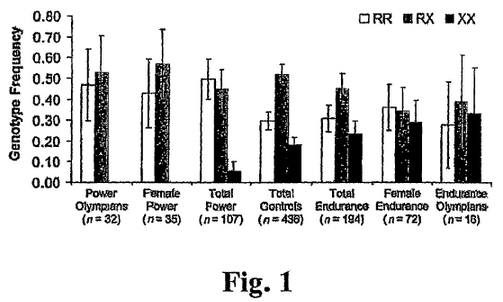
ACTN3 (Alpha-actinin-3) is an actin-binding protein encoded by the ACTN3 gene.  A particular mutation in the ACTN3 gene (rs1815739; R577X) results in a deficiency of the ACTN3 protein.  The non-mutant version of the gene is associated with sprint performance, the mutant version is associated with endurance.

23andMe does analyze the rs1815739 SNP in their tests (see “Speed Gene: Fact or Fiction?”). My own rs1815739 SNP genotype, for example, is TT, meaning that I have no working copies of ACTN3 in my fast-twitch muscle fibers.  From the complaint:

23andMe’s marketing materials describe in detail the ACTN3 gene testing that LabCorp has and is performing for 23andMe. More specifically, those marketing materials indicate that LabCorp analyzes and detects the single nucleotide polymorphism rs1815739, which is also referred to as R577X, in the ACTN3 gene. The rs1815739 polymorphism alters position 577 of the α-actinin-3 protein. The marketing materials also indicate that the Defendants associate athletic performance with the ACTN3 gene, which is “turned on in a type of muscle fiber used for power-based sports.” The testing method includes analyzing a sample obtained from a human for the presence of one or more genetic variations in the ACTN3 gene and detecting the presence of two 577R alleles (i.e., rs1815739(C,C)) at the loci encoding amino acid number 577 of the ACTN3 protein.  Defendants then use the presence of two 577R alleles to predict the potential sprinting, strength, or power performance of the human because the presence of two copies of the 577R allele is positively associated with potential sprinting, strength, or power performance. Thus, Defendants’ ACTN3 testing directly infringes upon one or more claims of the ’342 Patent.

Although Genetic Technologies did not identify which claims of the ‘342 patent it is asserting against 23andMe and LabCorp, only claims 1-8 are specifically genetic testing claims.  For example, claim 1 of the patent is a method claim:

1. A method to predict potential sprinting, strength, or power performance in a human comprising:

a)      analyzing a sample obtained from the human for the presence of one or more genetic variations in α-actinin-3 (ACTN3) gene;

b)      detecting the presence of two 577R alleles at the loci encoding amino acid number 577 of the α-actinin-3 (ACTN3) protein; and

c)      predicting the potential sprinting, strength, or power performance of the human, wherein the presence of two copies of the 577R allele is positively associated with potential sprinting, strength, or power performance.


The patent lists Kathryn Nance North (see here and here) as the sole inventor of this method.  The 2003 study that reported a link between ACTN3 and athletic performance (full text online here) lists six authors along with Professor North, including genetics blogger Daniel MacArthur.  Daniel wrote about ACTN3 a few years ago at Genetic Future.

What Now?

If the case isn’t immediately settled, then 23andMe and LabCorp will likely challenge the validity of the ‘342 patent on various grounds.  A quick review of the prosecution history (the back-and-forth with the patent office before the application issued as a granted patent) reveals that the patent application had very few prior art issues during prosecution, being challenged primarily by North’s earlier paper on ACTN3, instead encountering challenges under 35 U.S.C. 112 (enablement).

It is also likely that this patent will be challenged under the Mayo v. Prometheus holding, in which the Court held that not only is a law of nature itself unpatentable under 35 U.S.C. 101, but so is the application of that law of nature if the application merely relies upon elements already known in the art. In Mayo, the law of nature was the relationship between “concentrations of certain metabolites in the blood and the likelihood that a dosage of a thiopurine drug will prove ineffective or cause harm.”  Undoubtedly this case will examine whether the natural relationship between genetic variations in ACTN3 gene and the “potential sprinting, strength, or power performance” of a human is a similar law of nature.  If so, the question then becomes whether the claim of the ‘342 patent recites more than just that law of nature and the general instruction to apply it.  Based on the claim set forth above, this will be a significant challenge for the ‘342 patent.


National Genographic 2.0 Results Received

I received my results from the Geno 2.0 test from National Genographic tonight.  The results align fairly well with what I already know about my DNA.  For example, I knew I was haplogroup A2 (a Native American haplogroup), but the A2w is new so I have to do some research there.

Even more interesting is my paternal haplogroup designation.  The NatGeo tests lists the terminal SNP instead of a haplogroup that will typically encompass multiple SNPs.  I am listed as R-Z306, which is R1b1a2a1a1a3a1 on the current ISOGG Y-DNA tree.  However, my results indicate that I am L1+, which is associated with Null439 (I previously knew I was null439).  Many believe that L1+ is downstream of Z306+, but these types of questions are exactly what the NatGeo 2.0 test will help determine.

I immediately transferred my results to FTDNA, and if you go to the public null439 Y-SNP results page (here), for example, you’ll see that under my results are listed all SNPs for which I am derived, including L1, Z306, etc.  It’s truly an incredible list, and the real power of the results will come from comparing them to many other people.

As you can see, NatGeo estimates 3.2% Neanderthal (23andMe predicted 2.7%), and 3.3% Denisovan.  I’m not completely up on my Denisovan research, but I wonder if I am enriched for Denisovan because of my Native American ancestry.

Lastly, the NatGeo results report 2% Native American, directly in line with other tests.  23andMe, for example, has consistently reported 2-3%.


Disclosure: I received a complementary test kit from National Genographic for analysis purposes. My analysis, however, is based on my own opinions of the product and the results.