The Genetic Genealogist

Adding DNA to the Genealogist's Toolbox

Archive for September, 2011


23andMe Announces 80x Exome Sequencing for $999

Yesterday, at Health 2.0 in San Francisco, 23andMe announced that it will be offering sequencing of exomes with 80x coverage for $999.  At Exome 80x, 23andMe discusses their test:

Your exome is the 50 million DNA bases of your genome containing the information necessary to encode all your proteins. Informally, you can think of the exome as the DNA sequence of your genes.

Your entire genome is made up of your exome plus other DNA, consisting of three billion bases with repetitive sequences, sequences of unknown function, and DNA that does not code for proteins.

Note that the Exome 80x test is only available to current customers, and is determined on a “first come, first served” basis.  Further, test-takers will initially only receive their raw data of 50 million DNA bases at 80x coverage, but 23andMe plans to develop new tools to take advantage of exome sequencing.

The Exome?

Many non-geneticists will no doubt be wondering what the “exome” really is.  The exome is the protein-coding portion of your genome, and comprises roughly 1.5% of the total genome.

For insight into what type of information might be gleaned from exome data, Daniel MacArthur has an article entitled “Venter’s exome, and the challenge of rare variants for personal genomics” from August, 2008.  In the article, he discusses some of the findings from the analysis of J. Craig Venter’s exome.

The Genealogist’s Exome

As a genetic genealogist, I was of course interested in the ramifications of exome testing on testing for genetic ancestry purposes.  23andMe states the following on their Exome 80x page:

Exome data are less suitable for ancestry or genealogical research, since they will not provide mitochrondrial sequence or much information on the Y chromosome.

This is a strange sentence, and one I believe wasn’t properly screened.  In my experience few genealogists decide to pursue 23andMe testing for the mtDNA or Y-DNA results.  It’s autosomal DNA testing and tools like Ancestry Painting and Relative Finder for which most genealogists use 23andme testing, and it’s far too early to tell whether genealogists will be able to make use of exome sequencing (of course we will!).

I hope this sentiment does not discourage genetic genealogists from pursuing the Exome 80x product.  Genealogists have been – and continue to be – among the very first adopters of new DTC DNA testing (including 23andMe’s very first product back in the 2007 to 2009 time frame).  Indeed, genealogists having been driving the DTC genetic testing market since 2000 with the launch of Family Tree DNA!

The Possibilities

One of most exciting uses of the Exome 80x product might be in self-directed discovery of rare variants in genetic disorders.  Numerous rare genetic diseases, many of which likely result from unidentified rare variants, have not been exhaustively studied.  At least one group has estimated that 85% of disease-causing mutations are found in the exome.

I can envision 23andMe Community Projects for rare genetic disorders, similar to its Parkinson’s Community but much smaller in size, where several members of a family purchase the Exome 80x sequencing in an attempt to identify variants that might be involved in the disease.  These projects may be sponsored and supported by 23andme, or might simply be a family attempting to analyze their genomes themselves.

Other Viewpoints:

Will you be signing up for 23andMe’s Exome 80x product?

NFL Players Xavier Omon and Ogemdi Nwagbuo Confirmed as Half-Brothers

Direct-to-consumer DNA testing has led to the re-joining of yet another family.

Y-DNA and autosomal testing by Family Tree DNA has revealed that two NFL players , Xavier Omon (San Francisco 49ers)) and Ogemdi Nwagbuo (San Diego Chargers), are half-brothers.  ESPN has a long write-up of the story at “A brothers’ tale for Omon, Nwagbuo.”

Meeting for the First Time

The brothers had planned to meet face-to-face yesterday, September 1, 2011, as their teams met on the field.  Turns out Omon’s team, the 49ers, were victorious, meaning that if he’s anything like my brothers, he gave Nwagbuo a hard time about it!  The Mercury News has a story about the brothers’ first meeting at “Omon meets half-brother (a Charger) for first time,” and the SF Gate has a story at “49ers’ Xavier Omon meets half-brother.”

Family Tree DNA’s Press Release:

Houston, TX – August 31,2011 – Family Tree DNA, the pioneer and largest DNA testing company for genealogy purposes, through its Family Finder test, provided the conclusive proof that two NFL players are half-siblings.

Until a few months ago, Xavier Omon, from the San Francisco 49ers and Ogemdi Nwagbuo from the San Diego Chargers did not have a clue that they were related. Early August, at the request of ESPN, Family Tree DNA performed the Family Finder test on both, and the result was unequivocal: definitely half-siblings. More of the story can be found at the ESPN website,under the “Brother’s Tale” story.

The Family Finder test allows connecting with family members across all ancestral lines. While the Y-DNA matches men with a specific paternal line and the mtDNA finds potential relatives only along the maternal line, Family Finder can look for close relationships along all ancestral lines. Anyone, regardless of their gender, may confidently match to male and female cousins from any of their family lines in the past five generations. The science is based on linked blocks of DNA across the 22 autosomal chromosomes that are matched between two people. Based on this concept, Family Tree DNA bioinformatics team has worked extensively to develop the calculations that would yield the closeness of the relationship. The possibilities to find matches abound: grandparents, aunts and uncles; half siblings; first, second, third and fourth cousins; and, more tentatively, fifth cousins.

About Family Tree DNA

Founded in April 2000, Family Tree DNA was the first company to develop the commercial application of DNA testing for genealogical purposes, something that had previously been available only for academic and scientific research. Almost a decade later, the Houston-based company has a database with over 345,000 individual records – the largest DNA database in genetic genealogy, and a number that makes Family Tree DNA the prime source for anyone researching recent and distant family ties. In 2006 Family Tree DNA established a state of the art Genomics Research Center at its headquarters in Houston, Texas, where it currently performs R&D and processes over 200 advanced types of DNA tests for its customers.

Media contact

Sharon Weisz, —tel: 323-934-2700; e-mail: Sharon@familytreedna.com

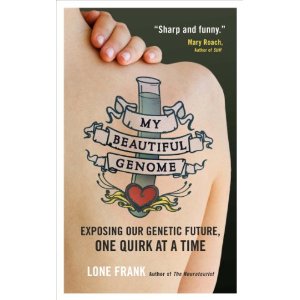
“My Beautiful Genome” by Lone Frank

Lone Frank, a journalist and author with a Ph.D. in neurobiology, has just published her fourth book, entitled “My Beautiful Genome: Exposing Our Genetic Future, One Quirk at a Time” (available for pre-order at Amazon).  A chapter of the book is available here (pdf).

Frank describes her book thusly: “This book is my very personal take on personal genomics. It chronicles my meetings and interviews with leading scientists and lays out the – somtimes [sic] disquieting – discoveries I make in my own genome.”

The book is described as follows at Amazon:

“Internationally acclaimed science writer Lone Frank swabs up her DNA to provide the first truly intimate account of the new science of consumer-led genomics. She challenges the scientists and business mavericks intent on mapping every baby’s genome, ponders the consequences of biological fortune-telling, and prods the psychologists who hope to uncover just how important our environment really is – a quest made all the more gripping as Frank considers her family’s and her own struggles with depression.”

I haven’t read the book myself, although I will soon be receiving a review copy.  Once I’ve finished it, I’ll write more about the book here at the blog. There is a recent write-up of Frank’s experiences at the Daily Mail entitled “If the blues genes fit…

I’m most interested to see what Frank finds in her genome, and how she interprets and uses her data beyond the interpretation provided by the testing companies.