The Genetic Genealogist

Adding DNA to the Genealogist's Toolbox

Archive for March, 2010


GeneTree Adds New Services

The following is a press release from GeneTree:

New GeneTree Services Enable Users to Make Sense of Genetic, Genealogy Information

  • New GeneTree Products and Services Focus on Making Genetic, Family History Information Comprehensible and Meaningful to Users
  • As a wholly owned subsidiary of Sorenson Molecular Genealogy Foundation, GeneTree is able to Leverage the World’s Most Comprehensive Collection of Correlated Genetic and Genealogical Information on Behalf of Users
  • Re-Designed Web Site Includes Enhanced Content and Features

SALT LAKE CITY (March 31, 2010) – GeneTree today announced that the company has launched a new product offering of integrated genetic and genealogical services unique in the marketplace for its ability to expand users’ knowledge of their genetic and family history connections. The company also announced it has significantly revamped its Web site, www.genetree.com.

GeneTree’s comprehensive new service offering focuses on integrating two essential sources of human identity: quality genetic tests and industry-standard family history consulting services. In contrast to providers that focus exclusively on anthropological deep ancestry, GeneTree’s product and service offering is designed to help people discover near-term family connections in the last six to ten generations as well as deep ancestral connections.

The company has developed a diverse array of genetic and genealogical consultation services to provide users with a rich sense of their family trees. These services range from providing instruction and support for people who want to make sense of their own research, to comprehensive services for those who prefer that GeneTree conduct research for them. GeneTree’s highly qualified, professional genetic genealogists provide individualized assistance about users’ family trees and how DNA results can help them in their search for connections.

Genetic information informs family history efforts in two primary ways. First, it helps to ensure the accuracy of the genealogical record, by validating family connections and identifying potential errors. Second, genetic analysis expands the universe of connections available to individuals and families for whom written genealogical records have hit a dead end.

GeneTree helped Lueda Thomas of Omaha, Neb., affirm the identity of her ancestor Josiah Sims, correct inconsistencies in two pedigree charts she was studying, and expand her family tree. “I have spent seven years trying to link Josiah Sims into another pedigree chart,” said Thomas. However, there was a 10-year discrepancy between the birth dates attributed to Sims on the two respective pedigree charts, though each reported the same name.

Thomas found two potential living relatives and worked with GeneTree to obtain DNA tests for each of them. Both tests yielded a perfect match and confirmed that the Josiah Sims on both of the pedigree charts she was studying were in fact the same person. In addition, a search in GeneTree’s database revealed another perfect match, providing Thomas with a third newly discovered living family member. “I had exhausted all of my resources and knew that DNA was the only way I could find an absolute answer to this question,” said Thomas.

GeneTree offers a series of DNA tests that can be tailored to the goals of users ranging from individuals to major family history research projects. The company’s genetic testing services, certified by the National Institute of Standards and Technology (NIST), include both Y-DNA (genetic information passed from fathers to sons) and mitochondrial (mtDNA; genetic information passed from mothers to all their children). GeneTree customers can use their DNA results to verify and significantly expand their family trees.

GeneTree’s revamped Web site features a complete redesign, together with practical insight about DNA testing and genealogy. A revised shopping cart contains products and services that enable users to take advantage of the synergies between genetic and genealogical information. In addition, GeneTree’s dynamic DNAvigator online map allows users to trace the geographic connections and migration patterns of their genetic ancestral groups.

“The popularity of shows like Who Do You Think You Are? demonstrate that there is a genuine hunger for people to know who they are fundamentally-what is their genetic legacy and how they fit into the larger family history picture,” said Jeff Wells, CEO of Genetree. “GeneTree is uniquely qualified to help people answer these questions.”

GeneTree clients will also benefit from the relationship with its parent, the non-profit Sorenson Molecular Genealogy Foundation (SMGF), which has developed the world’s largest and most comprehensive collection of genetic information correlated with multi-generational genealogical family pedigrees.

“Our relationship with SMGF enables GeneTree to combine sophisticated DNA analysis with traditional genealogical research to provide our customers with the most complete picture of human identity available anywhere in the world,” said Wells. “The extensive, complementary insights GeneTree customers can obtain through this process are without parallel in making genetic and family history information understandable and useful.”

About GeneTree

GeneTree (www.genetree.com) is the leading provider of genetic and family history services that unlock people’s ancestral legacy. Powered by the world’s largest, most comprehensive repository of genetic and genealogical information, GeneTree’s best-in-class genetic testing, genetic genealogy consulting and family history research enable individuals and extended families alike to dramatically extend their family trees.

Personal Genomics and Genetic Genealogy Tidbits

  • There’s a terrific discussion in the comments to “Genetic ancestry testing: people who don’t want to know” about people who refuse to undergo genetic ancestry testing for personal reasons.  I added my own 2 cents at comment 17 trying to explain some of the most common misunderstandings surrounding autosomal DNA testing.

Faces of America and Genetic Genealogy Testing

Randy Seaver at Genea-Musings (“I’m Puzzled by DNA Claims on ‘Faces of America’”) writes about the fourth and last episode of “Faces of America,” a PBS documentary series investigating the ancestry of several famous people in America. This fourth episode included several different types of genetic genealogy to examine the ancestral origins and relatedness of the show’s members.

1. Whole Genome Sequencing by Knome

The first type of genetic genealogy was whole-genome sequencing by Knome of Henry Louis Gates and his father. This analysis examined Henry’s (“Skip’s”) genome for medical conditions and physical traits, and also compared his DNA to his father’s, thereby allowing them to deduce the entire DNA contribution from his deceased mother. This segment was actually quite moving, as Dr. Gates was able to establish this intimate connection to the mother that he and his father obviously missed very much.

2. SNP Analysis by 23andMe

The second type of analysis was large-scale SNP analysis of everyone’s genome by 23andMe. The show primarily focused on the Ancestry Painting, which uses information from throughout the entire genome to determine a very rough estimate of your ancestry. Ancestry Painting breaks down the genome into three categories: Asian/Native American, European, and African. Stephen Colbert, for example, was 100% European, while Eva Longoria was 70% European, 27% Asian/indigenous, and 3% African. I don’t recall any mention or use of 23andMe’s medical or physical trait analysis in the show.

3. mtDNA and Y-DNA Haplogroups

The third type of genetic genealogy was haplogroup testing. In this segment, Dr. Gates spoke with Dr. Bryan Sykes of Oxford Ancestors, which was interesting because it was the first time I’ve ever seen him speak. There didn’t appear to be any surprises here.

4. Mysterious Genomic Comparisons

The fourth type of genetic genealogy testing in the episode is what has caused so much confusion among genealogists. Dr. Gates introduced David Altschuler and Mark Daily as “research geneticists at the Broad Institute.” According to Dr. Gates, Altschuler and Daily have “pioneered a new kind of genetic analysis that can determine if any two people share a common ancestor within the last several centuries.” Although Dr. Gates repeatedly said within the last “250 years”, the scientists repeatedly said “hundreds of years.” A slight difference perhaps, but I tended to disregard the “250 years” as more of a simplification by Gates for purposes of the show rather than any actual limit discussed by the scientists. Regardless, this doesn’t make their analysis any more clear.

Unfortunately, I have been unable to locate any discussion, literature, or publication by Altschuler or Daily (or anyone else) discussing this “new kind” of genetic analysis. If you’re familiar with one, please point it out in the comments so that we can understand their analysis.

Interestingly, the members of the series apparently did not match each other in 23andMe’s Family Finder, since the 23andMe system would have picked up on that, and further analysis would not have been necessary. And since it appeared that they did NOT undergo further testing, I imagine they used their 23andMe data for the analysis by Altschuler and Daily.

As an example of this comparison, according to Altschuler and Daily, Yo-Yo Ma (who was 100% Asian in his 23andMe Ancestry Painting) is related to Eva Longoria (who was 70% European, 27% Asian/indigenous, and 3% African) within the last few centuries. It obviously wasn’t through Native American DNA since any connection there was many, many thousands of years ago. Does Longoria have more recent Asian DNA perhaps? It seems unlikely (but is certainly not impossible). The fact that this was simply glossed over was an oversight.

I’m having a hard time understanding the results from Altschuler and Daily.  Can anyone else shed any light on their analysis?

Conclusion

Despite the confusion created by the fourth type of genetic analysis, I really enjoyed this episode of Faces of America. As always, it was interesting and entertaining to watch them receive their results and explore their ancestry.

What are your thoughts?

Pathway Genomics: A Review

Pathway Genomics

Kevin Davies, Ph.D., currently the Editor-in-Chief of Bio-IT World, recently wrote an article about Pathway Genomics in which he reviewed the company’s Health Test product (see “Pathway and Me: Consumer Genomics Firm Delivers First Results”):

“Earlier this year, I submitted a saliva sample to Pathway to get a feel for how the latest consumer genomics offering compares to the more established companies in the field. Pathway communicates the health results not by a numerical relative or lifetime risk but via a series of color-coded bins depending on their potential significance to the individual.”

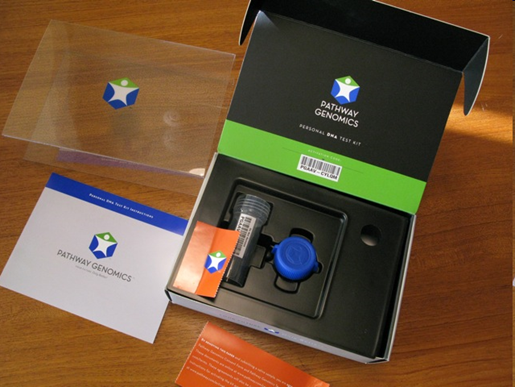
I too recently had the opportunity to test my DNA through Pathway Genomics. (DISCLAIMER: Although this test kit was not free, I am a consultant for Pathway Genomics. This review, however, contains my own opinions of the Pathway Genomics Ancestry Test product). This is a brief review of the Pathway Genomics Ancestry Test, which examines SNPs on the mtDNA (for both males and females) and the Y-chromosome (for males). Using those results, Pathway classifies test-takers into one of over 1,200 maternal haplogroups and one of over 525 paternal haplogroups.

mtDNA Results

Based on my SNP results, Pathway classified me as belonging to maternal haplogroup A2, a predominately Native American haplogroup:

clip_image002[5]

It was actually a major victory for Pathway to classify me as A2. Although I already knew that I’m haplogroup A2 based on prior sequencing, I have a very unusual A2 haplotype (so far, the only one like it in the world). Haplogroup A2 is typically differentiated from the parent haplogroup A by changes at (at least) sites 146, 153, 16111, and 16362 in the control region and at sites 8027 and 12007 in the coding region. I, however, am missing the 16111T mutation.

As a result, at least one other company has had trouble determining whether I am A or A2. 23andMe, for example, bases its A2 classification on two sites, 8027 (rs1116904) and 16111 (i3001593). Since I’m missing the 16111 mutation, 23andMe classifies me as simply A rather than A2 (and although 23andMe tests the 12007 SNP (rs2853497), they don’t appear to use it in the A2 calculation).

Y-DNA Results

Pathway classified my paternal haplogroup as R1b1b2a1a1, a subclade of R1b which is defined by U106 (aka S21 or M405) (SNP rs16981293 at position 8856078).

clip_image004

R1b1b2a1a1 is believed to be roughly 3,000 to 4,000 years old, and originated in central/northern Europe. The haplogroup is shared by both Craig Venter and James Watson, the first individuals to have their complete genomes published. I further belong to a subclade called R1b1b2a1a1c, which is defined by S26 (at position 13025258). 23andMe does not test the S26 SNP, and it is not currently clear whether Pathway tests the SNP.

Included with mtDNA and Y-DNA results is a summary of the current understanding of the origin and history of the haplogroup, and a migration map which shows:

“The migration map shows approximately when your ancestor originated and where they migrated across the globe. You can move the pointer along the bottom of the map to see different timeframes, or click on other migration lines to see the patterns of different haplogroups.”

The results also include a navigable haplogroup tree and information about some famous people whose mtDNA or Y-DNA results are known.

clip_image002[7]

Downloading SNPs

Although I am currently not able to download my SNP results, the Davies article at Bio-IT World noted that this will most likely be an option in the near future:

“For now, there is no easy mechanism to obtain the raw SNP/genotype results, as the other DTC companies provide (either via download or CD). But it is coming. ‘This is your information and you are certainly entitled to it,’ said Bornstein. Becker says the information will be made available as soon as Pathway is satisfied that the novel SNPs on its custom chip are validated.”

My Health Results

Unfortunately, I am not yet able to employ Pathway Genomic’s health test because I live in New York state. NY currently requires a physician’s involvement in DTC testing, which, in my opinion, is a paternalistic barrier between NY residents and their genetic sequence. Pathway noted that hopefully this problem will be fixed within the near future, at which time I will access and share my health results.