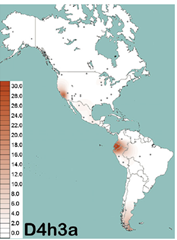
 An international team of researchers have concluded that humans entered the Americas from Asia along at least two different paths. By studying two rare mtDNA haplogroups found in Native Americans – D4h3 and X2a – the researchers conclude that D4h3 spread into the Americans along the Pacific coast while X2a entered through the ice-free corridor between the Laurentide and Cordilleran ice sheets.
From the Press Release: “Six major genetic lineages account for 95 percent of Native American mtDNA and are distributed everywhere in the Americas,†said first author Ugo Perego, director of operations at SMGF. “So we chose to analyze two rare genetic groups and eliminate that ‘statistical background noise.’ In this way, we found patterns that correspond to two separate migration routes.â€
To conduct the study, the scientists searched the Sorenson database for Native American mtDNA and then sequenced the entire mtDNA genome of some of the samples.
There is more coverage at Dienekes’ Anthropology Blog and The Spittoon.
The entire Press Release:
SALT LAKE CITY and PAVIA, Italy (Jan. 8, 2009)—Genetic researchers from the Sorenson Molecular Genealogy Foundation (SMGF) in Salt Lake City working with scientists from the University of Pavia in Italy today published a study shedding new light on the puzzling question of why Native Americans exhibited such extraordinary linguistic and cultural diversity when the first Europeans arrived in 1492.
Featured on the cover of Current Biology journal, the striking finding by an international team of researchers challenges the traditional idea that the first groups of humans to colonize the Americas came from a single population source, which would imply one language family, technology and culture, when they crossed an Ice Age land bridge connected to Asia 15-17,000 years ago.
By analyzing for the first time at the highest level of molecular resolution two rare lineages of the maternally inherited mitochondrial DNA (mtDNA) from modern Native Americans, geneticists identified separate migratory paths that marked the initial stages of human colonization. Traveling concurrently, one genetic group of Paleo-Indians followed the Pacific coastline route and arrived at the southern tip of South America, while the second group followed an ice-free corridor east of the Rocky Mountains and settled in the Great Plains and Great Lakes regions.
The evidence that separate groups of people with distinctive genetic roots entered the Americas independently at the same time strongly implies linguistic and cultural differences between them. “The origin of the first Americans is very controversial to archaeologists and even more so to linguists,†said study corresponding author Professor Antonio Torroni, heading the University of Pavia group. “Our genetic study reveals a scenario in which more than one language family could have arrived in the Americas with the earliest Paleo-Indians.†Torroni is a world-renowned population geneticist in the field of mtDNA research and the first to identify the major genetic groups to which 95 percent of Native Americans belong.
In March 2008, the same research team published a study that was the first to compile all known Native American mtDNA sequences into a single genetic tree with branches dated. Results showed almost all modern Native Americans descended from six ancestral founding mothers. They used the built-in molecular clock of DNA to establish the time the first humans moved into the Western Hemisphere, finding a narrow window between 15-17,000 years ago.
For both studies researchers combed the Sorenson database—the world’s largest collection of correlated genetic genealogy information containing DNA collected in more than 170 countries—for mtDNA belonging to Native American lineages. Then, using techniques developed at the University of Pavia, the samples were analyzed using a complete-mtDNA genome approach for the first time.
“Six major genetic lineages account for 95 percent of Native American mtDNA and are distributed everywhere in the Americas,†said first author Ugo Perego, director of operations at SMGF. “So we chose to analyze two rare genetic groups and eliminate that ‘statistical background noise.’ In this way, we found patterns that correspond to two separate migration routes.â€
Today’s study analyzed two rare genetic groups. D4h3 spread into the Americas along the Pacific coast and, at the same time, X2a migrated inland through an ice-free corridor between the Cordilleran and the Laurentide glaciers. The D4h3 group is rare today in North America, while X2a is found exclusively in the U.S. and Canada, mainly in the Great Lakes and Great Plains regions. The six most common Native American mtDNA lineages are A2, B2, C1b, C1c, C1d and D1.
“This study does not end the debate,†said co-author Dr. Alessandro Achilli, researcher at the University of Pavia and assistant professor at the University of Perugia, “but the implications of our findings are significant. The distinct industries and technologies observed in North American archeological sites might be related to separate genetic groups using different migratory routes rather than being the result of in situ differentiation. Future research will dissect common pan-American lineages into sub-branches, and we do expect distribution of some of these subgroups will parallel that of D4h3 and X2a.â€
The study, “Distinctive Paleo-Indian Migration Routes from Beringia Marked by Two Rare MtDNA Haplogroups,†was published online today by Current Biology and will be the cover story for the print version on Jan. 13, 2009.
I’m Haplogroup X2a2. Nice to read about my maternal ancestor’s migration.