
The Genetic Genealogist

Adding DNA to the Genealogist's Toolbox

Archive for January, 2009


23andMe and mondoBIOTECH Announce Partnership

imageimage

23andMe and mondoBIOTECH announced at Davos (the World Economic Forum in Switzerland) today that they will work together to further the study of rare diseases.  According to the press release (below), mondoBIOTECH will identify individuals suffering from certain rare diseases and sponsor their enrollment in the 23andMe Personal Genome Service™.  Researchers will use the information collected to learn more about the potential causes of these rare diseases.

CNBC Video:

Linda Avey appeared on CNBC this morning to discuss the company and the partnership – see “It’s All in the Genes.”

The Press Release:

Davos, Switzerland – January 28th 2009 – 23andMe, Inc., an industry leader in personal genetics, and Mondobiotech AG, a Swiss research company dedicated to the development of treatments for rare diseases, today announced at the World Economic Forum in Davos, Switzerland, that they are collaborating to advance research of rare diseases.

The announcement marks the return of the companies to the World Economic Forum, where they both were recognized as Technology Pioneers in 2008. 23andMe and Mondobiotech will work together to facilitate research of the genetic bases of rare and potentially fatal diseases, such as Pulmonary Arterial Hypertension, Sarcoidosis, and Pulmonary Fibrosis, the genetics of which are poorly understood. Mondobiotech will identify individuals suffering from certain rare diseases and sponsor their enrollment in the 23andMe Personal Genome Serviceâ„¢. Researchers then will be able to study the genetic information collected, along with any phenotypic information provided, in clinical trials, to understand potential causes of these diseases. 23andMe will coordinate genome-wide association studies for Mondobiotech affiliates using its research infrastructure and bioinformatics expertise.

The Illumina (NASDAQ: ILMN) DNA Analysis technology used by 23andMe is the world’s leading technology for genome-wide association studies and has the unique capability to include custom markers. This feature enabled 23andMe to select SNPs (single nucleotide polymorphisms), or variants that provide coverage of genes associated with drug response, information that is proving to be critical for the development of personalized medicine. In addition to having over half a million markers available for disease research, these “pharmacogenetic” indicators included in the 23andMe dataset could provide invaluable information for identifying treatment protocols.

“We are eager to take an active role in advancing research of rare genetic disorders,” said Linda Avey, co-founder of 23andMe. “By partnering with our colleagues at Mondobiotech, a company acutely focused in this area, we’ll be able to leverage the genetics and bioinformatics expertise of our science team toward better understanding of these often devastating conditions.”

“For years, we have been working on behalf of neglected and underserved disease communities to help improve the lives of people with rare and fatal diseases,” said Fabio Cavalli, Chief Executive Officer of Mondobiotech. “When we met the founders of 23andMe last year at Davos and saw what they were doing with genetics, we knew that a collaboration between the two companies could go a long way towards understanding the causes of the diseases we have been researching.”

About 23andMe

23andMe, Inc. is the leading personal genetics company dedicated to helping individuals understand their own genetic information through DNA analysis technologies and web-based interactive tools. The company’s Personal Genome Service™ enables individuals to gain deeper insights into their ancestry and inherited traits. 23andMe, Inc., was founded by Linda Avey and Anne Wojcicki in 2006, and the company is advised by a group of renowned experts in the fields of human genetics, bioinformatics and computer science. Its Series A investors include Genentech, Inc., Google Inc. (NASDAQ: GOOG) and New Enterprise Associates.

More information is available at www.23andme.com.
About Mondobiotech

Mondobiotech is the Swiss open source biotech aiming to improve the health of patients affected by rare diseases. Mondobiotech currently has a product pipeline of more than 300 peptides as treatment options for more than 600 rare diseases. The company licenses out their products to companies, foundations and private persons who are interested in improving the status of affected patients. The company has obtained 6 Orphan Medical Product Designations in Europe and in the US and licensed 7 products to BiogenIdec (NASDAQ: BIIB), InterMune (ITMN), United Therapeutics/LungRx (UTHR). Mondobiotech was selected Technology Pioneer 2008 by the World Economic Forum.

For more details, please visit www.mondobiotech.com.

Colleen Fitzpatrick’s New Website

Last September, I interviewed Colleen Fitzpatrick here at TGG.  Colleen has been very busy since then!  She has launched a new website called Identifinders, which offers a number of forensic genealogy services.

Additionally, Colleen was featured in “Does Publishing Need Genealogists?” by Publisher’s Weekly for her work in researching the circumstances surrounding two recent publishing cases: Misha Defonseca’s Misha: A Memoire of the Holocaust and Herman Rosenblat’s Angel at the Fence. From the article:

Their research uncovered baptismal and school records proving that Defonseca didn’t escape the Holocaust by running with wolves. She didn’t need to; her father was a Nazi collaborator. And if Defonseca had denied the evidence, Fitzpatrick and Sergeant were prepared to use DNA, which, along with photographs and archival records, are a forensic genealogist’s stock in trade. “I almost feel disappointed that Misha confessed,” wrote Fitzpatrick on her IdentiFinders.com Web site. “I was looking forward to identifying her through DNA.”

The Genealogy Market 2009

GenealogyMarket I’ve long been interested in the success and long-term outlook of the genealogy market.  Although altruistic genealogists have done immense amounts of work to transcribe and put records online, one of the strongest forces behind the digitization of genealogical records has been private profit-driven organizations.  And these organizations, of course, rely on the viability of the market.

FTM Media Kit

Randy Seaver at Genea-Musings recently linked to Family Tree Magazine’s 46 page 2009 Media Kit, which contains extensive information about the genealogy market and the Family Tree Magazine audience.  The report is filled with statistics about all facets of genealogy and genealogists, and the author(s) include links to all their primary information.

Genetic Genealogy Market

The report includes the conclusion that 651,600 people have taken a genetic genealogy test, based on my research (see “How Big is the Genetic Genealogy Market?“) from November 2007.  I think that the final number is bigger as of January 2009, probably closer to 750,000-800,000.  Unfortunately, the actual number has become increasingly more difficult to update because genetic genealogy companies are keeping their numbers private (which is probably understandable as the market has changed so much in the past year).  Additionally, I’m not certain how much the 23andMe and deCODEme customers increase my results.

For anyone interested in the genealogy market in general, I highly recommend reading the Media Kit.

Could You be a Chief Genealogy Officer?

As announced by Mark Tucker at ThinkGenealogy and Shelly Talalay Dardashti at Tracing the Tribe, CEO of FamilyLink.com Paul Allen tweeted the following yesterday:

“Starting job description for ‘chief genealogy officer’ who will help manage GenSeek–directory of all the world’s genealogy sources.”

You can learn more about GenSeek – a comprehensive genealogy website including the Family History Catalog 2.0 – at “What is this GenSeek of which you Speak?” from ThinkGenealogy.

This is an interesting development and suggests that innovative developments in genealogy are continuing and that they can be profitable (for instance, see Geni.com’s latest round of VC).  In the past few months, FamilyLink.com, Inc. has hired a new a new president (Steve Nickle), vice president (Jim Erickson), and chief technology officer (Allan Carroll).

For those who are not familiar with FamilyLink.com, the company’s recent press releases contain a great summary:

FamilyLink.com, Inc. is a family of services that includes WorldVitalRecords.com, FamilyHistoryLink.com, WebTree.com, and the We’re Related and My Family applications on Facebook. The focus of the company is to bring families closer through innovative online services. A combined global audience of 11.5 million unique individuals visits the Web properties owned and operated by FamilyLink.com, Inc. each month to generate 28 million monthly page views. We’re Related is one of the fastest-growing social networks for genealogists as well as other family members with more than 16.5 million users. The application helps individuals find relatives on Facebook, keep in touch with family members through news and status updates, build family trees, and share photos. Those who use We’re Related actively participate in guiding the product roadmap through an online forum and direct feedback.

Stephen Pinker, The New York Times, and Counsyl

imageAlthough I can hardly hope to introduce or discuss these recent events any better than Daniel MacArthur has already given at Genetic Future, I will at least bring this new information to your attention.

Last Wednesday the New York Times printed “My Genome, My Self”, an article written by Stephen Pinker, one of the Personal Genome Project’s “First 10.”  In the article, Pinker talks about his experience with genome sequencing through the PGP.  It is especially interesting since Pinker analyzes the issue from the point of view of a psychologist.  I highly recommend reading this article if you are at all interested in personalized medicine or genetics.

Much of the article discusses the confusing results that are returned by genome/disease analysis, due to our current lack of understanding in this enormous field:

“It became all the more confusing when I browsed for genes beyond those on the summary page. Both the P.G.P. and the genome browser turned up studies that linked various of my genes to an elevated risk of prostate cancer, deflating my initial relief at the lowered risk. Assessing risks from genomic data is not like using a pregnancy-test kit with its bright blue line. It’s more like writing a term paper on a topic with a huge and chaotic research literature. You are whipsawed by contradictory studies with different sample sizes, ages, sexes, ethnicities, selection criteria and levels of statistical significance. Geneticists working for 23andMe sift through the journals and make their best judgments of which associations are solid. But these judgments are necessarily subjective, and they can quickly become obsolete now that cheap genotyping techniques have opened the floodgates to new studies.”

Pinker and Genetic Genealogy

Pinker, who has had mtDNA and Y-DNA ancestry testing, discusses these results as well:

“It’s thrilling to find yourself so tangibly connected to two millenniums of history. And even this secular, ecumenical Jew experienced a primitive tribal stirring in learning of a deep genealogy that coincides with the handing down of traditions I grew up with. But my blue eyes remind me not to get carried away with delusions about a Semitic essence. Mitochondrial DNA, and the Y chromosome, do not literally tell you about “your ancestry” but only half of your ancestry a generation ago, a quarter two generations ago and so on, shrinking exponentially the further back you go. In fact, since the further back you go the more ancestors you theoretically have (eight great-grandparents, sixteen great-great-grandparents and so on), at some point there aren’t enough ancestors to go around, everyone’s ancestors overlap with everyone else’s, and the very concept of personal ancestry becomes meaningless. I found it just as thrilling to zoom outward in the diagrams of my genetic lineage and see my place in a family tree that embraces all of humanity.”

Counsyl – A New Player in the Field

In the article, Pinker references a new entrant in the field of personalized medicine, Counsyl:

“The genes analyzed by a new company called Counsyl are more actionable, as they say in the trade. Their “universal carrier screen” is meant to tell prospective parents whether they carry genes that put their potential children at risk for more than a hundred serious diseases like cystic fibrosis and alpha thalassemia.”

According to their website, Counsyl plans to offer a saliva-based test for more than 100 serious genetic diseases.  The test will be offered directly to consumers through the website, as well as through medical centers in the U.S.  There is no launch date set.

In addition to the articles at Genetic Future, you can read more reactions to this piece at:

More X-Chromosome Charts

Last month I wrote “Unlocking the Genealogical Secrets of the X Chromosome” and posted a few charts that show the inheritance of the X-chromosome through 8 generations.  I thought these charts might be helpful since inheritance of the X-chromosome can be difficult to understand without seeing it.

New Chart with Ahnentafel Numbers

Since posting the article, two new charts have been created using the originals.  I made one, and the other was made by Rodney Jewett (who gave me permission to re-post the chart here) and posted at dna-forums.org.

Mr. Jewett added the Ahnentafel numbers of contributing X-chromosome ancestors to the chart.  Using these numbers, an individual can simply create a numbered Ahnentafel report to identify X-chromosome contributing ancestors using this chart:

Note that Ann Turner also has a text file of the Ahnentafel numbers of those ancestors who potentially contributed to the X chromosome, through 10 generations.

New Chart Showing Contribution Percentages

I’ve been very intrigued by all the recent discussion of the X-chromosome in the genetic genealogy context, and I’ve been exposed to some facts about the X-chromosome of which I previously was unaware.

For instance, I kept seeing statements that suggested that different ancestors in each generation contributed different amounts to the X chromosome.  I read that at the 8th generation, one ancestor contributes 1/8th, some contribute 1/64th, and the others contribute between 1/16th and 1/32nd.  I kept trying to understand this, but I had to chart it out to grasp it.  Although this chart is for a male, I believe it will also work for a female by adjusting the generations slightly.  The chart is big so it might take a moment to download:

NewMaleChart5

Thus, the chart shows that if you are a male, your mother’s father’s mother’s father’s mother’s father’s mother contributed 1/8th of your X-chromosome, while your mother’s mother’s mother’s mother’s mother’s mother’s parents only contributed 1/64th.

Now, keep in mind that this chart serves only as a very rough guideline for inheritance.  Although males pass the X chromosome largely unchanged to their daughters, females will usually pass a mixed X chromosome to their child a mixture of the X chromosome they received from their father and the X chromosome they received from their mother. However, a child is unlikely to receive an X chromosome from their mother that is 50% from their maternal grandfather and 50% from their maternal grandmother – it will most likely be some other more random amount between 0% and 100%.  Thus, an ancestor is likely to be either under- or over-represented in an actual X chromosome.

Please, if you find any errors in my chart, please feel free to email me and I’ll do my best to correct them.

Potential Research

With the advent of affordable sequencing, I would love to see a study that examined X-chromosome inheritance in a family of 6 or 8 generations.  How closely would it match the theoretical inheritance probabilities from the chart above?  It’s probably just a matter of time before this research is conducted.

P.S. – Feel free to use these charts, but please give proper credit.

The Genea-Bloggers Weekly Genealogy Blogging Prompt #1

I don’t often post pure genealogy on this blog, but I thought I would take a break from genetic genealogy and join in on the Genea-Bloggers Weekly Genealogy Blogging Prompt, which was:  “Upload your favorite picture and talk about it on your blog. Answer the who/what/when/where/why of the subject matter and explain why it is your favorite.”

Although it is nearly impossible to pick a single favorite from my extensive photo collection, I chose the following photo as one of my favorites:

Three Generations of the Bettinger Family 2

People (L to R): Frank Bettinger (my great-grandfather), Angeline Taylor Bettinger (my great-great-great-grandmother born in 1815!), Ward Bettinger (my great-great-uncle), Melissa Albro Bettinger (my great-great-grandmother), Edgar Bettinger (my great-great-grandfather), and George Bettinger (my first cousin three times removed).  Unfortunately, I never met anyone in this photo, although I’ve heard a great deal about them.

Date:  I estimate that the photo was taken between 1898 and 1901, based on two facts.  First, Angeline died in 1901 meaning the photo must have been taken before then, and the second is that Ward – who appears to be at least ten years old in the photo – was born in 1888, suggesting that the photo was taken after 1898 or so.

Place: Probably the Bettinger Family Farm in Jefferson County, New York.

Why is this my favorite?

What’s not to love in this photo?  It’s an amazing collection of three generations of my surname family and includes four of my direct ancestors.  The photo also captures a moment in the final years of my great-great-great-grandmother Angeline, an incredibly interesting woman who was born in 1815.  And lastly, it is most likely taken on the grounds of the Bettinger Family Farm where my ancestors lived for 150+ years.

Maybe a little genetic genealogy?

OK, I can’t help but sneak in just a little tidbit of genetic genealogy.  I share a Y-chromosome with every male in this photo!  In fact, my Y-chromosome passed through two of the people in photo before reaching me: Edgar and Frank.  Interestingly, if I include my son, I have photographs of seven generations of my Y-chromosome line going all the way back to 1812 (196 years).

Humans Entered the Americas in More Than One Wave

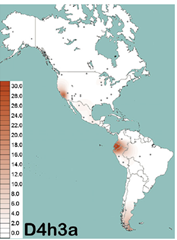
image An international team of researchers have concluded that humans entered the Americas from Asia along at least two different paths.  By studying two rare mtDNA haplogroups found in Native Americans – D4h3 and X2a – the researchers conclude that D4h3 spread into the Americans along the Pacific coast while X2a entered through the ice-free corridor between the Laurentide and Cordilleran ice sheets.
From the Press Release:  “Six major genetic lineages account for 95 percent of Native American mtDNA and are distributed everywhere in the Americas,” said first author Ugo Perego, director of operations at SMGF. “So we chose to analyze two rare genetic groups and eliminate that ‘statistical background noise.’ In this way, we found patterns that correspond to two separate migration routes.”

To conduct the study, the scientists searched the Sorenson database for Native American mtDNA and then sequenced the entire mtDNA genome of some of the samples.

There is more coverage at Dienekes’ Anthropology Blog and The Spittoon.

The entire Press Release:

SALT LAKE CITY and PAVIA, Italy (Jan. 8, 2009)—Genetic researchers from the Sorenson Molecular Genealogy Foundation (SMGF) in Salt Lake City working with scientists from the University of Pavia in Italy today published a study shedding new light on the puzzling question of why Native Americans exhibited such extraordinary linguistic and cultural diversity when the first Europeans arrived in 1492.

Featured on the cover of Current Biology journal, the striking finding by an international team of researchers challenges the traditional idea that the first groups of humans to colonize the Americas came from a single population source, which would imply one language family, technology and culture, when they crossed an Ice Age land bridge connected to Asia 15-17,000 years ago.

By analyzing for the first time at the highest level of molecular resolution two rare lineages of the maternally inherited mitochondrial DNA (mtDNA) from modern Native Americans, geneticists identified separate migratory paths that marked the initial stages of human colonization. Traveling concurrently, one genetic group of Paleo-Indians followed the Pacific coastline route and arrived at the southern tip of South America, while the second group followed an ice-free corridor east of the Rocky Mountains and settled in the Great Plains and Great Lakes regions.

The evidence that separate groups of people with distinctive genetic roots entered the Americas independently at the same time strongly implies linguistic and cultural differences between them. “The origin of the first Americans is very controversial to archaeologists and even more so to linguists,” said study corresponding author Professor Antonio Torroni, heading the University of Pavia group. “Our genetic study reveals a scenario in which more than one language family could have arrived in the Americas with the earliest Paleo-Indians.” Torroni is a world-renowned population geneticist in the field of mtDNA research and the first to identify the major genetic groups to which 95 percent of Native Americans belong.

In March 2008, the same research team published a study that was the first to compile all known Native American mtDNA sequences into a single genetic tree with branches dated. Results showed almost all modern Native Americans descended from six ancestral founding mothers. They used the built-in molecular clock of DNA to establish the time the first humans moved into the Western Hemisphere, finding a narrow window between 15-17,000 years ago.

For both studies researchers combed the Sorenson database—the world’s largest collection of correlated genetic genealogy information containing DNA collected in more than 170 countries—for mtDNA belonging to Native American lineages. Then, using techniques developed at the University of Pavia, the samples were analyzed using a complete-mtDNA genome approach for the first time.

“Six major genetic lineages account for 95 percent of Native American mtDNA and are distributed everywhere in the Americas,” said first author Ugo Perego, director of operations at SMGF. “So we chose to analyze two rare genetic groups and eliminate that ‘statistical background noise.’ In this way, we found patterns that correspond to two separate migration routes.”

Today’s study analyzed two rare genetic groups. D4h3 spread into the Americas along the Pacific coast and, at the same time, X2a migrated inland through an ice-free corridor between the Cordilleran and the Laurentide glaciers. The D4h3 group is rare today in North America, while X2a is found exclusively in the U.S. and Canada, mainly in the Great Lakes and Great Plains regions. The six most common Native American mtDNA lineages are A2, B2, C1b, C1c, C1d and D1.

“This study does not end the debate,” said co-author Dr. Alessandro Achilli, researcher at the University of Pavia and assistant professor at the University of Perugia, “but the implications of our findings are significant. The distinct industries and technologies observed in North American archeological sites might be related to separate genetic groups using different migratory routes rather than being the result of in situ differentiation. Future research will dissect common pan-American lineages into sub-branches, and we do expect distribution of some of these subgroups will parallel that of D4h3 and X2a.”

The study, “Distinctive Paleo-Indian Migration Routes from Beringia Marked by Two Rare MtDNA Haplogroups,” was published online today by Current Biology and will be the cover story for the print version on Jan. 13, 2009.

Using Genetic Genealogy to Solve the Mystery of Benjaman Kyle

Bkcleanshaven I recently wrote about using genetic genealogy to potentially identify a male’s unknown surname.  Although I had in mind using DNA to find an adopted male’s biological surname, the method has numerous other applications.  For instance, it can be used in an attempt to identify the surname of a male who has forgotten his biological surname.

A Mystery Man

Just before 7 a.m. on August 31, 2004, an adult male was found lying next to a dumpster behind a Burger King in Richmond Hill, Georgia.  He was naked, beaten, sunburned, and covered in bites from fire ants.  Benjaman Kyle, as he has decided to call himself (note the BK connection), eventually recovered from his physical ailments but was unable to remember anything about himself or his past.  To this day, he cannot remember anything, although he claims to have vague memories or affiliations for certain things.  For example, he appears to have some background knowledge of restaurant equipment and design.  Surprisingly, he does not match any known missing person report, and no one has come forward with knowledge of his identity, despite considerable media coverage.  For more background information about Benjaman Kyle, see “A Real Live Nobody” in SavannahNow.

A Suggestion for Benjaman Kyle

So how can genetic genealogy potentially help Benjaman?  He could, for example, join the Adopted Group Project at Family Tree DNA and order a 67-marker test (more info here).  Armed with these results, Benjaman could mine the public databases – including FTDNA’s database, Ysearch, and Ybase – to look for matches.  If he finds a very close match (for instance, 67 out of 67 markers), then there is a strong possibility that the two individuals will share the same surname, or at least reveal a starting point for further research.  The largest caveat to this method is that one of Benjaman Kyle’s male relatives must have taken a genetic genealogy test and made the results available.  However, given that as many as 500,000 to 800,000 people have already undergone genetic genealogy testing and as many as 50,000 to 100,000 people try genetic genealogy every year, it is certainly possible that a male relative has been tested.

Recent Research

In October, I wrote “DNA Could Reveal Your Surname, Of Course,” which discussed a new paper from the lab of Mark Jobling (see the project background here).  His research suggested that there is a 24% chance that two men who share the same surname share a common ancestor through that name, and this increases to nearly 50% if the surname they share is rare. The press release for the paper stated: “the fact that such a strong link exists between surname and Y chromosome type has a potential use in forensic science, since it suggests that, given large databases of names and Y chromosome profiles, surname prediction from DNA alone may be feasible.”

Thus, I recommend that Mr. Kyle use genetic genealogy to potentially identify his biological surname.

Genetic Genealogy in the News – January 1, 2009

umair shuaib.

Image via Wikipedia

HAPPY NEW YEAR!  I hope everyone is enjoying a relaxing start to the new year.  Thank you for reading TGG in 2008, and I hope you are as excited as I am about the developments in genetic genealogy that 2009 is sure to bring!

Here is a recap of some of the most recent news in genetic genealogy and personalized genomics in the end of 2008:

Personalized medicine covered in the New York Times.

Dr. Marjolein Kriek, First Woman to Have Her DNA Sequence Determined (HT: Megan Smolenyak).

DNA results show no link to ancient human remains – About 230 Native people participated in study to find Shuká Kaa descendants.  Dr. Brian Kemp, who I interviewed back in 2007, is attempting to find maternal relatives of 10,300 year-old remains named Shuká Kaa (Man Before Us) who is Haplogroup D.  Native Americans are often reluctant to donate their DNA, and this collection represents a huge sampling of Native mtDNA.  I hope the sequences will be shared.  See more here and here.

The Spittoon, 23andMe’s blog, has really focused on genetic genealogy this month.  There are two interesting articles, one regarding the Y-chromosome and one regarding the X-chromsome.  “ What’s in a Name: Surnames and the Y-Chromosome” and “X Marks the Spot: New Study Reveals Value of X-Chromosome in Tracing Prehistoric Human Migrations.”

Look into the eyes of the PGP-10 at Genetic Future – Daniel MacArthur posts photos of the Personal Genome Project’s “First 10” and discusses the current phase of the PGP.  Additionally, The Personal Genome has a “Video Interview with Stanley Lapidus of the PGP-10”.

2008 in review: Ethnicity Strikes Back at Dienekes’ Anthropology Blog.  From the post: “It is now clear that ethnic groups are not only cultural-political formations, but also (at least in part) distinct biological entities, emerging naturally as clusters of similarity from the genetic continuum.”  Be sure to read the comments for an interesting and heated discussion.

Thomas Goetz has a blog called “The Decision Tree,” which will also be the name of a new book that Goetz is writing about the shift from physician-directed medical treatment to patient-directed treatment, including a perspective on personalized genetics.  A re-launching post is here – I highly recommend subscribing to this blog.  Attila has further discussion with “The Decision Tree: Thomas Goetz’s upcoming book on predictive/personalized medicine.”

David Ewing Duncan writes “Discount DNA” at Portfolio.com about Complete Genomics.  See discussion at Genetic Future, and a similar article at Cosmic Log.