Note: there are some great X chromosome inheritance charts below – if you are unable to see them, be sure to click through to the original post!
Edit (06/17/2014) – Brighter, cleaner charts added below!
Most genetic genealogists have sent away their cheek swabs to learn about their mitochondrial DNA or their Y-DNA lines. Others have explored their autosomal DNA for ancestral information, a field that is growing quickly and will undergo rapid changes as the price of sequencing continues to fall.
Now genetic genealogists are beginning to discover the ancestral information locked away in the X chromosome. Indeed, X chromosome tests have been offered by companies such as Family Tree DNA for a number of years. Armed with some of this information as well as the advent of SNP chip information from 23andMe and deCODEme, genetic genealogists are making new discoveries in this very young arena.
Inheritance of the X Chromosome
To help you understand some of the X chromosome data, I’ve prepared this short summary regarding the unique and interesting inheritance of the X chromosome. Males, of course, have one Y chromosome from their father and one X chromosome from their mother. Females have two X chromosomes, one from each parent.
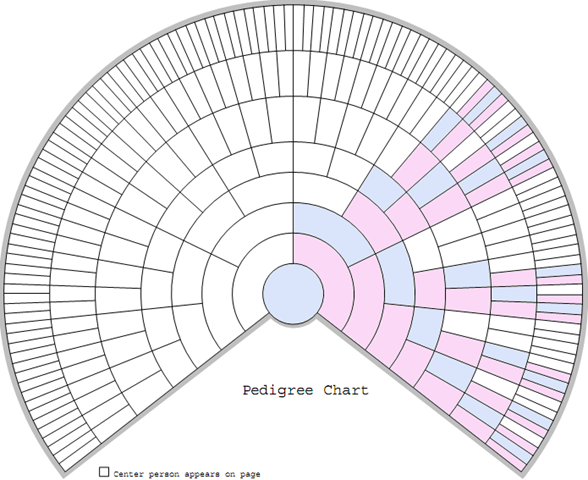
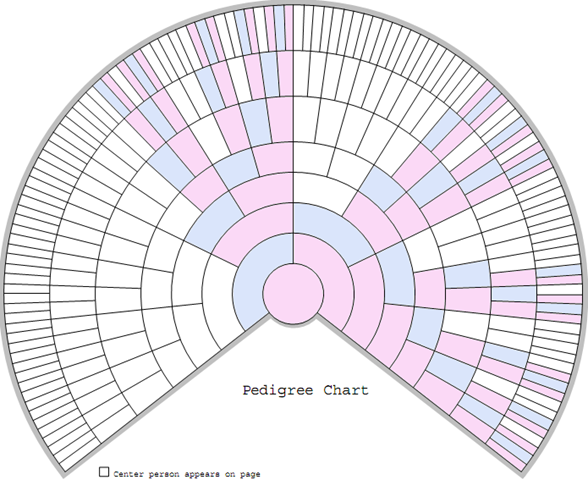
The charts below trace back the inheritance of the X chromosome through the level of GGGGG-grandparents. At that generation, a person has 128 ancestors. Of these 128 ancestors, a male will have 21 people who potentially contributed to their single X chromosome (8 males and 13 females). A female will have 34 potential contributors to her two X chromosomes (13 males and 21 females). Note that I say POTENTIAL contributors because it is unlikely that all these ancestors are equally represented in the X chromosome – it is more likely that some ancestors are completely missing while others are well-represented.
What I found to be particularly interesting is that the number of X contributors at each generation follows the Fibonacci sequence of 1, 2, 3, 5, 8, 13, 21, 34, 55, 89, 144, 233 (HT: John Chandler). A male will start with 1 X contributor and then follows through the sequence, while a female will start with 2 X contributors and follow through the sequence (although the numbers will be different if there is recent overlap in your family tree, as there is in mine).
Male Inheritance (click to enlarge) – Male contributors are in blue and female contributors are in pink:
Female Inheritance (Click to enlarge) – Male contributors are in blue and female contributors are in pink:
More Information
You can find more information about recent developments in the X chromosome field at the following:
- X chromosome applications by Kathy Johnston (registration required)
- Finding X Eve – Block 3 by David Faux
- X chromosome resource list by David Faux
- X chromosome block 3 by David Faux
- Matching X chromosome block by Kathy Johnston
- Summary 1 and Summary 2 and Summary 3 by David Faux
Conclusion
It is important to keep in mind that this investigation into the X chromosome is VERY new and thus can be confusing or unclear. While I don’t recommend jumping into this area if you aren’t ready for the many changes, reversals, or dead-ends that will undoubtedly appear, I would encourage anyone who is interested in assisting these researchers contribute their own information if you feel completely comfortable doing so.
It will be very interesting to see how this field develops over the next few years.
P.S. – Feel free to use these charts, all I ask is that I be credited with a link to the blog.
UPDATE: Ann Turner has a text file of the Ahnentafel numbers of those ancestors who potentially contributed to the X chromosome, through 10 generations. If you are a male, be sure to start the ahnentafel chart with your mother.
EDIT (06/17/2015): Two updated X charts (click to enlarge):
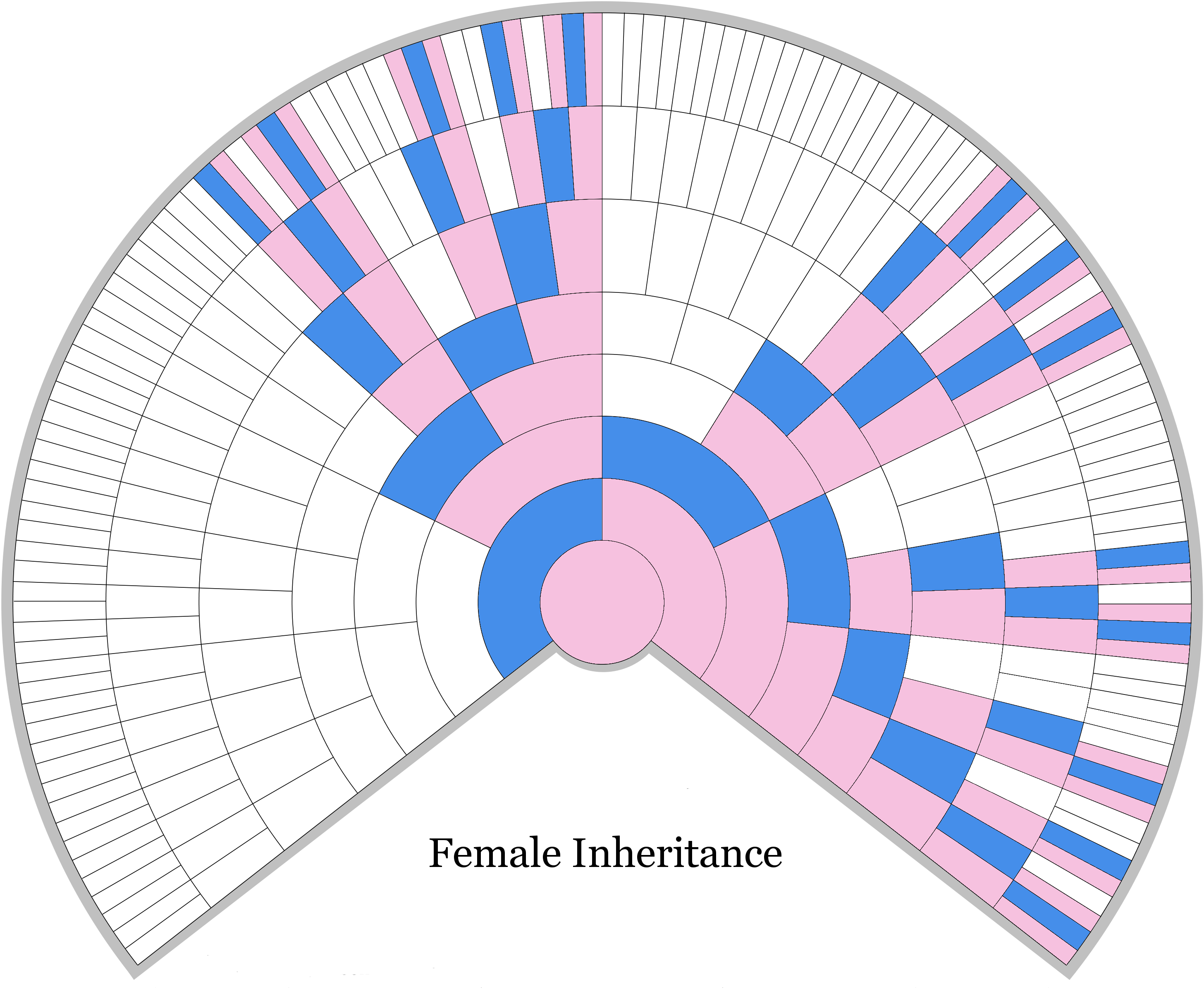
Female X-DNA Inheritance Chart
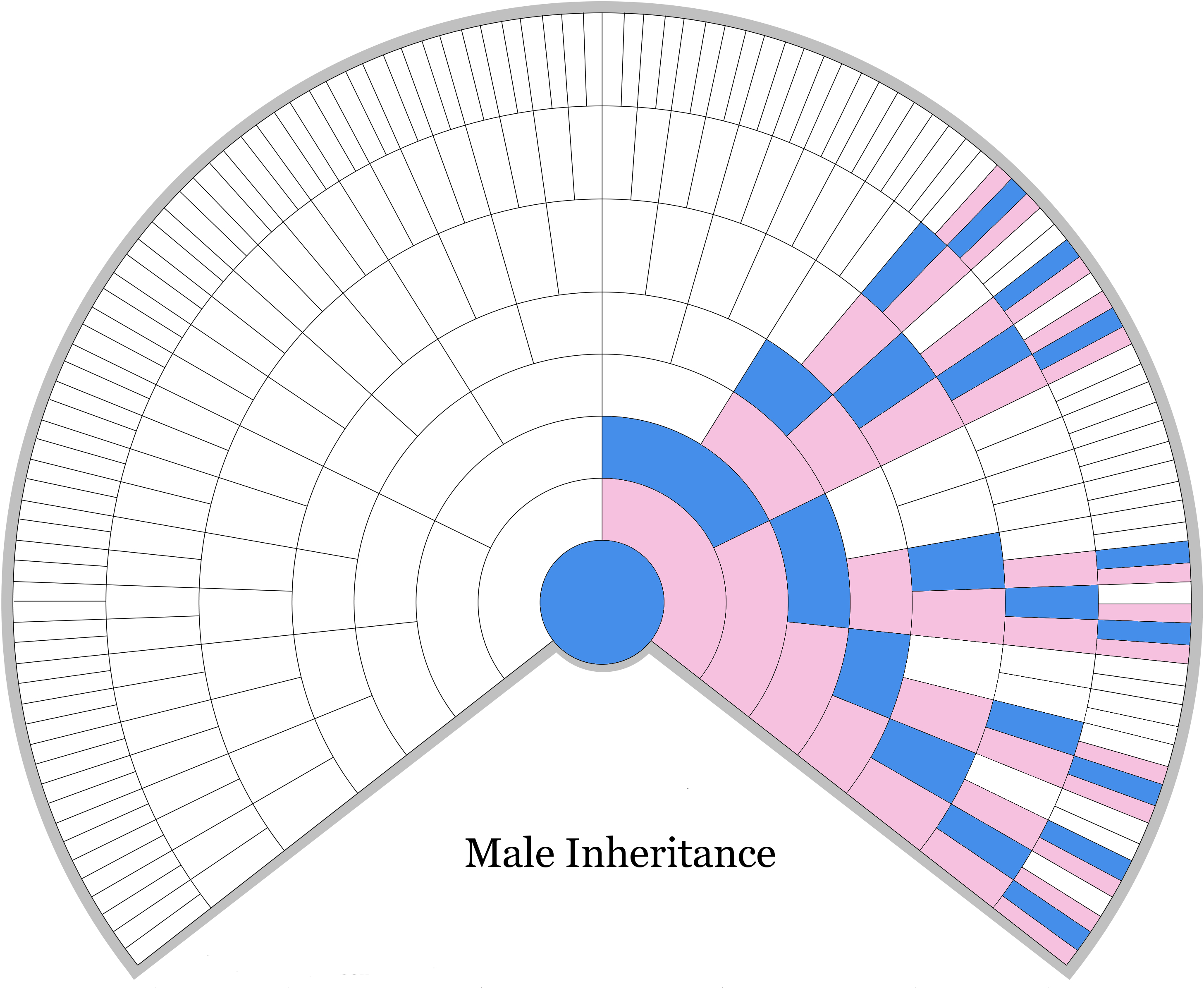
Male X-DNA Inheritance Chart
.
Blaine,
Speaking as a genetic genealogy novice: what would be the advantages of using X-chromosome markers over autosomal markers? It seems to me that from a genealogy point of view the X chromosome has all of the disadvantages of autosomes (e.g. recombination, less well-characterised geographic distribution) but provides information on fewer potential ancestors. Wouldn’t simply selecting an equivalent number of autosomal markers be more informative?
Or is the restricted number of contributing ancestors actually useful, in terms of constraining specific genealogical scenarios?
Daniel – Great question, considering the MANY problems using the X chromosome for genetic genealogy. But actually, the fact that the X chromosome provides information about fewer potential ancestors is in part what makes it somewhat appealing (as you suggested in your comment). At 7 generations there are 128 autosomal ancestors, but only a few of those are X chromosome ancestors (21 for males and 34 for females), thus potentially making analysis that much easier.
Another aspect is something that non-genealogists may not realize, namely that many genetic genealogists are not only interested in overall percentages of ancestry but are also interested in the smaller, nitty-gritty details. Thus, analysis of the X chromosome isn’t just about determining overall ancestry percentages. For example, I’ve been a genealogist for 20 years now, and I would love to know from which ancestors I obtained each bit of my DNA. My Y chromosome, rather than just being Haplogroup R1b with certain characterized markers, is a piece of DNA that I inherited from my 7-great-grandfather who emigrated to this country and fought in the Revolutionary War, and from his son, and so on. In the future, I envision being able to follow individual segments of autosomal and X chromosomal DNA through my family tree. Indeed, the SMGF is already beginning this process, as it collects both DNA and family trees.
Genetic genealogists are just beginning to look at the X chromosome, and extensive autosomal analysis is just around the corner. Hopefully some of what genetic genealogists learn through analysis of the X chromosome will be useful as we begin to examine autosomal markers.
Hi Blaine,
An excellent and informative response – thanks.
You’re spot-on that (as a genetic genealogy outsider with a background in pop gen) I tend to instinctively think of deep, global ancestry rather than specific lines of transmission across relatively recent history – but I can certainly appreciate the fascination of the latter. I appreciate the insight.
My X-chromosome would seemingly be 50% from my Austrian line and 50% from my colonial American line. It might be interesting for vresearchers to determine which DNA is from my Austrian line, since it would seem to be rather rare for Americans. So I am waiting to see which test to take and what the choices of tests are, along with tghe costs.
Philip – there are only a few limited options for X-chromosome testing right now, but I expect that there will be many options in the next three years.
Has anyone created software to help the process?
The X and the Y chromosome are scientifically responsible for the division of the humans on the basis on sexes which makes it imperative to peep into such secrets. After complete sequencing of the X chromosome there is a lot more to follow.
Carol Jonathan’s last blog post..Corporate Wellness: Your Gateway To Professional Success