The Genetic Genealogist

Adding DNA to the Genealogist's Toolbox

Archive for November, 2008


Family Tree DNA Facts & Genes Newsletter

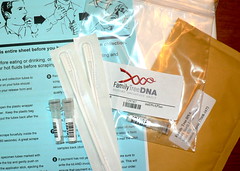
present for myself

Image by Valerie Reneé via Flickr

Family Tree DNA has a new issue of Facts & Genes available on their website.  If you didn’t receive this newsletter but would like to receive it in the future, you can register here.

I especially like the “Case Study in Genetic Genealogy”, which is reprinted in full below.  I, like others, sometimes jump too quickly to the conclusion that there has been a non-paternal event in a line.

Case Study in Genetic Genealogy

When I ["I" being a hypothetic someone who has tested through a genetic genealogy company] first tested, I had no matches with my surname, and a match with another surname. I was told that there was an event in the past, breaking the link of the Y chromosome and the surname – an illegitimacy.


Several years later, I now have matches with 3 other surnames, and no match with my surname. I am thoroughly confused. How can you explain this?

Recommendation

A conclusion of an illegitimate event, or other events that can break the link between the Y chromosome and surname, such as adoption, infidelity, and name change, should only be made after significant research, and testing all or at least the majority of the family trees that exist for the surname.

A surname distribution map of your surname in the ancestral country shows approximately 150 origins for the surname. This is not unusual for an occupational surname.

In your Surname Project, there are only 15 different groups of results – representing approximately 10% of the possible results for the surname.

Most likely you will find a match with your surname as more people test.

Keep in mind that for any surname, some Y-DNA results will ramify, while others will have a smaller population. This may mean that the Surname Project has one large group who match and other smaller groups. This situation could also depend on where recruiting has taken place.

In addition, some Y-DNA results for the surname may not be represented in your country beyond your family tree, but may be found in the ancestral country or another destination country.

I realize that one of the surnames you match is found in the same county as your surname in the 1800s. This is not sufficient evidence that an event occurred, such as illegitimacy.

Unless there is documented evidence, and until a majority of the family trees for a surname and variants are tested, it is recommended that where a result has no matches yet with the surname, a conclusion is not made until sufficient testing occurs.

Reprinted courtesy of Family Tree DNA (Copyright 2008, Family Tree DNA).

Family Tree DNA and MyHeritage Partner to Combine DNA With Family Trees

As the Guardian reported today in “Genealogy website MyHeritage offers low-cost DNA tests“, Family Tree DNA and MyHeritage have formed a partnership to combine DNA testing with online family trees.  From the press release:

“With close to 220,000 records, FamilyTreeDNA is the largest database of genealogic DNA information in the world. This provides the perfect complement to MyHeritage’s current research tools, giving our members another way to learn about where they come from,” said Gilad Japhet, founder and CEO of MyHeritage. “We help people around the world discover, connect and communicate with their extended family network and easily research their family history. Now, by working with FamilyTreeDNA, we can offer a solution when the paper trail runs out.”

imageAs part of the partnership, Family Tree DNA is offering special pricing to MyHeritage members.  However, readers of TGG can click here to obtain the discount without being a member of MyHeritage.  The following prices are with the discount:

  • Y-DNA25 – a Y-chromosome test for males (US$129)
  • mtDNA – a mitochondrial DNA test for males and females (US$129)
  • Y-DNA25 + mtDNA – a combined Y-chromosome and mitochondrial DNA test for males (US$219)

Security at Navigenics and 23andMe

Security of genetic information is an enormous concern for individuals, and thus an enormous concern facing commercial genetic enterprises.  I was recently having a conversation with someone about the security of genetic and personal information at companies such as 23andMe and Navigenics, and I pointed out that the very livelihood of these organizations depends on their ability to secure information.  A single security breach could potentially drive away future customers.

On that topic, Ryan Calo, a residential fellow at Stanford Law School’s Center for Internet & Society writes about a panel discussion held at the law school (pdf poster here):

“With a credit card and a saliva sample, consumers can now unlock the secrets carried in their DNA. Consumer genomics offers direct access to one’s genetic code, plus interpretations of health risks, family lineage, opportunities for social networking, and more. But how should consumer genomics be regulated? Join us for a panel discussion with leaders at the forefront of consumer genomics (23andme and Navigenics), media commentators (Alexis Madrigal from Wired), and policy makers.”

The moderator of the discussion was Hank Greely, a professor at Stanford whose work I highly respect and enjoy.

Calo writes in his blog that Navigenics has a strong statement in their privacy policy that they “will use reasonable and lawful efforts to limit the scope of any”  legally required disclosure, such as subpoenas and court orders.  During the talk, 23andMe co-founder Anne Wojcicki stated that 23andMe also has a policy to fight unreasonable requests for information (such as subpoenas).  Calo has more at his blog.

A recording of the panel discussion will be made available here at some point in the future.

The ASHG Ancestry Testing Task Force

Charmaine Royal, Ph.D., discusses “The pitfalls of tracing your ancestry” at NatureNews.  Dr. Royal, an associate professor at the Duke Institute for Genome Sciences and Policy, co-chairs the ASHG Ancestry Testing Task Force.

Brendan Maher of Nature’s In the Field blog has more at “ASHG 2008: A stance, more or less, on genetic ancestry testing.”  Not much more covered here that was already written at The Spittoon – see “ASHG Releases Ancestry Testing Statement Emphasizing Interpretation.”

If you’re interested in seeing the Task Force’s webcast, it’s available here.

The ASHG Ancestry Testing Statement and Recommendations

Edited (June 6, 2011): FINAL version of the paper available here.

Today at 1:15PM, the American Society of Human Genetics released the “ASHG Ancestry Testing Statement and Recommendations (pdf)” during a press briefing session entitled “ASHG Ancestry Testing Statement and Recommendations: Guidelines for Understanding the Issues and Implications Involved.  The briefing session, held from 1:15PM to 2:15PM, is part of the 58th annual ASHG meeting in Philadelphia.  The paper was drafted by the recently-appointed ASHG Ancestry Testing Task Force Committee.

Let me start my analysis by clearly pointing out my personal positions:

  • After years of experience in this field, I am a proponent of genetic genealogy testing, a scientific endeavor that has been utilized by as many as 500,000 to 800,000 customers.
  • I believe that education, not more government regulation, is the most efficient and appropriate answer to the issues raised by the authors of the paper.
  • I believe that autosomal genetic genealogy testing is in its infancy and should only be used with the understanding that the results are only extremely rough estimates that are subject to change as the field develops.

General Concerns:

With those personal positions in mind, and after reviewing the paper, I have a number of general concerns with the paper’s conclusions:

  • There are statements in the paper about psychological reactions to testing results, including the conclusion that “[t]he occurrence of or potential for emotional distress in people and groups following receipt of conflicting information about their ancestry has been well documented.”  Unfortunately, the statements are based on anecdotal stories or isolated examples rather than any systematic or scientific investigation of the reactions of individuals to the results of genetic genealogy testing.  I am unaware of any systematic objective study that looks at the reactions of individual to genetic genealogy testing results (outside of the paternity test or health testing arenas).  Indeed, a prior policy paper from the ASHG cites only a BBC documentary that examined the ancestry of three individuals of African descent and a newspaper article to support their conclusion that “[t]est-takers may…suffer emotional distress if test results are unexpected or undesired.”  I would suggest that the Task Force, rather than assume that this “emotional distress” response to genetic genealogy test results has been well documented, conduct an objective study specifically tailored to analyze genetic genealogy testing. The difference between the results of genetic genealogy testing and the results of health or medical testing is so vast that drawing comparisons between the two is extremely problematic and potentially inaccurate.
  • The paper muddles the distinction between Y-DNA/mtDNA testing and autosomal testing, even though the differences are huge.  The results of Y-DNA and mtDNA tests are STR numbers, SNP designations, or differences from the CRS which are then used to estimate a haplogroup or compare with another’s results.  Given the extensive data regarding haplogroup designation, the estimates are highly accurate.  Additionally, a haplogroup designation implies only a very broad geographical origin many thousands of years ago; it is not an estimation of genetic ancestry, as the authors of the policy paper imply.  Haplogroup designations have existed for more than 20 years and continue to be used by population geneticists and anthropologists.  The results of autosomal testing, however, are estimations of genetic ancestry.  These autosomal tests look at anywhere from 13 to 500,000 locations – out of billions – on the human genome and return percentages of ancestry based on those markers.  Autosomal testing can be confusing to test-takers because customer often assumes that the percentages are final and represent an accurate picture of their entire genome.
  • The authors mix the issues associated with the everyday genetic genealogy test-taker with the issues faced by very specific groups of test-takers.  For example, Native American groups are concerned about the effects that genetic genealogy will have on group identity and membership.  These same concerns have also been raised by lineage societies such as the SAR and the Mayflower SocietyAny regulations that a group believes it needs should be at the level of the group, not at the level of the testing! Groups that have these concerns should themselves decide whether and how to use genetic genealogy results for membership and group identity (such as the DAR and Mayflower Society are doing); regulating genetic genealogy at the testing level is not the most efficient or appropriate way for these groups resolve the ethical and social concerns.
  • There is mixing of the controversial phrase “direct-to-consumer” with genetic genealogy.  Of course it’s direct-to-consumer, who else would the results go to?  Surely the authors of the paper aren’t suggesting that genetic genealogy tests should be ordered and reviewed by a doctor or genetic counselor.  That would be a ridiculous restriction.
  • Although I am unaware of the composition of the ASHG Task Force, I hope that it is made up of a diverse group. Additionally, I hope that the Task Force is actively conversing with people outside the committee, including commercial testing entities, researchers, and customers of genetic genealogy in order to obtain a well-rounded view of the field.

Specific Concerns:

Now, onto a few specific criticisms of the paper:

Limited Scope:

“Many people pursue genetic ancestry testing because they wish to find out more information about either the local populations or broad geographical regions in which their ancestors lived. However, the power of commercial genetic tests to answer such questions is limited, and the precision of the answer is often limited by the imprecision of the question. The limitations arise from the fact that every person has hundreds of ancestors going back even a few centuries and thousands of ancestors in just a millennium. There is thus enormous non-deterministic variation to the portion of the genome retained in a descendant from a given ancestor, with a rough expectation that it halves every generation. Consequently, genetic tests can access only a fraction of these ancestral contributions. The genomic segments contributed by a particular ancestor are far from all being uniquely identifiable, so even if one’s genome has those specific genome contributions, identification of particular ancestry is always uncertain and statistical. It is also unclear how well-inferred ancestry serves to predict the tested individual’s genotypes at untested loci.”

This paragraph largely deals with autosomal testing, but there is no clear distinction made.  The questions that can be answered by genetic genealogy depend on the type of testing that is done.  Additionally, there is no way to know for sure, short of testing, which ancestors contributed to your autosomal DNA (and even current testing is unable to do this, although it likely will be able to do so in the future).  However, it is clear who contributed your Y-DNA and/or mtDNA (your father’s father’s father’s father contributed your Y-DNA, for example, even if their names are unknown).

Accuracy:

“A major concern about the DTC ancestry testing business is that there is no quality assurance guarantee, and there is not even a mechanism to couple market performance with anything relating to accuracy. Cost pressures and market competition will likely drive costs down, and lower costs for ancestry testing services will probably be tolerated in this environment even if the accuracy suffers.”

I believe that the Task Force is aware of the GENEALOGY-DNA Mailing list, but I wonder if they are similarly aware that genetic genealogists often test the same markers with multiple companies. For example, test-takers were recently able to compare their results to the SNP results provided by new large-scale chip testing from 23andMe or deCODEme.  Similarly, test-takers have also compared the results of SNP testing by 23andMe and deCODEme and found that the results were almost identical (see here).  Many genetic genealogists, especially those associated with the GENEALOGY-DNA mailing list, are aware of and continue to explore accuracy issues. As a result, these individuals provide a market regulation mechanism that is much more robust that the authors imply, especially since some testing companies monitor and interact with these lists to address the concerns of customers.

Group Identity:

“For some groups (some Native American tribes, for example), a major concern about scientific efforts to explain origins is the apparent diminished regard for important cultural, religious, social, historical and political processes that also inform group origin, membership, and identity, and access to group rights. Some related issues include the use of genetic ancestry information as the basis for: changing one’s identity on various government forms; making claims to certain group rights or benefits; and immigration purposes, such as seeking dual citizenship.”

Since I already discussed this above, I won’t add much here.  Again I argue that any needed regulations should be established at the level of the group or organization rather than at the level of testing.  The government should establish guidelines about how to use DNA testing results when filling out identity on government forms, and groups should determine how to use DNA testing results when addressing group rights or benefits.  This is the most efficient and appropriate way to regulate these concerns.

Emotional Distress:

“Knowledge about genetic ancestry – if undesirable and unexpected – can elicit a range of psychological responses including shock, disbelief, denial, anxiety, anger, fear and other well-known reactions to unwanted news. It can also lead to the reshaping of individual or group identity. The occurrence of or potential for emotional distress in people and groups following receipt of conflicting information about their ancestry has been well documented.”

I discussed this concern above, but I wanted to raise one more issue.  While researching the ancestry of my great-grandmother, I discovered on a census return that she was ‘adopted’ as a child, and in fact I still don’t know the identity of her birth parents.  Finding this unexpected result in this document caused a number of emotional responses over the ensuing years, including some anger and frustration.  Should the government regulate access to census records, published family histories, or town records since finding unexpected results in these research sources can elicit emotional responses?  Should I have to use the services of a professional genealogy counselor to share the results of the research with me?  Based on my own anecdotal experience during 20+ years of traditional genealogy, I would argue that far more emotional distress is elicited by traditional genealogy than is elicited by genetic genealogy!  Note, however, that I claim this information is anecdotal, not “well-documented.”

Conclusion:

If nothing else, I hope that his policy paper incites thoughtful conversation about these issues.  I am genuinely interested in your thoughts and comments about both the paper and my response.  This is a very important time for genetic genealogy, and I encourage you to join the conversation by leaving a comment here at TGG.

And finally, in case you think that I am in complete disagreement with the paper, let me leave you with the group’s first recommendation which I consider to be sage advice:

“Because the science of ancestry determination has limitations, greater efforts are needed on the part of both industry and academia to make the limitations of ancestry estimation clearer to consumers, the scientific community, and the public at large. In turn, the public has the responsibility to avail themselves of information regarding ancestry testing and strive to better understand the implications and limitations of these assessments.”

Genetic Genealogy at the ASHG Meeting in Philadelphia

The 58th annual meeting of the American Society of Human Genetics is currently being held in Philadelphia.  Today at 10:00AM there will be a session specifically about genetic genealogy entitled “The Social, Ethical, and Biomedical Implications of Ancestry Testing: Exploring New Terrain.”  From the abstract:

“What is genetic ancestry and how does it relate to race and ethnicity? The development of increasingly cost effective genomic sequencing technologies and public interest in genetic ancestry has led to a dramatic flourishing of direct-to-consumer products and new approaches to biomedical research. In this session, panelists define the contours of this emerging landscape and explore the commercial, biomedical, social and ethical implications of this burgeoning category of genomic application. Panelists consider the following questions: What genetic ancestry information is available to consumers? How is genetic ancestry used in biomedical research? What implications do genetic approaches to ancestry have on social identity? What ethical and policy issues must be addressed in this changing landscape? Panelists provide perspectives from industry, medicine, cultural studies, and bioethics.”

The moderator of this session is Sandra Soo-Jin Lee of Stanford University.  The panelists include Joanna Mountain who will talk about ‘New dimensions for direct-to-consumer genetic ancestry testing’; Kimberly Tallbear who will talk about ‘The genetic construction of indigeneity’; and Esteban González Burchard who will talk about ‘The importance of ancestry testing and genetics in biomedical research’.  Additionally, the moderator will discuss ‘Racing forward: The ethics of ancestry testing.’

Comments:

I don’t like the mixing of the controversial phrase “direct-to-consumer” with genetic genealogy.  Of course it’s direct-to-consumer, who else would the results go to?  Should your doctor or genetic counselor review your genetic genealogy results?  That would be a ridiculous restriction.

The panelists will also be discussing the “ethical and policy issues” in this changing landscape.  As always, I believe that education, not more government regulation, is the answer to these ethical and policy issues.

A Lecture by Spencer Wells

image Last week I had the opportunity to attend a lecture by Spencer Wells, director of the Genographic Project from National Geographic and IBM.

The talk was a Syracuse Symposium event, and the first big event ever to be held in Syracuse University’s new $110 million Life Sciences Center.  I thought it was fitting that the first event to celebrate the future of the new life sciences building was a lecture that examined the collective genetic journey of mankind.

Dr. Wells began by giving the audience a very brief introduction about DNA and genetic genealogy.  He included a great quote that “The question of origin is actually a question about genealogy.”  For those that are not familiar with the Genographic Project, it was launched in 2005 and includes three primary missions:

  1. Global DNA sampling from indigenous and traditional cultures which retain a geographic link with their current location;
  2. Public participation; and
  3. The legacy fund, which is funded by the public participation aspect of the project and aims to “empower indigenous and traditional peoples by supporting locally-led efforts.”

Dr. Wells is a great speaker and the hour-long lecture went by extremely quickly.  Some of the more interesting information he shared is not readily available on the Genographic Project’s website:

  • According to current projections, the project is about halfway finished and is predicted to end in 2011.
  • So far, 41,000 samples have been collected from indigenous populations, and 270,000 kits have been purchased by public participants in 130 countries (currently at about 800 kits ordered per week!).
  • The indigenous DNA samples are stored for future analysis – this will undoubtedly be an irreplaceable asset as indigenous populations continue to decline (although it does raise issues of informed consent; do indigenous people really understand the information?).
  • Eventually, the Genographic Project’s database will be searchable.

Valuable Research

He also highlighted the previous papers that resulted in party from the Genographic Project, including:

A new paper, soon to be released, will examine the genetic ancestry of the Toubou people indigenous to northern Chad in Saharan Africa.  The Toubou people have a rich and interesting history, but their actual genetic roots are unclear.  According to Sougoui, a Toubou:

“The Genographic Project is a great opportunity for us, the Toubou, because we are a people who are extremely interested in our origins… According to Toubou legend, we are a people who came from different places. This is a question that we continually talk about. We are anxiously waiting for the results of this study to answer this question for us. It is important for us as Toubou to know where we came from, how we got separated from other peoples, and how we actually fit into the world God created.”

Dr. Wells showed a short clip of a new documentary that is being made about the Genographic Project.  In the clip, we were shown the challenges of collecting DNA from the Toubou; looks like it will be another very interesting documentary.  See more about the Toubou project here and here.

The Q&A Session

During the Q&A session, someone asked what regions are missing from the database.  Perhaps unsurprisingly, the answer was the Americas and Australia.  Apparently the Project has had a very difficult time getting permission to take samples from these populations.

Many of the questions reflected the fact that many people are confused about the inheritance of Y-DNA and mtDNA.  Half the them were about whether a child or a sibling would have the same or different Y-DNA or mtDNA.

Conclusion

Dr. Wells is a great lecturer, and I highly recommend watching him speak if you are ever able to do so.  I learned a great deal about the Genographic Project, and I look forward to the information that will continue to be released from this valuable endeavor.

Nature Focuses on Personal Genomics

Nature has a brand new web focus on personal genomics (as of November 5th, 2008).  And best of all, most of the articles are entirely free to access, download, and read!  From the site:

“As the number of human beings with their genomes fully sequenced ticks higher and direct-to-consumer gene profiling companies push the limits of what medical genetics can do, the once fantastical notion that any given human can walk into a doctor’s office with his or her genome on a hard drive looks more and more like a reality. Still the question remains to be answered: how do we use this wealth information? In this Nature web focus we proudly present the challenges this approaching reality poses for technology, the legal and ethical confines of research, and the ability of genomics to translate into clinical utility.”

Here are just a few of the interesting news & opinion articles:

And unlike other bloggers who will undoubtedly mention these articles, I recommend that you read or peruse all the articles, not just the ones I happen to agree with!

In addition to the articles, Nature has a podcast (mp3) of special features on personal human genomes.  And lastly, follow along as Nature blogs from the 58th Annual Meeting of the American Society of Human Genetics in Philadelphia from November 11-15.  It looks like this is going to be quite a meeting.

HT: tweet from attilacsordas – are you tweeting yet?  Join me there.