The Genetic Genealogist

Adding DNA to the Genealogist's Toolbox

Archive for August, 2008


Federation of Genealogical Societies Meeting

This Friday, September 5th, I’ll be attending the FGS meeting in Philadelphia.  I’m excited because this is my first big genealogy meeting (after 20 years of genealogy!), and because I get to sit and watch some great presenters discuss genetic genealogy.  The program is here.

I hope to meet some other genealogy bloggers, if any of you are planning to attend!

Using DNA to Examine James Madison’s Family Tree

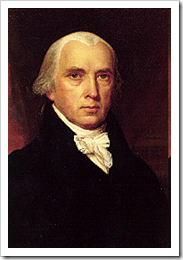
imageAccording to a 200-year-old family legend, Bettye Kearse – an African American – is the direct descendant of James Madison.  Madison, of course, was a founding father and fourth President of the United States.  As the story goes, he fathered a child name Jim with a slave cook named Coreen.  For the past 4 years she and genetic genealogist Bruce Jackson of the Roots Project have tried to use DNA to prove or disprove a story passed through 5 generations of the family.

Unfortunately, Kearse and Jackson have been unable to obtain DNA samples from Madison’s descendants, stating that they have been “neither sincere nor forthcoming in this effort.”  The president of the National Society of Madison Family Descendants, Frederick M. Smith, cited confidentiality concerns and declined to comment.

An article in the Washington Post describes the situation.  According to Smith, “his society has received several claims of family ties to the president over the years and those wishing to test their DNA against that of a Madison family descendant can do so through an online genetic testing service, a method he called objective and without racial bias.”  However, Jackson called the approach “scientifically flawed.”  I disagree with Jackson; this method would clearly shed light on the question.  Of course a negative result will mean more research and testing, but a positive result would really get the ball rolling.  I also don’t believe that Jackson’s lab or organization should perform the comparison; it clearly should be a neutral third party.

The Madison Society has suggested that Family Tree DNA be used to compare Kearse’s DNA to DNA from an anonymous Madison descendant.  According to the article, Jackson maintains that “there was no way to verify, genetically or historically, whether the so-called Madison DNA being used for the test would be valid. If the test came back negative, he said, it would prove nothing, but Kearse’s claim might still be dismissed as false.”

Of course, traveling down the Madison family tree is not the only direction to go.  I’m sure Kearse will be able to identify a distant Madison relative who will be willing to submit a DNA sample.  Indeed, in December, “Jackson traveled to England to meet with a British genealogist in hopes of locating a descendant of Madison’s great-great-grandfather, John Maddison Sr., a ship’s carpenter who emigrated to Virginia in the 1650s.”

The Confucius Genealogy Compilation Committee Rejects DNA Testing

iStock_000002679865XSmallSee the new article at Seed Magazine “Inheriting Confucius,” which discusses efforts to generate a family tree containing the 2 million+ descendants of Confucius.

Kong De-Yong, a 77th(!) generation descendant of Confucius, has been compiling the tree for the last 10 years.  Although the Committee is accepting submissions from women and other previously excluded groups, it is not accepting DNA contributions.  According to the article, this “hints at the limits of Chinese engagement with the age of genomics, and demonstrates how high cultural stakes can constrain science.”  Unfortunately, as the author of the article suggests, many people might be afraid of the results of such DNA testing: “Given the potential implications of genetic knowledge for long-presumed members of the [Confucius] family, they think it better not to know.”

However, there is of course no need for the Committee’s participation in order to learn more about Confucius’ DNA or Confucuis’ descendants (although it would be nice, of course).  A Confucius DNA Project has already been initiated by the Beijing Institute of Genomics, and Confucius descendants can submit a sample for analysis for the price of $125.

Interesting News in the World of Genetic Genealogy

Genetic Genealogy

Technology Review, an MIT publication, has an article entitled “Genealogy Gets More Precise: Rapidly growing databases enable a more complete picture of one’s ancestry.“  The article, which is relatively balanced, discusses some of the benefits and challenges associated with genetic genealogy testing.

Also check out the article and video “Mapping Out a Nascent Market” at boston.com, which is directed towards personal genetic companies such as deCODEme, 23andMe, Navigenics, and Knome.

And lastly, scientists have sequenced and recreated the Neanderthal mtDNA genome.  For more information see john hawks weblog, Genetic Archaeology, Genea-Musings (with a humorous twist), Anthropology.net, and The Spittoon.  The original article is in Cell.  Turns out there are roughly 206 differences between the CRS (the Cambridge Reference Sequence, the mtDNA to which all human mtDNA is compared) and Neanderthal mtDNA; 195 transitions and 11 transversions.

The Summer 2008 Genea-Blogger Group Games

I’ve decided to join the 2008 Genea-Blogger Group Games (see here for more info).  I’m a little late, but the organizers have decided to allow entrants until tonight at 9:00pm PDT.  The Opening Ceremonies were held on Friday.  I’m hoping to put a genetic genealogy twist on my entries, if possible, to highlight how genetics can augment traditional genealogical research.

image

The categories I plan to participate in are:

  • Back Up Your Data!
    • A. Prepare a comprehensive backup plan for your digital research files and a security plan for your hard copies and photos
    • C. Backup all your data using a flash drive, an external drive, CDs, DVDs, or an online resource
    • E. All your data is backed up digitally and secured physically and you can recover from any disaster while losing only one month or less worth of research
  • Write, Write, Write!
    • B. Participate in a genealogy or family history related blog carnival. See the AnceStories post “August Is…” (http://ancestories1.blogspot.com/2008/08/august-is.html) for a list of these carnivals and their submission URLs and deadlines.
    • D. Write a brief biographical sketch on one of your ancestors.
    • E. Sign up to host a future carnival
  • Reach Out & Perform Genealogical Acts of Kindness!

Are Disease-Causing mtDNA Mutations Common?

image Genetic genealogy has the potential to reveal information about your health (for example, DYS464 can reveal infertility and sequencing of the entire mtDNA genome can reveal mutations that are suspected of being associated with certain disorders).  Although I usually don’t consider this possibility to be serious enough to discourage genetic genealogy testing, I do believe that people should be aware of the possibility before being tested.

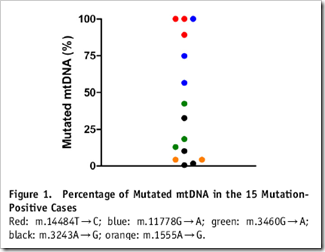
A new study in the American Journal of Human Genetics (available here) examined the frequency of ten (potentially) pathogenic mitochondrial point mutations in 3168 neonatal cord blood samples.  Of these samples, a total of 15 (or 1 in 200) harbored one or more of the mutations.

Interestingly, the mtDNA of 12 of the 15 samples were heteroplasmic, meaning that their cells harbored both mutated and non-mutated mtDNA genomes.  Figure 1 from the paper, above, shows the percentage of mutated mtDNA in each of the 15 samples with mutations, from nearly 0% to the 100% in the three homoplasmic samples.

The abstract:

“Mitochondrial DNA (mtDNA) mutations are a major cause of genetic disease, but their prevalence in the general population is not known. We determined the frequency of ten mitochondrial point mutations in 3168 neonatal-cord-blood samples from sequential live births, analyzing matched maternal-blood samples to estimate the de novo mutation rate. mtDNA mutations were detected in 15 offspring (0.54%, 95% CI = 0.30-0.89%). Of these live births, 0.00107% (95% CI = 0.00087-0.0127) harbored a mutation not detected in the mother’s blood, providing an estimate of the de novo mutation rate. The most common mutation was m.3243A-G. m.14484T-C was only found on sub-branches of mtDNA haplogroup J. In conclusion, at least one in 200 healthy humans harbors a pathogenic mtDNA mutation that potentially causes disease in the offspring of female carriers. The exclusive detection of m.14484T-Con haplogroup J implicates the background mtDNA haplotype in mutagenesis. These findings emphasize the importance of developing new approaches to prevent transmission.”

HT: Dienekes’ Anthropology Blog