The Genetic Genealogist

Adding DNA to the Genealogist's Toolbox

Archive for March, 2008


RootsTelevision Won Four Telly Awards!

Congratulations to RootsTelevision, co-founded by Megan Smolenyak Smolenyak and Marcy Brown, which just won FOUR Telly Awards! The press release is included below. And don’t forget that you can watch RootsTelevision right here at TGG!

RootsTelevision.com Wins Four Telly Awards in Its First Year

PROVO, UT, March 26, 2008 – RootsTelevision.com, an online channel dedicated to all aspects of genealogy and family history, has been recognized in the 29th Annual Telly Awards for four of its original productions. Selected from more than 14,000 shows were “DNA Stories: A Tale of Two Fathers” (documentary), “Heir Jordan: Extreme Genealogy” (entertainment), “Roots Books: Psychic Roots” (talk show), and “Flat Stanley’s Family Tree” (children’s audience).

“We’re delighted,” said RootsTelevision.com co-founder, Marcy Brown. “To receive this kind of recognition during our first year of existence is remarkable, and winning in four different categories is even more astonishing. We take this as an indication that our decision to pioneer online programming for the substantial but neglected niche of millions of genealogists was a risk worth taking.”

The four winning shows include an episode of “DNA Stories,” a series that focuses on the exploding hobby of genetic genealogy and shows how avid roots-seekers are using DNA testing to solve family history riddles. The award-winning “Tale of Two Fathers” episode features Bob Zins and his efforts to determine whether the man who raised him was really his father. “Heir Jordan: Extreme Genealogy” showcases the unexpected twin talents of Jordan Auslander, who’s both a professional genealogist and stand-up comic. “Roots Books,” a talk show hosted by Sharon DeBartolo Carmack, received its award for the especially popular “Psychic Roots” episode that centers on a discussion of the role of serendipity in genealogy between Sharon and popular speaker and author, Hank Jones. And “Flat Stanley’s Family Tree” follows the beloved children’s character as he explores his colonial roots in Williamsburg, Virginia and his gold rush roots in California.

Founded in 1978, The Telly is the premier award honoring outstanding local, regional and cable TV programs, as well as the finest video and film productions. The Telly Awards, a highly respected international competition, annually showcases the best work of the most respected production companies in the world.

About RootsTelevision.com
RootsTelevision.com was co-founded by producer, Marcy Brown, and professional genealogist, Megan Smolenyak Smolenyak (yes, her real name). Marcy and Megan, who frequently refer to themselves as “two chicks and a channel,” launched online in late 2006 and already provide more than 1,000 videos – free, on-demand and 24/7 — for family history enthusiasts around the globe. For more information, please visit www.rootstelevision.com.

Links to the award-winning shows:

DNA Stories: A Tale of Two Fathers:

http://rootstelevision.com/players/player_dna.php?bctid=240040765

Heir Jordan: Extreme Genealogy:

http://rootstelevision.com/players/player_rootsliving.php?bctid=240119643

Roots Books: Psychic Roots:

http://rootstelevision.com/players/player_rootsbooks.php?bctid=240035625

Flat Stanley’s Family Tree:

http://rootstelevision.com/players/player_kids.php?bctid=525667948

Interesting DNA Links – March 26, 2008

Here are a few of the many interesting links from the DNA blogosphere:

  • DNA Testing Firms Eye Consumers (BBC) – yet another article that looks at both sides of the “should you test” debate.
  • Genetic Testing Gets Personal (Washington Post) – a lengthy discussion of many different types of DNA testing.
  • The Scientific Studies/Papers Page at ISOGG – I’ve been meaning to share this one for a while. The page describes methods for obtaining and reading scientific papers about genetic genealogy (or any other scientific topic, for that matter). This is a helpful resource for anyone who is interested in learning more about the science behind genetic genealogy.

ISOGG Launches Newsletter

imageThe International Society of Genetic Genealogy (ISOGG) has just launched a new newsletter. The first edition, March 2008, is available here. This edition discusses GINA, a DNA Success Story by Shoshone, a segment called “The Armchair Geneticist: Where Hobby Produces Science”, What’s New in ISOGG, and a Featured DNA Project.

The newsletter is well-written and has some great graphics, so be sure to subscribe to this FREE newsletter (see the bottom of the newsletter for subscription information).

Happy St. Patrick’s Day!

In honor of St. Patrick’s Day and my Irish DNA, here is picture of one of the many beautiful places I visited on my trip to Ireland – Slea Head, the tip of the Dingle peninsula, as a storm rolls in (2004):

Slea Head

The Six Founding Native American Mothers

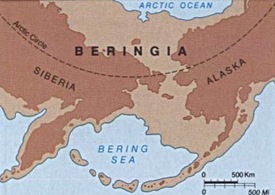
BeringiaIf you’re interested in DNA, Native American History, or genetic genealogy, then you’re undoubtedly heard of a new paper from PLoS ONE called “The Phylogeny of the Four Pan-American mtDNA Haplogroups: Implications for Evolutionary and Disease Studies.” The authors, from all around the world (including Ugo A. Perego from SMGF and Antonio Torroni from Italy) analyze over 100 complete Native America mtDNA genomes. From the abstract:

“In this study, a comprehensive overview of all available complete mitochondrial DNA (mtDNA) genomes of the four pan-American haplogroups A2, B2, C1, and D1 is provided by revising the information scattered throughout GenBank and the literature, and adding 14 novel mtDNA sequences. The phylogenies of haplogroups A2, B2, C1, and D1 reveal a large number of sub-haplogroups but suggest that the ancestral Beringian population(s) contributed only six (successful) founder haplotypes to these haplogroups.”

All Native American mtDNA can be traced back to five Haplogroups called A, B, C, D, and X. More specifically, Native American mtDNA belongs to sub-haplogroups that are unique to the Americas and not found in Asia or Europe: A2, B2, C1, D1, and X2a (with minor groups C4c, D2, D3, and D4h3). Based on the study, the A2, B2, C1, and D1 groups are estimated to have developed between 18,000 and 21,000 years ago. Since the Native American mtDNA sub-haplogroups are not found in Asia, they are believed to have developed while founding groups were crossing into the Americas from Asia via Beringia.

The study suggests that 95% of Native American mtDNAs are descended from the six founding mothers of the A2, B2, C1b, Cc, C1d, and D1 sub-haplogroups. The other 5% is composed of the X2a, D2, D3, C4, and D4h3 sub-haplogroups.

It should be noted that these results are not considered the last word on the subject, as more sequences and further research is needed. From the paper:

“Our snapshot of the phylogenies for haplogroups A2, B2, C1, and D1 is only partially representative of Native American mtDNA variation, since most likely it only marginally includes the variation of Native American populations from Central and South America.”

For more information:

Genetic Testing on NBC’s Today Show

MSNBC has a very short article entitled "DNA Testing: Would You Do It?"  Last Friday, Linda Avey and Anne Wojcicki – co-founders of 23andMe – were interviewed by NBC News Correspondent Peter Alexander and Today show host Ann Curry to discuss the company.  The 7.5 minute video is below:

DNA Testing of New York’s New Governor David Paterson

As of Monday the 17th of March, David Paterson will be the Governor of New York State.  Lt. Gov. Paterson recently sat down with Susan Arbetter of WHMT’s NYNOW to discuss the results of his genetic genealogy test results.  Paterson is probably the first governor in the United States to have undergone genetic genealogy testing, and might be the highest government official to do so and then speak openly about it.  These videos are very enjoyable, and it’s interesting to learn more about the future Governor.

In the first segment, Arbetter and Paterson discuss some of Paterson’s genealogy.  They also discuss Paterson’s Y-DNA, which is of European origin.  Arbetter writes on her blog: "On the Lt. Governor’s paternal side, like almost 25% of all African Americans, he’s got white progenitors from England, Ireland and Scotland."


In the second segment, Paterson starts out discussing his maternal ancestry and the West African origin of his mtDNA.  Arbetter writes on her blog: "On his maternal side he has eastern European Jewish ancestry, as well as strong ties to what’s known as the Guinea Bissou region of West Africa which is now divided among Cameroon, Sierra Leone and Gambia."

In the final section, Arbetter and Paterson discuss issues of race and politics:

Arbetter blogged about Paterson’s DNA testing at "The Lt. Governor’s DNA: A Citizen of the World" and "Paterson’s Staff; Spitzer’s children."

New eBook: I Have The Results of My Genetic Genealogy Test, Now What?

I often get emails from people who are new to genetic genealogy asking questions about their newly-received DNA testing results. They are unsure about about what the results mean, how to find more information, or what to do next. I also see people ask these questions in all of the DNA forums and mailing lists that I subscribe to. Although I do my best to help the people that email me, I often wish there was more I could do.

In an attempt to assist people with the interpretation of their genetic genealogy testing results, I’ve written an eBook that takes the reader step-by-step through an analysis of their Y-DNA or mtDNA results, including estimating a haplogroup and sub-clade from testing results, finding resources to learn more about particular haplogroups, and finding haplogroup and haplotype matches, among many other topics. Here is the Table of Contents from the 28-page eBook:

Chapter 1: What Is (And Isn’t) Genetic Genealogy?
Chapter 2: How Do I Interpret My Y-DNA Results?
Chapter 3: How Do I Interpret My mtDNA Results?
Chapter 4: Monitoring the Field of Genetic Genealogy

I’m offering this eBook for free to anyone that might be interested in interpreting the results of their genetic genealogy test. And please feel free to share this eBook with your friends, mailing list, or anyone else. Without further ado:

Untitled - 3

I’ve spent many hours over the past few months working on this eBook, and I hope that you find it helpful in your own genetic genealogy journey. If you find anything that might need correction, or have any suggestions for future editions, please feel free to email me. And check back often for updates to this eBook. If you find the eBook helpful, please consider subscribing to my blog for updates and future releases.

Controversial Article About Genetic Tests At The Jewish Journal

An article entitled “Gene Test Kits – Can They Lead To Dating Services” by Annalee Newitz discusses the author’s thoughts on the implications of genome sequencing offered by the number of companies that have sprung up in the past year. As a genetic genealogist who is interested in the intersection of law, science, and ethics, I’m always interested in articles that examine the ethical issues associated with affordable genome sequencing. Unfortunately, this article turned out to have little substance behind some serious accusations.

“Snake Oil”?

Newitz begins by mentioning companies 23andMe and deCODEme, both of which recently launched genome scanning services. She then proceeds to her thesis, which is that these services are not only not useful, they are dangerous. She states:

“While there are many theories about how genetic expression works on our personalities and health, there are few solid facts. Some tests, such as those for various kinds of developmental disabilities, have provable results. But many genetic tests, like those 23andme claim can reveal ‘athletic ability,’ are the biotech version of snake oil.”

Snake oil was used by the author to describe this product as having exaggerated marketing but questionable quality. If you do a search for ’23andMe and “athletic ability”‘, the second link is 23andMe’s “Variations: Speed Gene: Fact or Fiction?” which examines the proposed link between the ACTN3 gene and athletic ability. The mini-report cites the scientific study (Lucia et al. (2007). “Citius and longius (faster and longer) with no alpha-actinin-3 in skeletal muscles?” Br J Sports Med. 41(9): 616-7) behind the link and concludes in part with:

“The fact that this long jumper is the first and so far only Olympic power athlete to be found who lacks the “gene for speed” is evidence for how important this gene is in determining this type of athletic ability. But his success is a testament to the fact that genes are not destiny.”

The question of ‘exaggerated marketing’ or ‘questionable quality’ are debatable, as we’ve certainly seen in the blogosphere in the past year, so I won’t get into any further analysis other to say that these companies, much like genetic genealogy companies, apply the results of scientific studies to the customer’s DNA and are not simply making up the information. It’s important to remember that the people taking these tests are pioneers; they are amply warned that the results are not a diagnosis and shouldn’t be used to make any important life decisions. The average price of these tests, $1,000 to $2,500, also suggests that people will not buy them on a whim.

Eugenics?

My biggest concern comes from Newitz’s suggestion that genome scanning will lead to selective breeding (although she uses the term ‘eugenics’):

“But I don’t think it is just a little fun, like chocolate or “find the inner you” classes are. What I see when I look at a site like 23andme is nothing less than the future of eugenics. I don’t mean the scary capital E eugenics of the 1930s that involved killing Jews and sterilizing “loose women.” I mean wild-type eugenics, the kind of genetic engineering that happens in nature without any dictatorial intervention.”

“While newspaper stories about the new personalized genomics services trumpet the arrival of the future, I see nothing but the past. This isn’t science for the masses; it’s not enlightenment. It’s just the same old stuff dressed up in the language of modern biology and tricked out with a zoomy Javascript interface.”

I would argue that customers are using genomic services as a science and for their own enlightenment. For instance, just head over to the GENEALOGY-DNA archives and see all the discussion and analysis of the results of these products in the past 4 months. Genetic genealogists, most of whom are not phd-trained scientists (i.e. the masses), are already beginning to analyze the results of genomic sequencing for SNPs that might be associated with particular haplotypes, and thus reveal information about genetic genealogy. Although this represents just a fraction of the people who have been tested or are interested in testing, it suggests that people are interested in genome scanning as a scientific pursuit to learn more about themselves.

Newitz has an incredible resume (see Wikipedia), but after reading the article I was disappointed by her interpretation of the services offered by genome scanning companies. Although embracing very valid concerns about the cheap availability of genetic information, Newitz turned to sensationalism instead of an insightful discussion of the concerns. It’s possible that she chose to be a little controversial for the purpose of interesting journalism, but I feel like the sensationalism took away any value from the discussion. I’m certainly not discounting any of Ms. Newitz’s concerns, I just wish the article had shared more information in order to produce more informed readers.

February In Review – What Can I Learn From My Visitors?

This post isn’t exactly about genetic genealogy. Rather, it is about what I can learn from my visitors in order to make The Genetic Genealogist a better place to visit. By analyzing statistics at the end of each month, I hope to continue to refine the direction of the blog to create and present the best content possible. Here are a few of the things I learned from my visitors this month:

The Top Ten Most Visited Posts:

  1. The Family Tree of Blue Eyed Individuals
  2. Where Was My Y-DNA and mtDNA in 1808?
  3. Family Tree DNA Launches DNATraints, A New DNA Testing Company
  4. 23andMe Revisited
  5. African American Lives 2 (February 2008)
  6. African American Lives 2 (A preview from April 2007)
  7. Buick And Ancestry DNA Team Up For a DNA Contest
  8. Genetic Genealogy is SO Mainstream – More Black History Month Events
  9. Famous DNA Review Part III – Niall of the Nine Hostages
  10. The First Personal Genomic Sequencing Test Offered for $985

What did I learn from this list? Well, here are a few interesting facts about these posts:

  • Only 5 of the top 10 articles were actually written in February 2008! This tells me that previously-written content is important, and that I should consider reviewing and updating popular older posts.
  • Four of the top 10 articles were about genetic genealogy and Black History Month. In addition to older content, new content about current topics (such as Black History Month) is equally as important.
  • The first two posts were popular among StumbleUpon readers. I’m not surprised by the first article, as it has obvious popular appeal – but I was surprised by the second article. You can never be sure what posts will be picked up and popularized by social media.

Top 15 Keywords in February 2008:

What can I learn from the keywords used by readers to find my blog?

  1. african american lives 2
  2. dna articles
  3. 23andme
  4. navigenetics
  5. genetic genealogy
  6. articles on dna
  7. genetic genealogist
  8. sorenson genomics
  9. africandna.com
  10. buick ancestry
  11. famous dna
  12. dnatraits
  13. genetic genealogy blog
  14. genealogy test
  15. megan smolenyak

Analytics allows me to track other information about these keywords, including (1) how many pages were viewed by people who came to the site via a particular keyword; and (2) the bounce rate of visitors who came via a keyword. Bounce rate is the percentage of people who exit a site from the first page they visit. So, for instance, for my first keyword “african american lives 2″, the average pages read was 2.4, and the bounce rate was 59% (which are both right around my average). What did I learn from my keywords?

  • Again, timely searches are important, as keywords #1, #9, #10, and #12 are all associated with Black History Month or the February launch of a new company (DNATraits).
  • Not surprisingly, TGG is not what people are looking for when they search “genealogy test”, as the page rate was 1 and the bounce rate was 93%. Nothing too surprising there, as I do not sell genealogy tests at TGG.
  • Very surprisingly, the keyword “genetic genealogy blog” had a page rate of 1.1 and a bounce rate of 87%! What are you people looking for? This is one of the only genetic genealogy blogs on the planet! This is a very interesting result that requires further analysis – do I make it clear ‘above the fold’ that this blog is about genetic genealogy? In sharp contrast, the term “genetic genealogist” had a very high page rate at 3.3, and a very low bounce rate at 46%.
  • The highest page rate (3.6) and lowest bounce rate (29%) belonged to the keyword “buick ancestry” from Buick And Ancestry DNA Team Up For a DNA Contest.