The Genetic Genealogist

Adding DNA to the Genealogist's Toolbox

Archive for February, 2008


Famous DNA Review, Part IV – Jesse James

image Jesse Woodson James, born September 5, 1847 and died April 3, 1882, was an infamous American outlaw. Despite strong evidence that James was killed on April 3, 1882, some theorized that his death was staged and that he in fact survived to father additional children.

In 1995, researchers set out to use relatively new DNA analysis to examine the rumors surrounding James’ death. They exhumed the body believed to be that of James from the Mt. Olivet Cemetery in Kearney, Nebraska. Although the remains were poorly preserved, the scientists were able to obtain DNA from two of four teeth. They also had DNA from two hairs that were recovered in 1978 from James’ original burial site on the James farm.

The mtDNA HVR1 sequence from the teeth and hairs were identical and belonged to Haplogroup T2, with 5 mutations relative to the CRS (16126C, 16274A, 16294T, 16296T, and 16304C).

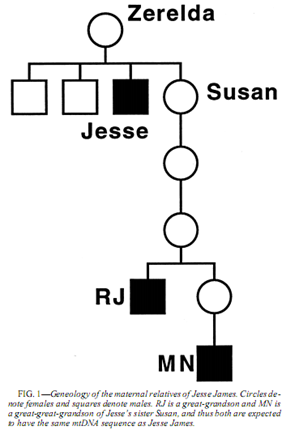
The researchers then compared James mtDNA haplotype to that of his sister Susan’s great-grandson and great-great grandson, both of whom were exact matches. Thus, either the body is that of Jesse James, or it is a body that just happens to have the same mtDNA haplotype as James. The authors of the paper did a great job of clearly stating that while strongly suggestive, the results are not absolutely conclusive:

“Do the mtDNA results prove that the exhumed remains are those of Jesse James? The answer to this question must be no, as there is always the possibility (however remote) that the remains are from a different maternal relative of RJ and MN, or from an unrelated person with the same mtDNA sequence. However, it should be emphasized that the mtDNA results are in complete agreement with the other scientific investigations of the exhumed remains: there is no scientific basis whatsoever for doubting that the exhumed remains are those of Jesse James. The burden of proof now shifts to those who, for whatever reason, choose to still doubt the identification. The mtDNA results reported herein provide a standard which other claimants to the legacy of Jesse James must satisfy.”

I wonder if any of the original DNA could be recovered again for research in the future.

James’ haplotype is available at Mitosearch (EEYCU). Interestingly, even with the increasing popularity of genetic genealogy and the many people who have entered their own haploytpe into Mitosearch, James does not have any exact matches in the database. This fact lends credence to the conclusion that the body tested is that of Jesse James.

Other Posts in the Famous DNA Series:

The Palatine DNA Project

iStock_000000516280XSmall DNA Projects, often affiliated with a genetic genealogy testing company, are used to coordinate the testing and result analysis of individuals that have the same surname, originate from a common location, or have a comment set of ancestors. For example, I’ve started the Bettinger DNA Project for individuals with the “Bettinger” surname. An example of a project that hopes to analyze the DNA of a common set of ancestors is the Palantine DNA Project.

From Wikipedia:

“Around 1709, the Rhineland-Palatinate region between what is now known as Germany and France was highly contested by each side. At least 13,000 residents left for Holland and London. The English sent them on to America where close to 300 families, led by the Reverend Joshua Kocherthal and the Reverend Johann Frederick Hager, settled in the Hudson River Valley, most noticeably in Saugerties, New York.”

According to the Project’s website:

“This Palatine DNA Project welcomes all direct descendants of these brave and hardy men and women. The goal is to determine if and how these families are related and to reunite those families that were split apart during the great exodus from Germany and resettlement throughout the world. DNA testing can make this possible, and this new Palatine DNA Project will coordinate test results from all companies in an effort to reach this goal. Not only will participants learn about their connections to Germany but they will also learn about their very deep roots, the path their ancestors took out of Africa many thousands of years ago that led them eventually to Germany.”

There is more information about the Palantine DNA Project in an article from The Daily Freeman, a small newspaper from that area of New York. It’s a fun article, worth a quick look. Interestingly, as I was reading the article, I recognized the name of a friend that I went to college with. It truly is a small world.

The Genealogists

image Many people do not realize that the genetics of the future will rely heavily on the work done by previous, current, and future generations of genealogists. Researchers hoping to uncover links between a disease and a particular gene or mutation often recruit entire families or use compiled genealogical databases for information. Just a few of the recent examples of researchers benefiting from the work of genealogists include:

  1. Genizon BioSciences will examine genetic diseases using DNA from descendants of the Quebec Founder Population;
  2. A mutation believed to increase the risk of colon cancer was traced to a single family in the early 1600′s;
  3. A recent study pinpointing the mutation responsible for blue eyes used data from the Copenhagen Family Bank, and;
  4. Numerous studies published by deCODE, a company that uses an exclusive database of Icelandic genealogy (80% of all Icelandic people who have ever lived can be traced on family trees).

In honor of the contributions that genealogists have and will make to scientist’s understanding of the genetic basis of disease, and in honor of the many unique and well-written genealogy blogs, I created The Genealogists, a Feedburner network (subscribe via RSS here). The network, which helps unite genealogy bloggers and introduce new blogs to readers, currently has 18 members:

  • The Genetic Genealogist
  • 100 Years in America
  • A light that shines again
  • AnceStories: The Stories of My Ancestors
  • Bluebonnet Country Genealogy Blog
  • Creative Gene
  • FamHist
  • footnoteMaven
  • Genea-Musings
  • Genealogy Reviews Online
  • GeneaSofts
  • iPentimento
  • Ives Family History Blog
  • Roots Television | Megan’s Roots World
  • Small-leaved Shamrock
  • The Oracle of OMcHodoy
  • Tracing the Tribe: The Jewish Genealogy Blog
  • Zalewski Family Genealogy
  • Please feel free to stop by each of these wonderful blogs, or to ensure that you don’t miss any of the latest genealogy news simply subscribe to The Genealogist feed.

    Buick and Ancestry DNA Team Up For A DNA Contest

    image

    Car manufacturer Buick and the Generation Network’s Ancestry DNA have joined together to offer contest winners the “chance to discover your heritage.” To enter this contest, just go to buick.ancestry.com. You’ll also find a short video there about the PBS series African American Lives 2.

    Ten first-place winners with receive a free DNA test kit from Ancestry DNA. An additional 1,000 winners will receive a “Family History Kit” which includes a copy of Family Tree Maker Essentials software, a DVD of African American Lives (not sure if it is this year’s or last year’s) and a copy of “In Search of Our Roots: How 19 Extraordinary African Americans Reclaimed Their Past.” I personally would enjoy either prize.

    The contest is open to those 18 and over, and ends on March 31, 2008. Unfortunately the rules are mainly about the mechanics of the contest and do not contain any information about genetic genealogy testing. Presumably winners will be given more information about the risks and benefits of testing when they receive the test.

    As you’ll recall, I wrote a few days ago about the contest hosted by Anheuser-Busch and AfricanDNA.com. I’m curious about how Buick and Anheuser-Busch choose to coordinate with genetic genealogy companies to offer these contests.

    HT: Ancestry Insider

    The Family Tree of Blue-Eyed Individuals

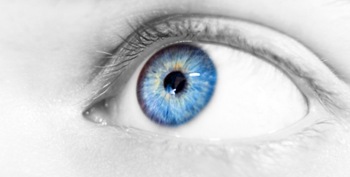
    iStock_000003075935XSmall Researchers at the University of Copenhagen suggest that a mutation that arose around 6,000 to 10,000 years ago was inherited by every individual who has blue eyes (original study here). This mutation, located within an intron in a gene called HERC2, reduces the activity of a neighboring gene called OCA2. The researchers located the same mutation in 155 blue-eyed individuals from Denmark as well as in 5 individuals in Turkey and 2 in Jordan. From ScienceDaily:
    “‘Originally, we all had brown eyes,’ said Professor Eiberg from the Department of Cellular and Molecular Medicine. ‘But a genetic mutation affecting the OCA2 gene in our chromosomes resulted in the creation of a ‘switch,’ which literally ‘turned of’ the ability to produce brown eyes.”

    This is the big question: How do the researchers come to the conclusion that everyone with the blue eye gene is descended from the same blue-eyed individual?

    The researchers make this conclusion because 97% of the blue-eyed individuals in their study had the same set of 13 SNP mutations in the OCA2 and HERC2 genes on chromosome 15. The other 3% differed by only 1 to 3 mutations. The argument goes that if the the rs12913832(G) mutation had happened randomly in populations around the world, then it would have sprung up in different haplotypes (that is, the 13 SNPs in the OCA2 and HERC2 genes would be randomly different amongst those populations). Instead, 97% of blue-eyed people tested have exactly the same SNP haplotype at that particular location, suggesting that the rs12913832(G) mutation only successfully arose once and has spread around the world in conjunction with those 13 SNPs.

    Why are there so many blue-eyed people in the Scandinavia and Baltic areas?

    The authors suggest that there is a positive selective force to select for blue eyes in this region. Theories include “selection for pigmentation traits which include UV expositor causing skin cancer, vitamin D deficiency, and also sexual selection.”

    rs12913832 is tested by 23andMe, SeqWright and deCODEme (from SNPedia).

    More information:

    Genetic Genealogy is SO Mainstream – More Black History Month Events

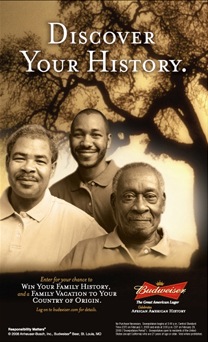
    black_his08In honor of Black History Month, Anheuser-Busch – through the flagship Budweiser brand – announces a sweepstakes called “Discover Your History” in which a grand-prize winner and three guests will be given a trip to “their ancestral background as determined via genetic testing.” Nine other winners will receive “genetic genealogy testing and ancestral family tree research.”

    The testing will be performed by AfricanDNA.com L.L.C., the company founded by Harvard University Professor Henry Louis Gates Jr. in conjunction with Family Tree DNA.

    From Anheuser-Busch’s press release:

    “One of the most basic human desires is to understand who we are and how our family is woven into the broader, historic context of humanity,” said Johnny Furr Jr., vice president, Community Affairs and Supplier Diversity for Anheuser-Busch, Inc. “We at Budweiser are proud to offer a lucky family the chance to embark on this remarkable journey of discovery. We hope to inspire others to use today’s technology to learn about their ancestors and region of origin.”

    In addition to the contest, Anheuser-Busch is also partnering with radio host Michael Baisden to offer 20 additional genetic genealogy tests and complete family tree compilations. To win these tests, listeners must call in during “The Michael Baisden Show” to answer questions about black history. Visit www.michaelbaisden.com for more details. Back to the press release:

    “In total, 30 families will receive priceless information regarding their family history. The genetic testing will be done by AfricanDNA.com LLC, a company founded by Harvard University Professor Henry Louis Gates Jr. His firm aims to use historians and anthropologists to explain which of various genetic possibilities – prompted by DNA traces – is more historically likely. The genealogy investigation works by matching a customer’s DNA to a database of samples collected from Africans living today. The large migrations of African people during the last 3,000 years mean that a contestant’s DNA might share genetic similarities with somebody living today in Ghana, Cameroon, Kenya, Angola, Nigeria or Sierra Leone.”

    I was unable to find the contest rules at either www.michaelbaisden.com or www.budweiser.com, but hopefully they at least note some of the limitations of genetic genealogy tests. I do like the fact, however, that they are offering traditional genealogical research along with the testing. As I’ve always said, genetic genealogy is at its best when it is combined with “old-fashioned” paper trail research.

    Given that I hosted a contest to give away a free genetic genealogy test just a few weeks ago, you could probably guess that I think this is a fun idea. I do wonder, however, how Anheuser-Busch of all companies came up with the idea.

    DNAPrint Genomics to be Acquired by Nanobac Pharmaceuticals

    DNAPrintG GenomeWeb Daily News announced on Friday that DNAPrint Genomics is being purchased by Nanobac Pharmaceuticals (I’ve written about DNAPrint here and here, including about their Doggie DNAPrint product). Here is the press release from Nanobac.

    DNAPrint had a big year in 2007 with a number of partnerships and new products, and many people have forgotten or were unaware that the autosomal genetic genealogical tests offered by DNAPrint’s AncestrybyDNA are just a small part of the company’s business. From the Nanobac press release:

    “DNAG’s primary objective has been, and Nanobac’s primary objective will be, to develop progressive theranostics drugs, which combine extensively modeled drugs with genomics-derived intelligence to create more economical and powerful drug/test combination products with superior performance parameters. DNAG’s flagship product, PT-401, is expected to result in more effective treatment of anemia, and its Protectin(TM) (CD-59) diagnostic test is expected to allow patients and their physicians to more effectively manage the risks and treatment decisions for diabetes. DNAG supports its clinical programs, in part, through the sale of consumer genetics tests genotyping services on a contractual basis.”

    Will DNAPrint/Nanobac continue to offer and develop their autosomal DNA testing products in the face of startups like deCODEme, 23andMe, and SeqWright? I wonder if they’ve seen any decline in business since the launch of these companies. I think DNAPrint/Nanobac will have to implement some type of SNP chip technology to be competitive in this market.

    African American Lives 2

    AAL2 According to some sources, genetic genealogy testing rises considerably during February, which is Black History Month (as I wrote about last February). Part of this might be due to last year’s very popular TV show “African American Lives” on PBS. Starting next week (on the 6th) is the first half of the latest version of the show, “African American Lives 2.” I’ll be watching, and I think most of you will be interested in the show as well.

    In anticipation of this series, Diverse Education has written an article entitled “The Value of Knowing Where You Come From.” The author of this article, Cassie Chew, recently interviewed me and a few of my quotes made it into the article. The article wonders if there is a possible genetic explanation for behaviors that run in families. For instance, one of Oprah’s ancestors appeared to have built a school on his land, and Oprah recently opened a school in South Africa. Is the appreciation of education genetic?

    As I explained to the author, it is possible, but there are also many other possible explanations. For instance, the appreciation of education could have been instilled in the children of each generation by parents, which wouldn’t require any genetic component. Additionally, it is likely that if we looked hard enough we could find an ancestor who exhibited any characteristic we value in ourselves (while we ignore the ancestor who portrayed the opposite of that characteristic!). Scientists just aren’t able to currently identify genetic explanations for almost all human behavior, and the answer will certainly almost never be a gene or two. Our behavior is a very complex mixture of nature and nurture.

    African American Lives 2 will air February 6th and 13th from 9 to 11pm on PBS.