The Genetic Genealogist

Adding DNA to the Genealogist's Toolbox

Archive for November, 2007


The First Personal Genomic Sequencing Test Offered for $985

decodeme.jpg

Today, deCODE genetics announced the launch of their consumer genotyping service, deCODEme. deCODEme is the first personal genomics company to launch, and will provide sequencing information about 1 million SNPs for the introductory price of $985. The service has two components:

1. The genotyping of ~1 million SNPs (single nucleotide polymorphisms, or personal differences in the genetic code), and;

2. A secured website for presenting the data obtained from the sequencing.

The official press release from the parent company deCODE genetics, contains some interesting information about the product:

“Through your subscription to deCODEme, you can learn what your DNA says about your ancestry, your body –traits such as hair and eye color– as well as whether you may have genetic variants that have been associated with higher or lower than average risk of a range of common diseases. This information will be continually updated as new discoveries are made.

“Subscribers will create a secure password-controlled personal account. Just a few weeks after sending in a simple cheek swab, customers will receive expert analysis of more than a million key variants across their genome, accessible through an easy-to-use and intuitive user interface.”

What Does This Mean for Genetic Genealogists?

The SNP chip used by deCODEme – human1M – tests 40,097 loci on the X chromosome, 2,283 on the Y chromosome (if there is one!), and 163 mitochondrial SNPs. The information gleaned from the deCODEme sequencing can be translated into ancestral information. From Nicholas Wade’s New York Times article “Company Offers Genome Assessment“:

“Besides information about disease risk and normal physiology, Decode will also examine the Y chromosome and mitochondrial DNA, the only two elements of the genome that are always passed down essentially unchanged from one generation to the next. SNPs on the Y chromosome reflect the origin of a man’s ancestors back to 50,000 years ago when modern humans first left their ancestral homeland in northeast Africa. Those on the mitochondrial DNA reflect the wanderings of women throughout the globe.”

The deCODEme ancestry page states the following:

“Your DNA has been passed between generations for hundreds of centuries. deCODEme allows you to virtually reconstruct the geographical distribution of your ancestors back hundreds and even thousands of generations. Through an intuitive interface you will be able to view how your mother and father and their ancestors contributed to your genome and how much of your genome is derived from people from Africa, Europe or Asia. We offer a clear and concise analysis of this information with user-friendly explanations and graphics.”

SEQanswers, who has registered for an account and provided a length, information-packed review post, provides the analysis options available on a post-registration landing page:

“These options are “my GENE profile”, “my PHYSICAL attributes”, “my ANCESTRY”, and “COMPAREme”.”

Thus, it appears that deCODEme is planning to translate the results of their genotyping into a easy-to-use format for anyone interested in their genetic genealogy, under “myANCESTRY.”

The Ethical Concerns Associated With Genomic Sequencing

The problem, of course, is that genetic sequencing has the potential to raise numerous ethical concerns. The New York Times article presented the following quote:

“If people can go into this testing knowing what its limits are, and can take it with a grain of salt, that’s fine,” said Angela Trepanier, incoming president of the National Society of Genetic Counselors. “But you have to be really careful about what you know and don’t know.”

deCODE is also careful to state that the assessment should not replace proper medical care:

“Dr. Kari Stefansson, chief executive of Decode Genetics, said the genotyping information his company would provide was not the same as a genetic test. If customers felt they were at particular risk of a disease, they should get a proper test from their physician, he said.”

Also, some State laws prevent elements of the deCODEme process. After registering, the applicant must testify that:

“I am not a citizen of any of the following states: Arizona, California, Connecticut, Georgia, Maryland, Michigan, New Jersey, New York, Rhode Island, and Wyoming.  As a resident of any of the above states, you will not be allowed to use the deCODEme.com genetic risk calculations part of this website, as mentioned in the Genetic Scan customer agreement.”

This could create a problem for people who live in these states and wish to purchase this product.

As with any product that can reveal medically-relevant information, there are also privacy concerns. The deCODEme website does has a lengthy privacy page which addresses some of these concerns.

For More Information:

A webcast of the announcement is available at deCODE’s website. I would recommend spending a few minutes to watch it. In addition to providing useful information, it showed numerous shots of beautiful Iceland.

GenomeWeb Daily News has a story entitled “Decode Throws Hat into Consumer Genomics Ring.”

Forbes has an article at “Personal Genome Race Goes Into Overdrive.”

There’s already a lengthy discussion at RootsWeb’s GENEALOGY-DNA mailing list.

The Wall Street Journal has a blog post at “Decode Me? Personal DNA Sleuthing on a Q-tip.”

Special Upgrade Offer for Relative Genetics Customers

DNA Heritage is offering a special price for former customers of Relative Genetics. The RG Upgrade is

“It is now possible for old customers of Relative Genetics to upgrade from 26 to 43 markers through DNA Heritage. This applies to customers for whom the DNA sample is already on file with Relative Genetics.

The cost for this test is just $75.”

If you were a customer of Relative Genetics and are interested in this opportunity, the upgrade offer is here.

A Genetic Genealogy Book Review

41bz5d08ghl_aa240_.jpg

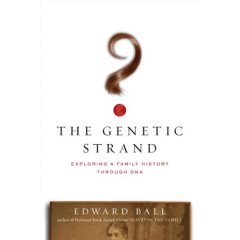
Edward Ball is the author of Slaves in the Family, which won the National Book Award for Nonfiction in 1998. Mr. Ball’s latest book is the subject of this review-by-proxy (I haven’t read it myself, so I’ll be sharing what others have said).

The new book, The Genetic Strand: Exploring a Family History Through DNA, is reported to “intrigue America’s many amateur genealogists and also serve as a cautionary tale.” The book follows Ball’s journey through his family’s genetic genealogy after he discovers locks of hair in an old family desk.

Megan Smolenyak reviewed the book over a week ago at Megan’s Roots World with “The Genetic Strand: Slightly Disappointing.” Megan’s review brings up a number of points, including Ball’s failure to provide some essential information (like his family tree). One of the most interesting critiques, which was also criticized by a review in the New York Post, surrounds the following paragraph:

“Genealogy, a search for family history, is practiced by millions of middle-aged and middle class Americans, for whom it has traditionally been a way to snatch a bit of glory or a helping of a fantasy from the past. It is, after all, the little activities, visiting libraries and surfing Web sites, that allow one to acquire “good genes.” Most people who do family research are white, and most of them look for ancestors with the goal to unearth the whitest, most moneyed forebears they can. That is one definition of good genes.”

That is quite an assertion to make, and one that I have a very difficult time believing. I recommend reading Megan’s review (here), the New York Post review (here), Entertainment Weekly’s review (here), and the Genealogue’s take (here). Megan even suggests another book about genetic genealogy which she found to be very enjoyable. I guess I some reading to do!

Genetic Genealogy in the Classroom

genographic.JPG

Forty advanced placement science students at Soldan International High School in St. Louis have submitted their DNA for testing with the National Geographic Society’s Genographic project. An article in the St. Louis-Post Dispatch highlights some of the statements made by the students and faculty:

“Many times students don’t see the relevance of what they’re learning,” said Assistant Principal Alice Manus, the Soldan project coordinator. “What they’re learning here will have all sorts of relevance because, really, we’re looking into their lives.”

One student, named John, had more reason to be excited about this test than most – his father died when he was only 13. “I never knew him that well,” said the Soldan sophomore. “Maybe this will tell me more about who he was and where he came from.”

I think this is a great way to introduce students to issues associated with genomic sequencing including the science, the societal impact, and the ethical issues. I do wonder, however, how the class afforded the testing. Sometimes companies will offer reduced rate packages to encourage testing. I would hate to think that this sort of project would only be available to affluent communities that can afford the price of the test (even the $99 test at the Genographic project).

Discovering Biology in a Digital World blogged about this yesterday. One of that post’s concerns was how a teacher would deal with potential non-paternal events revealed by the testing. This is definitely a valid concern, although it would be rare since non-paternal events are most often uncovered through comparative genetic genealogy.

I was especially shocked to read the comments at Discovering Biology in a Digital World. A comment left by a Christopher stated that he “had no idea that National Geographic had this Project – or that its actually open to the public as well.” Christoper, don’t you know that there’s an entire blog devoted to genetic genealogy?

Genetic Genealogy Eliminates Two As Descendants of Joseph Smith

Update: Ugo Perego is not affiliated withh the website mentioned in the last two sentences.

Did Joseph Smith father children with any of his plural wives? The Deseret News has a lengthy article about recent efforts by a geneticist to answer the long-debated question about the founder of the Latter Day Saint movement.

Ugo Perego, the director of operations at the Sorenson Molecular Genealogy Foundation, has used genetic genealogy in an attempt to identify or rule out potential descendants of Smith. In 2005, Perego showed that three males were not descendants of Smith, and new testing has shown that two more alleged descendants of Smith are not his true descendants.

In order to rule out descendants, it was first necessary to characterize the Y-DNA thought to belong to Joseph Smith. According to the article:

“Perego has mapped Smith’s DNA by retrieving samples from living descendants of two sons he had with Emma Smith [his first wife] — Joseph Smith III and Alexander Hale Smith. ‘Their Y chromosomes were identical, so we know for 100 percent sure what Joseph Smith’s Y chromosome looked like. We can now use that standard to verify any other alleged sons,’ which he did with those who have been eliminated as possible descendants.”

Interestingly, Perego was able to show that the men (1) were not the descendants of Smith, and (2) were actually descendants of the other men who were married to these wives of Joseph.

I especially like Perego’s motivations for doing this independent project supported by Sorenson:

“As a scientist, I like to look for truth. If there is a book that says this person was Joseph’s son, and I have evidence that’s not right, it’s important for me to offer an alternative explanation from science that people can refer to. New authors in the future can then take that new genetic evidence into consideration.”

Perego has an interesting website describing his efforts.  There is a website that discusses the ongoing DNA research, but Perego is not in any affiliated with that site.

True ‘Roots’ – Update on Chris and Alex Haley’s Y-DNA

The 24-7 Family History Circle has an update on a story I wrote about few weeks ago (Chris and Alex Haley’s DNA). Chris Haley, the nephew of author Alex Haley, recently agreed to submit DNA for a Y-DNA test. Like his uncle, Haley is very interested in genealogy and his ancestry.

According to the article, which was written by Megan Smolenyak Smolenyak, the Haleys were already fairly certain of their ancestry: “to the best of the family’s knowledge, the progenitor of the Haley line was of European origin, not African.” Indeed, the results show that the Haley Y-DNA belongs to Haplogroup R1b, a traditionally European haplogroup. My favorite part of this article, and one that many of my readers might find interesting, are all the suggestions regarding future directions that Haley can take to learn more about his ‘roots’ (sorry, I had to). Interestingly, Haley already has an anonymous 46-marker match in the DNA Ancestry database.

One of Megan’s suggestions is to find other people with the surname that the Haleys believe they might be descended from (Baugh), and trade information. Indeed, there is already a Baugh DNA Project with posted results, which might be a great place to start! This is yet another great example of genetic genealogy’s ability to solve genealogical mysteries when combined with traditional research methods.

In case you missed it, the video from Roots Television of Chris Haley swabbing his cheeks for DNA is hilarious:

chris%20haley%20dna.jpg

Navigenics – A Personal Genomics Start-Up

navigenics.jpg

Last week, the genomic start-up company Navigenics issued a press release introducing their team of advisors and investors, and announcing $25 million in financing. There was an accompanying story in the Wall Street Journal, “Is There a Heart Attack in Your Future?” According to the article, the tests that will eventually be offered by Navigenics have already been tested by at least one of the company’s co-founders:

“David Agus, a cancer researcher at Cedars-Sinai Medical Center in Los Angeles who is a co-founder of the company, says he took the test and found he had a 68% risk of having a heart attack in his lifetime, compared with about 40% in the general population. His kids, he says, now help him stay away from French fries. “I’m a believer in empowerment,” he says.”

David Hamilton at VentureBeat: life sciences covered the press release and the WSJ journal with “Navigenics finally offers you a peek at your genome — except not really, and not yet.” As Hamilton points out, Navigenics is currently “taking pre-orders for the testing service, which will essentially scan your genome for individual DNA ‘letters’ (technically, nucleotides or base pairs) that differ from those in established ‘reference’ genomes.” He also writes:

“Pricing still isn’t final, but the company’s [head of business affairs] DuRoss says an initial registration fee will run around $2,500 and will cover a year of the Navigenics service. Additional years will probably be priced at around $250.”

ScienceRoll has an interesting round-up of Navigenics, 23andMe, and Helix Health. He reviews their websites and their (proposed) services, and creates a wishlist for the three companies. Eye on DNA has a great post as well.

The Genetic Genealogy Market, Part II

market1.JPG

Yesterday, I looked at the size of the Genetic Genealogy market, and concluded that as of November 2007, there had been as many (or perhaps ‘at least’) 600,000 to 700,000 genetic genealogy tests performed, with 80,000 to 100,000 new tests per year. As the footnoteMaven mentioned, it might be interesting to see if we could turn those numbers into dollar amounts.

The following is a very rough attempt to translate the numbers into market value, with the following caveats: (1) I am not an economist, and I haven’t taken an economics class since high school; (2) the numbers do not take into account testing upgrades, which are offered by a number of companies; (3) the numbers do not take into account sequencing of the entire mitochondrial genome, specialized allele tests, or combination tests (e.g. Y-DNA and mtDNA) and; (4) the average cost of testing only reflects the companies included in yesterday’s accounting, and do not include the free SMGF test.

Three averages:

1. Autosomal DNA testing = $333.00 (Range is $184 – $650)

2. Y-DNA testing = $237 (Range is $107.50 – $375)

3. mtDNA testing = $211 (Range is $107.50 – $375)

So, if there have been 600,000 tests, let’s assume that 1/3rd were autosomal, 1/3rd were Y-DNA, and 1/3rd were mtDNA. That works out to $66.6 million for autosomal tests, $47.4 million for Y-DNA tests, and $42.4 million for mtDNA tests. That is a total of $156.2 million, which represents the total value of the market from its beginnings through November 2007.

But how much will the market be worth in 2008? Let’s assume that there will be 100,000 new tests in 2008, and that they will be equally divided among autosomal, Y-DNA, and mtDNA tests. That works out to $11.1 million for autosomal, $7.9 million for Y-DNA, and $7.0 million for mtDNA – a total of $26 million per year.

What do you think? Could the genetic genealogy market really be worth $26 million a year? Do my calculations undervalue the market? And if there are any actual economists out there who might want to comment on my analysis, I’d love to hear your thoughts.

P.S. – Yesterday I received an email from someone who pointed out that many people buy tests from multiple companies, and the 600,000 to 700,000 doesn’t reflect that.  I agree, but given the number of companies that I don’t have numbers for, the numbers are likely to cancel each other out.  Additionally, today’s figures would of course not be affected by buying tests from more than one company.

Feel free to leave a comment below.

How Big is the Genetic Genealogy Market?

market1.JPG

I was recently having a discussion with someone about the size of the genetic testing market, and I mentioned the number of people who had already paid for genetic genealogy testing. This oft-repeated number, 460,000, is the addition of two figures from a short 2006 EMBO article (“Genetic Genealogy Goes Global” EMBO 1072 (2006)):

  1. “Companies such as Oxford Ancestors, Family Tree DNA and DNAPrint Genomics have attracted more than 300,000 customers in the past six years.”
  2. “During the first 15 months of the five-year [Genographic] project, 160,000 people signed on, far more than had been anticipated.”

So, 300,000 + 160,000 = 460,000. A year later, however, these numbers are obsolete and I wanted to bring them as up-to-date as possible. To do this, I took the 2006 EMBO papers and scoured the internet for testing numbers revealed by any of the genetic genealogy testing firms. The results suggest that the current number is much higher than 460,000. My findings are below:

1. Oxford Ancestors, FTDNA, and DNAPrint Genomics = 300,000 up to November 2006. Although I am not certain of the accuracy of this number from the 2006 EMBO article, I decided to use it as a starting point.

2. FTDNA sells 30,000 kits per year as of 2007 (source), so I added 30,000 to represent November 2006 to November 2007.

3. Genographic Project – By October 27th, DNA has been collected from 225,000 individuals, with 1,000 kits sold per week (source), so I added 226,000.

4. African Ancestry – As of May 2007, African Ancestry had tested 10,000 individuals (source), so I added 10,000.

5. Sorenson Genomics – As of 2006, the company had sold 1,500 testing kits in Asia through affiliates (source), so I added 1,500.

6. Genomac in Prague – As of June 2007, this company had tested 5,000 individuals (source), so I added 5,000.

7. Relative Genetics – As of 2002, this company had 19,000 genetic genealogy sequences in its database (source). I’m not sure if they were all from customers, and I’m not sure how much growth they experienced in the intervening 5 years. Thus, to be conservative, I added just 19,000.

8. I wasn’t sure whether or not to add SMGF, which as of 2006 had collected over 60,000 DNA samples and genealogical charts (source). This would not reflect a paid part of the market, but might represent people who would be interested in further genetic genealogy testing.

In conclusion, given the numbers revealed from the above sources in addition to the traditional figure of 460,000, there have been at least 591,500 kits sold and/or DNA samples tested. If I add in the SMGF numbers, it rises to 651,500. Given my research, I believe that if the 300,000 number from the EMBO article is correct, the number of people who have undergone genetic genealogy testing might be as high as 600,000 to 700,000 people. Additionally, this number appears to be growing by as much as 80,000 to 100,000 per year. My confidence is these numbers is boosted by the fact that I do not have information for a number of companies that offer genetic genealogy testing. As the interest in genetic genealogy grows, I predict that the 1 millionth genetic genealogy customer will push the “buy” button as early as 2009.

Carnival of Genealogy, 35th Edition

Welcome to the November 4, 2007 edition of the Carnival of Genealogy. The topic for this edition was actually more of a question… Do you have a family mystery that might be solved by DNA? I offered to analyze a submitted post for questions or family mysteries that might be solved using genetic genealogy. There were a number of interesting and challenging articles, and everyone kept me very busy! If you’ve ever considered using DNA to analyze your ancestry, you’ll want to read all the way through this Carnival!

I wanted to start off with a post from the footnoteMaven entitled “Ask The Genetic Genealogist.” In the post, she refers to me as “Dr. DNA” – I could really get used to that! The footnoteMaven has a cousin on her father’s side who was recently diagnosed as having sickle cell trait. Sickle cell is caused by any one of a number of identified mutations of the hemoglobin gene on chromosome 11. Sickle cell trait means that the cousin has one good copy of the hemoglobin gene and one bad copy – one from each parent. Since this is autosomal DNA, the traditional tool of genetic genealogy, Y-DNA and mtDNA tests, won’t be of much help. There are a number of DNA testing companies that will sequence the hemoglobin gene to check for mutations, but testing your cousin’s siblings won’t reveal which parent had the mutated gene. It would be best to test the parents, but they have passed away. Unfortunately, answering your mystery would most likely be very expensive and time-consuming, at least at the current stage of technology. In 5 to 10 years, as whole genome sequencing becomes cheaper, it might be a much easier project. There are some autosomal genealogy tests which purport to reveal ancestral origins (such as Africa, Europe, Asia, etc..), but this would not reveal any information about the source of the mutated hemoglobin gene.

The next article is from Taneya’s Genealogy Blog, entitled “Can Kalonji get his Sons of Confederacy Membership? Maybe DNA can help!” This is her first carnival submission! Taneya’s husband, a McClellan descendant, wants his Sons of Confederacy membership by identifying his great-grandfather’s family. Taneya has a theory that her husband’s great-grandfather, Champ McClellan, is actually a son of a white McClellan and is thus a member of the family of the Confederate soldier General William Blount McClellan. Lucky for me, Taneya has done all her DNA homework. Since her husband is descended from one of Champ’s daughters, they have identified a male cousin who will undergo Y-DNA testing. Then, they hope to compare the results to a male descendant of General William B. McClellan (which they are looking to recruit). This type of project has been done successfully a number of times. Although the results are not definitive, they can be a great addition to the paper search. I would recommend that the McClellans who are tested join the McClellan DNA Project at Family Tree DNA, which has at least one McClellan participant from Tennessee.

Now on to “Ancestral clues from DNA studies” from Genea-Musings. I’ve enjoyed Randy Seaver’s previous discussions of DNA testing, some of which he links to in this post. Randy has identified possible DNA testing that he would be interested in doing. I really like his idea of listing the people in his tree with whom each test would match. This would be a great exercise for anyone who is new to genetic genealogy – if you were to test your mtDNA, who else in your family tree has or had that same mtDNA? My favorite quote is the following: “Once you start thinking about the possibilities, and actually identifying potential cousins that could be tested, there are many more than two lines [who can be tested].” This is a great point, and one that the media ALWAYS overlooks. Although a Y-DNA test only reveals a tiny portion of your ancestry, why stop with a single Y-DNA test? Why not test your other male lines? Randy points out that this has its own challenges (extensive paper trail research, finding people who will undergo testing, finding someone to pay for it!), but it can be well worth the effort.

In “Mary Todd Lincoln’s Bloody Cloak”, the footnoteMaven writes about sources of Abraham Lincoln’s DNA, including a lock of his hair, and blood on the cloak allegedly worn by his wife, Mary Todd Lincoln, on the night of his assassination. The cloak is currently at the center of a controversy – it is owned by the Chicago Historical Society, but there are many questions surrounding it. footnoteMaven asks “while the cloak belongs to the Historical Society, does the DNA on the cloak? Do the results of DNA testing belong to the Society, the public, Lincoln ancestors, or to history?” She goes on to write about some of the other ethical issues associated with DNA testing of the dead and offers source material for further reading. This issues will only become more important as the technology grows, so I think it is very important that we all discuss them now, rather than later.

Lisa at A light that shines again writes “Mr. Tierney, I presume?” Lisa writes a nice little review of Y-DNA testing and offers a number of links for Irish DNA projects, both mtDNA and Y-DNA. My favorite part is the following quote: “No, DNA won’t give me the joy that I’ve received when I’ve found a photo of an ancestor, or discovered an ancestor’s previously unknown given name on a document, but it can provide information about deeper family heritage in ways that were not possible just short years ago.”

Janice at Cow Hampshire commiserates about the difficulty of some surname research in “Yanking the LONG New Hampshire DNA Chain.” Many surnames, such as Long, were so common in certain regions of the early country that genealogical research is incredibly challenging. As Janice writes, “the use of DNA studies as part of surname projects are quickly becoming the method of choice to resolve genealogical roadblocks,” There are many success stories as a result of DNA research, and undoubtedly many more to come as more people are tested, and especially as the technology develops. Janice also provides a number of links to other surname DNA projects.

The Smoky Mountain Family Historian writes about “DNA and Genealogy.” Lori writes about the inability of the results from her brother’s Y-DNA test to break through her Thornton brick wall. My suggestions would be to join the Thornton DNA Project, which has almost 50 participants, if you haven’t already. I see there are a number of participants in the Carolinas. Lori also writes about her interest in mtDNA testing. She asks whether she should ask her mother to be tested, or whether she can be tested. Since children inherit their mother’s mtDNA, you can submit DNA for this test – no need to ask your mother! Lori also wonders “how likely I would be to determine that there is or is not Native American heritage in the matrilineal line with the mtDNA tests.” The results of your mtDNA test will be very strong evidence for or against Native American heritage in your direct mtDNA line. My own test, for example, unexpectedly revealed that my mtDNA belongs to Haplogroup A2, a Native American haplogroup. Note, however, that if the mtDNA belongs to another haplogroup, that does NOT mean that the ancestor was not Native American – it simply means that their ancient maternal line was not Native American. And to answer the final question, almost any mtDNA test (including the least expensive ones!) will place the DNA into a particular haplogroup and thus reveal whether or not it is of Native American origin. Good luck!

Colleen at The Oracle of OMcHodoy writes about “Naming Patterns of a Different Kind” and the multiple appearances of certain surnames in her family tree. I think many genealogists have experienced this phenomenon – finding a surname repeated once, or twice, or more in completely separate branches of the tree. Sometimes this is due to location, but often it can occur with a distance of hundreds of years and thousands of miles. Colleen wonders “if DNA testing could determine if there are in fact any connections between these like-named families.” DNA testing, if you were able to identify descendants from each line who were willing to undergo testing, would surely present strong evidence either for or against a potential relationship. If they match, there is a likelihood they are related – the degree of the match will suggest how closely they are related (within the last 5 generations, or the last 20 generations, for example). If they don’t match, then that ends that particular inquiry. It is interesting to note that there are Tighe, Williams, and McHugh DNA Projects which might further add to your understanding. Actually, this brings up another important point – search Surname Projects, because your ancestor’s DNA might already be tested!!

Next is Apple at Apple’s Tree, who asks “Will DNA Solve My Mysteries?” Apple first looks to her mtDNA and is correct when she concludes that the results will not identify her great-grandmother’s mother. That will only happen in conjunction with traditional paper trail research. However, I would add that the information might still be valuable. My own mtDNA testing, for instance, did not reveal the mother of Sarah Bodden, the dead-end in my maternal line. The test did reveal that Sarah Bodden’s mother was of Native American descent (her mtDNA belonged to Haplogroup A), which was 100% more information than I had previously. Apple then turns to her father’s Y-DNA, which was of the surname Berry. I have good news for Apple – there already is a Berry Family DNA Project, with over 100 participants, which might help her break through her brick wall! Apple’s third family mystery is her gr-gr-gr-grandfather William Wisner, who might descend from Ananias Wisner. Apple is absolutely correct when she concludes that comparing William’s Y-DNA to Ananias’ Y-DNA might support her hypothesis, although it will not be 100% conclusive proof of ancestry – rather, it will be conclusive proof of some relationship between the two. DNA is always best when used in conjunction with traditional genealogical research. Apple’s fourth and final mystery is whether DNA testing can be used to identify the surname of her ADOPTED gr-gr-grandfather, Michael Camfield. Again, I have great news for Apple. There are a number of Y-DNA databases that contain DNA results in conjunction with surnames. By plugging in the results of Michael’s Y-DNA, you might find matches that will provide clues to his actual surname. This method has even been used to identify sperm donors! There is Ysearch, Ybase, and SMGF, just to name a few. Good luck!

Lee at The I Seek Dead People Blog asks, “Was Grandma stepping out, or what?” In the post, he writes about one of the most challenging branches in his tree, the TURNER branch. Lee recently asked his uncle, a Turner, to submit DNA for a Y-DNA test. Unfortunately, the results were a complete surprise, and the Y-DNA matched another surname entirely. Although this represents a set-back, it also presents the opportunity to re-examine a paper trail for further clues. Was there ever a MILLS who lived next door? A Mills relative who might have left behind a young child to be adopted? As Lee writes, “Now that I’ve recovered from the initial shock, my next step is to thoroughly examine the information our newly discovered cousins have been kind enough to share. Although at first glance, our two families appear to have nothing in common, not even a location, further study could find the answer lurking in there somewhere. And after that…well…I simply don’t know.” I wish you the best of luck in your hunt. And thank you for one of best blog post titles in today’s Carnival!

John at Transylvanian Dutch asks “Can DNA solve these mysteries?” John’s first family mystery is the family legend that his mother’s mother’s mother’s mother – Sarah Hartley – was Native American. As John points out, an mtDNA test might reveal Native American ancestry, IF Sarah’s mother’s mother’s, etc. was of Native American descent. Additionally, John is correct when he states that even if the test comes back negative for Native American mtDNA, that doesn’t mean that Sarah was Native American; that ancestry could have come from either her father or her mother, but not from Sarah’s ancient maternal line. If John had the time and inclination (and money!), he could attempt to trace DNA from some of Sarah’s other ancestry, such as Y-DNA from her father. John’s second family mystery involves identifying siblings of an immigrant ancestor. Unfortunately, neither the tentative brother nor the sister (of course) have any male descendants who could submit their Y-DNA for testing. Under the current facts, mtDNA won’t be of any assistance either. Proving the relationships can’t be done with DNA, but good luck with your research!

The next question comes from Jessica’s Genejournal, entitled “Not Sure if DNA testing would help me…” Jessica’s question is very broad, but I’ll attempt to answer it as clearly as possible. She asks if DNA testing could be used to determine the parents of an ancestor, assuming that there is a male or female line that is available for testing. Taken alone, the results of a DNA test will not identify anyone – the results are just a series of numbers and letters. However, DNA can work wonders when it is compared to other DNA. For example, if traditional genealogical research has identified an ancestor’s potential parents, find a descendant and have them tested to compare to your ancestor’s DNA. If it’s a match, then your hypothesis is supported. If not, then it’s time to do more testing and more research (always keeping in mind the possibility of non-paternal events in any DNA line). The great thing about this technique is that it can be used for many generations – I’ve seen connections made as far back as the 1500’s.

Jasia at Creative Gene asks “Can DNA Testing Solve This Mystery For Me?” Although Jasia’s ancestry is exclusively Polish, she’s always wondered about a distinctly non-Polish surname in her tree – Killian – which is traditionally an Irish or German surname. She asks whether or not she can “determine if this Killian surname in my family is Irish or German in origin?” It is important to note that testing the mtDNA of your Killian ancestor will trace the maternal line of the ancestor, and not the surname line. To trace the surname, you will want to find a male descendant of this Killian family. That being said, you never know what information will be revealed my mtDNA testing. The results might match another person who has done extensive research on the family but hasn’t posted it online. Or, five years from now, a distant Killian relative might post their mtDNA results and find you in the mtDNA databases. There is also a small Killian Surname Group, although it is for Y-DNA and they are looking for descendants of German Killians. Even so, matching or not matching this family might provide further information. Good luck!

Although there is not a traditional genetic genealogy component in “An Investment in Life and the Family Orchard” from Wisdom from Wenchypoo’s Mental Wastebasket, there are a number of interesting points. First, as science learns more and more about the connections between DNA and disease, it is a good idea for everyone to “Gather all the health information you can about your relatives at least three generations back. Find out who is allergic to what, who has what disease, who has what deformity, and find out where THEIR problems came from.” Also, Wenchypoo suggests that we “Assemble a health scrapbook or CD-ROM if you have to, so it can be handed down for future generations to add their own health information to it.” Good advice.

Thomas at Destination: Austin Family writes about all those familiar family quirks that cannot be or should not be explained in “What DNA Can’t Explain in My Family Tree.” As Thomas points out, future DNA research will undoubtedly provide answers to many of our family quirks. But do we really want to know? He says: “There are many mysteries in my family tree that may, some day, be solved by DNA testing, but I’m not sure I want that. Some mysteries should remain mysteries – those things that make us think about relatives we know or used to know, their quirks, their eccentricities. When you recognize these “traits,” if you can call them that, and how they seem to run in the family, they are what make my research engaging and the subjects seem so much more than a collection of birth dates, death dates and the like.” Although DNA might contain the answers to many of these eccentricities, hopefully we will all be able to decide whether or not we want to learn those answers.

Next, Lisa at 100 Years in America writes “100 Years in America: A rose by any other name…” She wonders if the ancestry of her Ujlaki ancestors, who lived in what is now northern Croatia on the border with Hungary, can be identified using DNA. “Were they true Croatian Slavs? Or did they hail from the Hungarian Magyar tribe?” “How specific can genetic tests get with regard to origins – Western European vs. Eastern European, Croatian vs. Hungarian vs. Austrian?” These are great questions, Lisa. Unless you have DNA samples from your ancestors, their autosomal DNA has been jumbled around considerably in the intervening generations, making autosomal testing almost impossible at the current stage of technology. Y-DNA and mtDNA tests, on the other hand, could be useful. Although these tests do not reveal the specific location of a surname on a map, the results can be compared to others who have paper trails that place them on the map. Often, very similar results will be found in close proximity geographically. The results can serve as an additional source of information to support the all-important paper trail research. Lisa also asks, “When a surname is so uncommon (like Ujlaki) what are the chances that I might find someone else interested in a project for that name? Is it worth the time and money for someone with a relatively rare surname to participate in a genetic surname project?” I suppose I’m biased – I have a rare last name, and I’ve started my own surname project. So far, there’s only one member (me). But I think it’s worthwhile – at some point, someone else with my name will be tested and will join the group.

Lisa at Small-leaved Shamrock writes “Bad genes – discovered!” Lisa recently uncovered some documents about her gr-gr-gr-uncle at the National Archives and learned that he suffered from troublesome varicose veins, which seems to be “nothing new to Cowhey descendants.” Her question for me is: “Knowing that you descend from a family with a certain type of ailment (whether it is varicose veins, more serious heart problems, a type of cancer, etc.), what are your options with regard to knowing what the chances are that you have inherited the wrong family gene?” Great question! Unfortunately, it appears that there is currently no DNA test for varicose veins, and even knowing the answer would likely not be beneficial if there is no preventative treatment. However, with the advent of inexpensive whole-genome sequencing, these types of questions will soon have much more definitive answers. Hold onto this question – in five to ten years this mystery will be much easier to explore.

Next is “Can DNA Analysis Confirm My Ancestry?” at Steve’s Genealogy Blog. Steve provides an excellent review of using Y-DNA to solve a mystery. He has done extensive paper trail research to identify his maternal grandfather’s ancestor, and now wants to use Y-DNA testing to support his hypothesis. He has identified a male relative in his family (two uncles and a cousin) who can provide the necessary Y-DNA (remember that it was his maternal grandfather), and now must identify and find a Y-DNA descendant of the hypothetical ancestor (who had one son and NINE grandsons – you hit the jackpot there!). Steve states: “If the DNA samples from the two lines match, I would have confirmation that the proposed lineage could be correct. If the DNA samples from the two lines don’t match, I would have confirmation that the proposed lineage is most likely incorrect.” Great job Steve, and good luck finding the Y-DNA!

At GeneaBlogie, Craig asks “Can DNA Solve ‘The Lumbee Problem?’” More specifically, he asks: “How does a group of people who have American Indian ancestry but no records of treaties, reservations, Native language, or peculiarly “Indian” customs come to be accepted–socially and legally–as Indians?” The Lumbee are a group of people in North Carolina are might be descendants of Native Americans and the survivors of the Lost Colony of North Carolina. The federal government has never recognized the Lumbee as Native Americans. Since Craig has ancestors who might be of Lumbee descent, he wonders if DNA can suggest a link to the Lumbee. The good news is that there is already a Lumbee Tribe DNA Project that is hoping to learn more about the group’s ancestry. There is also the Lost Colony DNA Project, which is a new effort to discover the fate of the Lost Colony residents. This project is looking for participants who are Lumbee descendants, or have specific surnames. Given this extensive DNA exploration into a such a small group of individuals, this is wonderful opportunity for anyone who might have genetic connections to the Lumbee or Lost Colony surnames.

Now, how about a little genetic genealogy ethics lesson?

The footnoteMaven starts us off with an ‘ethics fairytale” at “Little Red Genetic Hood.” Even if Little Red Genetic Hood has the ability to stop by her great-great-great-grandmother’s house and test her mtDNA, should she do so? The Big Bad Ethics Wolf isn’t so sure!

In another post with a great title, Terry at Hill Country of Monroe County, Mississippi asks “Are human males obsolete? Did g-g-g-grandmother have an “encounter” with the milkman?” He writes: “My question concerns not a specific genealogical case involving DNA studies, but rather concerns a larger issue of bio-ethics and related topics.” I think I could probably spend hours addressing Terry’s concerns. And I say ‘addressing’ because I’m not sure there are any definite answers to the issues he raises. So here are my thoughts on a few of the topics. First, “does greater emphasis on genetic testing erode the traditional nuclear family and, with that erosion, further reduce family values?” It’s true that our genomes hold secrets, both new and old, and revealing those secrets can sometimes have unintended consequences. However, I would argue that for most people, especially genealogists, finding unexpected DNA results are much like finding an unexpected paper trail result. It can be surprising, but my ancestry is my ancestry, regardless of what I expect it to be. Along the same line, my family is my family, regardless of what I thought it was. Of course, not everyone will feel this way. Second, “will romantic love be replaced with genetic breeding based upon the DNA code and Mendelian genetics?” I think it’s a possibility, either for right or for wrong. It will be a rough fight between individual rights and the ethics of society. If I can choose my child’s genetic attributes, should society be allowed to stop me? On the other hand, do we as a society want to allow this type of genetic picking and choosing? And Terry’s third question is “just because we can do something, should we? Is “knowing” so important that we need to turn to DNA testing to determine which of our great-great-great-grandmothers had a brief encounter with some stray DNA?” To this I would say that information isn’t dangerous – with any new technology comes new information. The real danger comes from what we do with that information.

So that’s it. I hope everyone enjoys the Carnival, and finds some useful information. I would caution that nothing herein is provided as medical or legal advice – it is merely a discussion of the possibilities and potential uses of genetic genealogy and personal genomics.

Call for Submissions. The next edition of the Carnival of Genealogy will be a “carousel” edition. Just like carousels have a variety of animal figures on the ride so too will the next edition of the COG have different topics. All topics (genealogy-related of course!) are welcome. Submit any article you’d like. This edition will be hosted by Jasia on the Creative Gene blog. The deadline for submissions is November 15.

Please submit your blog article to the next edition of the Carnival of Genealogy using our carnival submission form. Past posts and future hosts can be found on our blog carnival index page.