The Genetic Genealogist

Adding DNA to the Genealogist's Toolbox

Archive for October, 2007


First 60 Minutes, Now Scientific Journals – Genetic Genealogy in Today’s Science

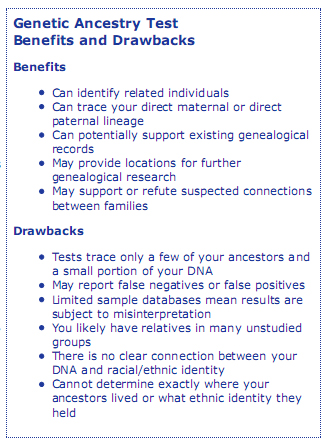
Today’s issue of Science contains a new look into the world of genetic genealogy. “The Science and Business of Genetic Ancestry Testing“, led by researchers at the University of Texas at Austin, examines the benefits and drawbacks of genetic genealogy. Here is a table summary of the researcher’s conclusions:
science.JPG

Table from: “Deep Roots”” at www.utexas.edu/features/2007/ancestry/.

One interesting fact from the article is that the number of people who have purchased genetic genealogy tests is estimated to be over 460,000! If you would like to read more about this study, there are a number of other sources of information, including a press release from The University of Texas at Austin, where the first author, Deborah A. Bolnick, is assistant professor of anthropology. There is also a feature story at The University of Texas’ website. In this feature story, Dr. Bolnick states:


“Your DNA is just one of many tools that you can use to confirm what you know, or find out something new about your ancient heritage,” Bolnick adds. “It’s fascinating that our cells contain information about our history, but we shouldn’t privilege genetic data over our personal, cultural experiences.”

Although I applaud the study’s effort to recognize and highlight the positive uses for genetic genealogy, and I respect the authors and the work that they did, there’s nothing new here. The most well-stated and concise reaction to the (oft-repeated) assertion that genetic genealogy has limitations recently came from Megan Smolenyak, one of the most experienced and knowledgeable participants in this field:

“Since I’ve been watching this same formula repeat itself since 2001, I’ve developed a pet peeve about the built-in, patronizing assumption that genealogists are too dense to understand the fundamentals of what DNA can and can’t do — rather than the reality that we’re pioneers delighted with the prospect of learning what had previously been unknowable and well aware of the limitations.”

Genetic genealogy DOES have significant limitations and it IS vastly important to inform customers about them, but it is also important to recognize that many many genetic genealogists embrace these tests in full knowledge of the limitations. Our personal experiences, oral memories, and written documents can only reveal a small part of our ancestral history. Genetic genealogy, as the vast majority of individuals recognize, adds another small piece to the ancestral puzzle.

Again, let me reiterate that the more consumer education there is the better. There is no such thing as too much consumer education, and a number of the genetic genealogy companies could do quite a bit more to educate their customers before and after a test is purchased and run. I do wonder, however, about some of their conclusions about the dangers of a mis- or un-informed consumer base. First, they hypothesize that test-takers may change how they report their ethnicity on governmental forms or other applications, making it more difficult to track the social effects of race. Second, they state that “attitudes toward genetic research could change” and “support for molecular and anthropological genetics might decrease”, while “historically disadvantaged communities might increase their distrust of the scientific establishment.”

My concern is that they are significantly overstating the potential effects of an uninformed customer base. Let’s look at the numbers – Assuming for the sake of easy calculations that every single one of the 460,000 people who have experimented with genetic genealogy were in the United States, this would only be 0.15% of the population. Additionally, I would posit that a majority of participants are happy with the experience. So now we’re talking far less than 0.15% of the U.S. population who might adversely impact the field of genetics because of genetic genealogy. Although genetic genealogists are an active and vocal bunch, I don’t think they have the power to make the changes the researchers enumerate. If there were that many participants, and if they had that much leverage as a group, maybe I would get more visitors to my blog!

On the contrary, I believe that genetic genealogists ADVANCE the field of genetics.

Genetic genealogists embraced genetic testing long before it was the norm, before the exploding fields of personal genomics or personalized medicine. Genetic genealogists have created listserves and mailing lists to further their understanding and promote the field; they have funded, authored, and published their own scientific and statistical studies which have added to human genetic knowledge; they have published books to help others understand the science, the limitations, and the benefits; some have even started blogs.

Genetic genealogists are genetic pioneers. Most of us understand the limitations of the science, and thank our DNA for the opportunity to peek into our past.

HT: Dienekes’ Anthropology Blog

DNAPrint and Bioserve – 600,000 Genetic Genealogy Tests

Genome Technology Online mentioned the new partnership between DNAPrint Genomics, Inc. and BioServe, a company that offers “the Global Repository®, a growing library of over 600,000 human DNA, tissue and serum samples linked to detailed clinical and demographic data from 140,000 consented and anonymized patients from four continents.”

As part of the partnership, DNAPrint will analyze the 600,000 human samples in the Global Repository using the ANCESTRYbyDNA test. According to Richard Gabriel, the CEO and President of DNAPrint Genomics:

“By removing the question of ancestry from a clinical sample researchers can more readily evaluate which medicines will produce side effects within certain ethnic groups, and which medicines will work for the widest spectrum of a population.”

The CEO of BioServe, Dr. Kevin Krenitsky, stated in the press release that “now that we are able to add the genetic ancestry component to our samples, a new layer of sample data quality and analysis can be provided that was not previously available to researchers.”

An order of 600,000 ANCESTRYbyDNA tests will be quite a boon for DNAPrint Genomics, which has been actively seeking markets other than traditional genetic genealogy consumers. And it is possible that this initiative will create a demand for this type of data in many more studies of biological samples.

DNAAncestry.com Review

dna_logo.gif

Tim Agazio at Genealogy Reviews Online presents the first post in a series that will review the genetic genealogy testing process at DNAAncestry. In this first installment, Tim discusses the website, the tests offered, and the ease of ordering.

I will actually be doing a similar review in the near future, as I’ve ordered a test from DNAAncestry for my maternal grandfather’s Y-chromosome. Since he unfortunately passed away in 1983, it will be a great opportunity to talk about finding other alternatives, finding other people with the same surname, and joining surname projects – in addition to other questions often asked about genetic genealogy. If there is anything you’d like me to highlight in this process, please leave a comment and I will do my best to address it!

So, if you’re interested in getting a first-hand look at the process, stay tuned to The Genetic Genealogist, and to Tim at Genealogy Reviews Online. Since Tim and I are both members of The Genealogists, one easy way to ensure you never miss a post is to subscribe to The Genealogists’ feed!

Other recent developments related to DNA Ancestry:

1. DNA Ancestry is now public and out of beta. The original press release is here, and there’s been some chatter around the blogosphere (The Ancestry.com blog, The Chicago Sun-Times).

2. According to TechCrunch, “Spectrum Equity Investors has led a $300 million investment to acquire majority interest in Provo Utah-based The Generations Network (the parent company of Ancestry.com, MyFamily.com and other sites) according to a source with knowledge of the deal.” According to this unnamed source, TGN is highly profitable and had 8.2 million unique worldwide visitors in August.

DNA Direct Now Offers Genetic Genealogy Testing

dnadirect.gif

DNA Direct, a direct-to-consumer genetic testing company, has just announced the addition of Ancestry and Ethnicity DNA testing to their suite of products.

One of the best things about this offering is the FIND tool. FIND is a way to identify the type of DNA test that best suits the customer’s need(s). Through a series of very simple questions that guide the user step-by-step, the tool helps him or her decide between ethnicity tests, Y-DNA tests, or mtDNA tests. I had fun just playing around with it.

The company also provides information about genetic genealogy, including “How DNA Reveals Ancestry,” “Who’s Using Ancestry & Ethnicity Tests,” and “DNA Testing Resources“, just to name a few. There are some great sources of information listed on the DNA Testing Resources page, and at least one AMAZING resource, if I do say so myself!

DNA Direct is partnering with Ancestry.com to offer Y-DNA and mtDNA tests, and with DNAPrint Genomics to offer the autosomal tests. For more information about this announcement, see Eye On DNA – Hsien was one of the organizers of this new project at DNA Direct.

To Sequence or Not to Sequence – That is the Question

tgg3.JPG

An article appearing Sunday at Bloomberg.com, “Cheap, Detailed Genetic Testing Might Soon Be Ready for Market“, highlights some of the recent developments in DNA sequencing. The article is a response to three studies published yesterday at Nature Methods (available here, here, and here) which reportedly “explore cheap technologies to decipher and analyze individual patients’ DNA by allowing researchers to quickly find the small portions of the human genome that make protein and describe them, while discarding irrelevant data.”

According to the author of the Bloomberg article, “complete” DNA sequencing for as little as $300 could be ready within months. Although it is unclear what the author means by “complete”, it is entirely foreseeable that SNP testing will soon be available for a reasonable price.

All this leads to the question which is so hotly debated in the blogosphere – if inefficient sequencing becomes available to the average consumer, should they get their genome sequenced?

As the article points out, there are already around 1,000 different DNA sequencing tests which range in price from $200 to $3,000. However, Cathy Wicklund, the president of the National Society of Genetic Counselors, believes that people should “think hard before asking for complete genome testing”:

“Just because we have the technology doesn’t necessarily mean that we should jump to offer it,” she said. “Consumers should ask themselves, `What is this going to tell me, is it going to give me information that’s helpful right now?’ “

There are a number of strong voices in this arena, others who believe that genomic sequencing without further extensive studies that link genotype and phenotype is useless and potentially harmful to any consumer who does not have a strong genetics background. Although I respect this position, I believe that attempting to ward people away from genomic sequencing will prove to be ineffective. Genetics is about to leave the hands of the medical professional, and there’s nothing we can (or perhaps should) do about it.

Fortunately or unfortunately, the wave is coming. In just months or a few short years, anyone will be able to open an envelope or log into a website and see their entire genomic sequence, from the very first nucleotide to the very last. Thus the question is not whether people should get their genome sequenced – because they invariably will – but rather what can be done to educate consumers. With a background in genetics, I know better than many consumers all the dangers that my genetic sequence will reveal. But I’ll still be ready to swab my cheeks the instant I can afford a complete genomic sequence.

Is there really no proper place for the average non-geneticist, non-physician-assisted consumer in the whole genome market? What if I can’t afford a genetic specialist – should I be denied the opportunity to sequence my genome? What if my health insurer refuses to pay for genetic sequencing? Should only the knowledgeable or the rich be allowed to learn more about their genes?

I would argue that there is a place for the “early consumer.” Early consumers are the pioneers, the curious who do something because it is new and exciting and they want to learn more about the technology and about themselves. For instance, there are so many people that get into genetic genealogy even though they don’t know the first thing about genetics. When they get their results back, they do what the human mind was designed to do – they go out and attempt to learn more (and helping educate them is exactly why I started The Genetic Genealogist in the first place). Luckily, there are already others who are leading the consumer education front.

All new technology comes with risks. Even genetic genealogy, the sequencing of a few SNPs or a few 100 base pairs, can reveal unexpected or unwanted results. But should the risks really cause so much fear and caution? We are who we are regardless of whether or not we get sequenced. Sequencing just arms us with information that could, now or in the future, be useful. For me, the benefits far outweigh the risks.

In my opinion, the answer is to educate, educate, educate. Convincing people that their genome is scary or useless will dissuade very few from sequencing and will likely only alienate the pioneers.

More Genetic Genealogy in the News!

image-4.JPG

I was being completely serious yesterday. I can barely keep up with all the genetic genealogy in the news, so here’s yet another round-up of the all the latest:

Sorenson Genomics is everywhere in the news. For example, a recent article in the Daily Herald discusses Scott Woodward’s love of genetics. Woodward is the Director and Chief Scientific Officer of the Sorenson Molecular Genealogy Foundation. Megan Smolenyak wrote about this article at Megan’s Roots World. Sorenson also announced that it will merge the Identigene and GeneTree DNA testing units (HT: Genome Technology Online).

Jasia at Creative Gene discusses some of the financial costs associated with genetic genealogy. It appears that this will be a series of posts, and I’m very interested to see how the costs compare to traditional genealogical research. Note that Creative Gene is a member of The Genealogists, a Feedburner Network of some of today’s best genealogical blogs.

DNA Decoding Maps Mainstream Future” is an article from the Wall Street Journal that analysizes the stiff competition for the $10,000, or $1000, or even the $100 genome. Four major contenders are identified, including “Illumina Inc., of San Diego; Applera Corp.’s Applied Biosystems unit in Foster City, Calif.; Roche Holding AG’s 454 Life Sciences in Branford, Conn.; and Helicos BioSciences Corp., of Cambridge, Mass.” (HT: Scienceroll):

“It currently costs between $300,000 and $3 million to sequence a genome. But with better chemicals and faster computers, the companies say, the cost will fall to $10,000 within a few years.”

Hsien at Eye On DNA has a podcast of Dr. George Church in “Futures in Biotech.” As you know, Dr. Church is the head of the Personal Genome Project, and one of the “First 10.”

Scot to Bring DNA From Russia With Lermentov” is an article from scotsman.com which discusses Bryan Sykes’ plan to prove a link between Scots with the surname Learmonth, and Russians with the surname Lermentov. According to Sykes, up to 250,000 Russians may have Scottish blood:

“Russia now has thousands of Lermontovs. The Lermontov Society, founded 15 years ago, believes they are descended from George Learmonth, a Scottish adventurer who fought for the Poles but was captured by Russian forces in the late 17th century. As a mercenary soldier, he swapped sides and decided to stay on in Russia, where he married and started a family.

The Learmonth heraldic crest, first registered in Scotland in 1672, has very similar characteristics to the Lermontov crest, which first appeared in 1782. George’s descendants are likely to have changed their name to fit in with Russian society.”

A very interesting article, and yet another example of using genetic genealogy to answer real-life historical questions. (HT: Hsien).

So there you are, all the latest news in genetic genealogy!

Genetic Genealogy In the News

image3.JPG
There is so much information about genetic genealogy in the news right now that I am having a hard time keeping up. That, of course, is good news. So here is a round-up of some of the best from the web:

Seeking Columbus’s Origins, With a Swab” is an article in today’s New York Times (HT: Liz). Scientists and genetic genealogists hope to use Y-DNA to compare DNA that might be Columbus’s to modern-day people with a related surname.

Genetic Genealogy Mildly Hot” is a post by Hsien at Eye On DNA that explains why “family tree dna” was one of the top 100 searches at Google Trends yesterday. Got a guess?

In “60 Minutes on DNA: Deja Vu All Over Again“, Megan Smolenyak looks at Sunday’s 60 Minutes segment about genetic genealogy. It’s a brilliant post, especially with the following sentence:

“Since I’ve been watching this same formula repeat itself since 2001, I’ve developed a pet peeve about the built-in, patronizing assumption that genealogists are too dense to understand the fundamentals of what DNA can and can’t do — rather than the reality that we’re pioneers delighted with the prospect of learning what had previously been unknowable and well aware of the limitations.”

We’re pioneers, people! If there is anyone being tested who doesn’t understand the limitations of genetic genealogy, then they’re not reading The Genetic Genealogist, or Megan’s Roots World.

There’s some new information about 23andMe’s latest round of venture capital funding.

Genomics: The Personal Side of Genomics” is a round-up by Nature of some of the latest innovations in DNA sequencing. A nice discussion of some aspects of The Personal Genome Project (HT: Brian).

The DNA Cracker: Closing the Book on Jack” is an article about using DNA databases to find relatives and identify potential suspects for criminal investigations. The article is also largely about Bryan Sykes, the founder of Oxford Ancestors (HT: Hsien).

And finally, the Sorenson Molecular Genealogy Foundation (SMGF) has announced that its DNA database will expand by at least 30,000 samples this year, due to expansive collection projects in a number of regions around the world.

Genetic Genealogy on 60 Minutes

60minutes.jpg

Did you catch the genetic genealogy segment on 60 Minutes last night? I was not able to watch it, unfortunately, but I’ve been following some online reactions. For instance, at Megan’s Roots World (written when the segment was being made), Anglo-Celtic Connections and DNA for Everyone. There’s a great discussion at the DNA-NEWBIE Yahoo Group, and at the GENEALOGY-DNA Rootsweb list.

For those who missed the segment last night, HERE is the full report, with a video and transcript. Note that the journalists interviewed Hank Greely, a law professor at Stanford who I’ve mentioned here before, and who has a great chapter in an upcoming book – Revisiting Race in a Genomic Age, (forthcoming) edited by Barbara Koenig, Sandra Soo-Jin Lee, and Sarah Richardson. Rutgers University Press, 2007.

It appears that while the journalists did a fair job of presenting a balanced report, the overall feel was that genetic genealogy is being oversold. That message isn’t new or revolutionary – in fact, many in the field have been saying this for a while. Megan Smolenyak wrote a fantastic article about this very subject about a year ago – “Honoring Our Ancestors: Is Genetic Genealogy Being Oversold?

If you saw the segment, please leave your thoughts below.

Favorite Science Blogs at The Scientist

The Scientist is attempting to compile the list of the most popular science blogs:

“We at The Scientist are asking you to help compile the first list of the best life science blogs. Tell us what your favorite life science blogs are and why by clicking the button and leaving a comment, and we will publish a list of the most popular choices across the different areas of life sciences. With your help we hope to provide a list of who is currently hot in the science blogosphere, and why you should be reading them.”

It’s not a popularity contest (oh wait, it is!), but if you think of any great science-related blogs (ahem), stop by and let them know!

And if you don’t feel like nominating anyone, just scroll through the list and click on some links!  It’s a great way to discover new science blogs.

Genetic Genealogy at the BBC

Megan Smolenyak of Roots Television (have you checked it out yet?) and Megan’s Roots World recently wrote a piece for the BBC’s Family History website, in association with their wildly popular Who Do You Think You Are? series.  “Genetic Genealogy – What Can If Offer?” is a great article for anyone who might be interested in learning about the opportunities and limitations associated with genetic genealogy.

And, you might see a familiar blog mentioned in the “Find Out More” section!