The Genetic Genealogist

Adding DNA to the Genealogist's Toolbox

Archive for June, 2007


The Genographic Project Public Participation Mitochondrial DNA Database

The Genographic Project is probably the largest genetic genealogy project in the world. For $99, the project will sequence seqments of either your mtDNA or your Y chromosome for addition into their publicly available database. The goal of the project, with ten research centers around the world, is to “map humanity’s genetic journey through the ages,” and to “address anthropological questions on a global scale using genetics as a tool.” There has been a huge response to this project, and they just released their first research paper using the results they have collected to date:

“Family Tree DNA is proud to announce that the first paper resulting from data collected through the Genographic Project has been published today at the PLOS GENETICS. “The Genographic Project Public Participation Mitochondrial DNA Database” can be found at http://genetics.plosjournals.org and it will be uploaded to the Family Tree DNA public library as well.

The paper resulted from the collaboration of the Genographic Project Scientific Team, Family Tree DNA Genomics Research Center, and the IBM Data Analytics Research Group.”

Results

This paper is all about the mtDNA sequences they have obtained through the project. In the first 18 months of the project, they have collected an amazing 78,590 mtDNA genotypes!! In the paper, they describe their genotyping parameters (i.e. how they go about sequencing the mtDNA), the frequency of each haplogroup in the database (for instance, 38.2% of the database is Haplogroup H!), and their attempt to identify any potential Neaderthal contribution to the database (there isn’t any).

The researchers also list a few goals for the future of the project and the scientific community as a whole:

“First, as sequencing procedures have become more efficient and stretches of 600 bp can easily be obtained, we suggest standardizing the reported ‘‘HVS-I’’ range to include positions 16024–16569 as presented herein.”

“Second, it would be worthwhile to create a standard list of coding-region SNPs used by the scientific community for Hg assignment.”

Third, the project should actively recruit samples from people in non-Western populations “to properly survey the genetic variation in non-Western Eurasian lineages.”

So what is the take-home message from this new paper? That the Genographic Database is a valuable, standardized database for geneticists, genealogists, anthropologists, and other -ists. The last paragraph of the study states: “In summary, we report both data and new classification methods developed using by far the largest standardized mtDNA database yet created, and detail the logistic, scientific, and public considerations unique to the Genographic Project. Most importantly, we return to the public a database made possible by their enthusiastic participation in the Genographic Project.”

Here’s Figure 4 from the project, a phylogenetic tree of mtDNA haplogroups, with the number of each haplogroup represented in the database (click it to get a larger version):

figure-4.jpg

(Note that PLoS uses the Creative Commons Attribution License for all their papers, meaning that the public is free to, among other things, “copy, distribute, display, and perform the work”, as well as “make derivative works,” as long as the user gives the original author and source credit.  Thus, the above figure comes from:

The Genographic Project Public Participation Mitochondrial DNA Database Behar DM, Rosset S, Blue-Smith J, Balanovsky O, Tzur S, et al. PLoS Genetics Vol. 3, No. 6, e104 doi:10.1371/journal.pgen.0030104

This is, of course, another great reason to love and support open-access journals such as PLoS.)

Genealogy of a Thinking Blogger Award

thinkingblogger2ql6.jpg

Two fellow genealogists recently nominated me for a “The Thinking Blogger Award.” My honored thank you to Tim at Genealogy Reviews Online and Randy at Genea-Musings. The rules of this meme are pretty simple:

1. If you get tagged, write a post with links to 5 blogs that make you think;

2. Link to the original post at The Thinking Blog (see above) so that people can easily find the exact origin of the meme, and;

3. Optionally, display the “Thinking Blogger Award” graphic.

Being the genealogist that I am, I was curious about the history of my particular award. The meme started on February 11, 2007 at The Thinking Blog, so it had 136 days to travel the blogosphere!

The genealogy of my thinking blogger award is below, underneath the 5 blogs I’m nominating for the award. Amazingly, my award traveled through 70 blogs before it reached me! It traveled around the world, from the U.S. to the U.K. to France to Syria and back to the U.S. The types of blogs varied widely, including genealogy, politics, social change, environmental, art, and parenting. It was a incredibly interesting trip through an ‘award-winning’ series of blogs.

Here are the five blogs I would like to nominate for the Thinking Blogger Award. I wish I could nominate everyone I enjoy reading so much (especially all my fellow DNA Network bloggers – I wanted to nominate EyeonDNA and Scienceroll, but of course they’ve already been nominated), and unfortunately I can’t nominate Tim or Randy again!

  1. PHD Comics – If you have a Ph.D., or ever thought about getting one, this comic tells it exactly how it is.
  2. John Hawks Anthropology Weblog – Always interesting information from the latest in the anthropological world (which of course is relevant for genetic genealogists and probably all geneticists).
  3. Dienekes’ Anthropology Blog – Ditto.
  4. Anthropology.net – Ditto again.
  5. Anglo-Celtic Connections – All the latest genealogical news.

Here is the genealogy of my Thinking Blogger Award:

From Genea-Musings – June 24, 2007

  1. West in New England
  2. Cow Hampshire – Cow Hampshire is both my award-grandmother and my award-great-grandmother, so I’ll follow the line below:

From Genealogy Reviews Online – June 24, 2007

1. Cow Hampshire

2. Seacoast NRG

3. Caught in the Stream

4. Climate of Our Future

5. The Alien Next Door

6. Somerset Bob’s Place

7. Cinq door handle

8. Notes of an Asian Gastronomist

9. Jolly Green Girl’s Confidential

10. The green fingered photographer

11. Me, My Life, My Garden

12. Everything and Nothing

13. Around My Kitchen Table – June 9, 2007

14. Elizabeth Grace

15. Dirty Little Secret

16. Mom and More

17. Showintale Journey

18. Places to Go

19. MyBootsnMe

20. ghosts in the machine

21. Sleeping Kitten – Dancing Dog

22. …why paisley?

23. Inklings

24. Modern Musings

25. SeevsPlace

26. Family-Counts – May 1, 2007

27. Loula dans l’oeil de l’ouragan

28. Murmures

29. eatbees blog

30. Decentering Damascus

31. MUNICH – AND A LITTLE BIT OF EVERYTHING

32. Under the Holly Tree

33. Peace in the Desert

34. Renegade Eye

35. New Lines from a Floating Life

36. five public opinions

37. HarrangueMan

38. Magic Bellybutton

39. Shishyboo

40. cRaZy tRacE – April 1, 2007

41. fracas

42. Juggling cats

43. eat my f-ing stilettos

44. celluloid blonde

45. Jippy Jabber

46. A Family Story

47. Jason. For the love of God…

48. Cameron’s Corner

49. Uncommon Nonsense

50. Cakerwakers

51. cribchronicles

52. From the Mountain Top

53. The Mad Momma

54. Exiled in Toyland

55. i obsess

56. 24/7

57. Redneck Mommy – March 2, 2007

58. A Work of Art

59. The Journey

60. Under the Mad Hat

61. Bub andPie

62. So Fast Away: Journal of a Joyful, Grateful, Manic Melancholic

63. Life, the Ongoing Education

64. CaliforniaTeacherGuy

65. History Is Elementary

66. another history blog

67. Primordial Blog

68. Sandwalk

69. Greg Laden

70. The Thinking Blog – February 11, 2007

Genetic Genealogy and Non-Paternal Events

There is a certain occurrence in genetic genealogy called a Non-Paternal or Non Paternity Event. This is a break in the ancestry of a person’s Y chromosome and surname. A person named “Smith,” for instance, might have a Y chromosome that is clearly “Johnson.”

A non paternal event can occur when an adopted male takes the surname of his adoptive family, or a male child takes his step-father’s surname, or a male child takes his mother’s surname (undoubtedly there are other circumstances as well).

When a break in the Y chromosome is suspected or confirmed, it is possible that the break might have occurred 1,000 years ago, 100 years ago, or with the testee’s birth.

An article in The Atlantic titled “Who’s Your Daddy” addresses the ‘unintended consequences of genetic screening for disease.’ Or, in some cases, the unintended consequences of testing for genetic genealogy. The author, Steve Olson, recently underwent genetic genealogy testing:

“A scientific officer at a genetic testing company knew that I was interested in genealogy, and he had offered to run my DNA through a sequencer. A few weeks earlier, I’d swished mouthwash inside my cheeks, sealed the mouthwash in a tube, and mailed the tube to the company.”

The results of Mr. Olson’s (when I say that name out loud, all I can think of is ‘Little House on the Prairie’!) test revealed that his DNA was what he predicted it would be – of Scandinavian descent.

However, as Mr. Olson points out, this doesn’t always happen. The article cites Bennett Greenspan, of Family Tree DNA, as stating that “any project that has more than 20 or 30 people in it is likely to have an oops in it.” This aligns well with the traditional belief that anywhere from 5 to 15% of men are not the actual biological fathers of their children. Following this out 10 generations, there is a 40% chance of a non-paternal event!

Along the same lines, a recent article was published on the Wall Street Journals ‘informedreader’ blog titled “As DNA Tests Spread, So Do Nasty Paternity Surprises.” The article cited Steve Olson’s piece in The Atlantic.

I must admit, I have a deep understanding of this issue and the effect it can have on tested individuals. I have a solid paper trail to Germany back to the 1750’s, but when I received the results of my test, I was shocked to find that my DNA belonged to a small and unique subclade of R1b1c that was only found in England! All of my closest matches also originated in the British Isles.

My first thought was a non-paternal event. I even asked my Mom whether my dad was actually my dad (I was 99.9% joking, of course)! I was so proud of my German heritage, and here I was faced with the possibility that I wasn’t German at all.

However, after a few months, new results showed that other people belonging to the unique subclade of R1b1c also originated in the same area of Germany that my ancestors came from. Thus, rather than worrying about a potential non-paternal event, I was the first person identified with this subclade to be from Germany.


Thanks to Hsien at EyeonDNA for her help!

DNA Testing Offered to Participants of the Slave Descendants Freedom Society Seminar Series

Two companies recently teamed up to offer their services to families with roots in the African Diaspora. Slave Descendants Freedom Society and Diversity Restoration Solutions are bringing a seminar series to 50 cities in the United States, Canada, and Europe titled “Restoring African American Families Using Genealogy and History.” The seminar will focus on topics such as slavery in America, the importance of African American family genealogy as it relates to slavery, and 13 steps to restoring a family with genealogy and history. According to a recent press release:

“This interactive seminar series is a stepping stone in that it seeks to help African Americans find their self identity, understand the benefits of restoring the core family base, and move forward in leveraging resources as a people,” said Sheppard, author of “Ancestor’s Call,” a genealogy and historical accounting of the Grandy family and Moses Grandy, an ancestor whose story was originally told in a rare 1843 slave narrative. “It’s important that we lay the foundation for generations coming after us; our children and grandchildren need to know who they are in order to receive their inheritance. This seminar honors the contributions of our ancestors but with an emphasis that this recognition should not occur just during Black History Month, but as a way of life, everyday. Participants will come away with a greater understanding of themselves, an action plan for tracing their family tree and hopefully a stronger appreciation for family and desire to pay it forward in their community.” A pdf brochure is available.

On Thursday, the two companies announced that they have partnered with Family Tree DNA to offer attendees of the Family Restoration Roundtable Educational Seminar series the opportunity to take a genetic genealogy test to learn more about their Y-chromosomal and mtDNA ancestral lines.

“We look forward to working with Family Tree DNA,” said Eric Sheppard president and founder of Diversity Restoration Solutions, Inc. (DRS), a cultural diversity empowerment training company, and co-founder and chairman of Slave Descendants Freedom Society (SDFS), a nonprofit slave history and genealogy organization. “Genetic research has been instrumental as an additional resource for tracing family history. Today, researching lineage is not just about reviewing census data, court records and other historical documents. DNA testing is a significant addition to a genealogy search because a person can learn whether they are related to someone in a matter of a few weeks.”

Megan Smolenyak on Science Friday

If you missed Ira Flatow’s interview with Megan Smolenyak on NPR’s Science Friday, you can download the podcast in a number of different formats at NPR.  The interview is the result of this week’s big announcement that Ancestry.com is teaming up with Sorenson Genomics to offer DNA testing.  Great job Megan!

BRCA2 as a Cycle Path in Cambridge

Today represents a brief break from genetic genealogy, in a way, but I thought the topic was interesting enough to talk about.

brca2.jpg

BRCA2 (Breast Cancer Type 2 susceptibility protein) is a tumor suppressor gene involved in the repair of DNA damage. BRCA2 binds to and regulates another protein (the product of the RAD51 gene) to fix DNA breaks caused by any number of factors. BRCA2 was discovered in 1995 by Professor Michael Stratton and Dr. Richard Wooster in cooperation with the Wellcome Trust Sanger Institute.

To date, researchers have identified 450 different mutations in the BRCA2 gene, some of which unfortunately cause an increased risk of cancer. Typically, the mutated gene produces an abnormally short protein that is unable to help the cell fix DNA breaks. Thus, mutations can accumulate and eventually lead to cancer (breast, ovarian, prostate, or pancreatic).

As always, identifying a gene involved in cancer is just the first step in what will someday be prevention of cancer. In honor of the discovery of the BRCA2 gene, the Wellcome Trust helped in the construction of a bicycle path between Addenbrooke’s Hospital in Cambridge and the nearby village of Great Shelford. The path, part of the National Cycle Network Route 11, is decorated with over 10,000 lines of 4 colors representing the nucleotide sequence of BRCA2. You can see a brief portion of the path in the picture above.

According to a recent article in Nature (doi:10.1038/447991a), “were the entire human genome laid down at the same scale, the path would circle Earth about ten times.

Many thanks to Brian!

Genetic Genealogy and the Amish

I am a genetic genealogist because I thought it would be a fun and interesting thing to do. Some people, however, are genetic genealogists because it is a matter of life and death.

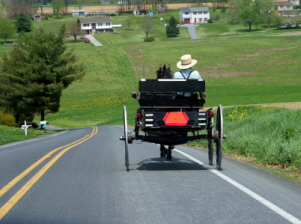
amish1.jpg

The Amish/Mennonites and Genetic Disorders

The Amish migrated from Europe (Germany/Switzerland) to the United States in the 1700s. One such group, the Old Order Amish of Lancaster County, Pennsylvania, began with 200 Swiss immigrants. Today, there are roughly 200,000 Old Order Amish. Because of the difficult lifestyle, the lack of evangelism, and the language barrier, there is essentially no conversion to the Amish religion. In addition, marriage outside the community is forbidden. As a result, the community has remained closed for over 10 generations and is still using the same 200 genomes of their founders! This is known as founder effect, which means that a population is started by just a small number of individuals and as a result that new population will be different (both genetically and phenotypically) from the parent population, potentially with low genetic variation.

If I were to sequence the genomes of 200 individuals that I had somehow randomly selected, I would undoubtedly uncover a number of undesirable mutations hidden in their genes. Most of these mutations would not cause any detectable phenotype because these individuals would still have a healthy copy of the mutated gene (for the DNA newbies, we all carry 2 sets of 22 chromosomes plus 2 sex chromosomes, meaning that we have two copies of most genes).

Within the Amish populations, the mutated gene perpetuates and flourishes because it is never diluted into the general public. This means that it becomes increasingly likely that two individuals, both carrying a copy of the mutated gene, will marry and produce offspring. These children then have a random chance of inheriting two mutated copies of the gene.

Crigler-Najjar Syndrome

A recent article in USA Today, “Blue glow signifies life in peril in Pennsylvania Dutch country” analyzes the effect of one of the genetic diseases threatening the Amish. Crigler-Najjar syndrome is extremely rare, with only about 110 known cases in the entire world. Almost 20% of those cases are among the Amish and Mennonite in Pennsylvania.

People with Crigler-Najjar syndrome are unable to break down bilirubin, a natural waste product from old blood cells, and it builds to a toxic level in their blood. Untreated, the condition leads to brain damage and death. The afflicted, with yellowed eyes and golden skin as a result of their condition, are forced to spend 10 to 12 hours a day in bed underneath bright blue lights. These beds cost about $1,000, and fans must be used to keep the children cool under the intensity of the lights. Although there is no cure, a liver transplant is one option.

The Clinic for Special Children

In 1990 a clinic opened in Straburg that specialized in children with rare diseases. The Clinic for Special Children was founded by Dr. Holmes Morton, who once worked with Dr. John Crigler, the physician who first described Crigler-Najjar syndrome in 1952 with Dr. Victor Najjar. The building, located on a site that was once an Amish field, was erected by 70 local men in the traditional barn-raising manner.

According to Wikipedia:

The clinic treats about 600 children for 80 different genetic disorders or syndromes such as glutaric aciduria (GA1), maple syrup urine disease (MSUD), Crigler-Najjar syndrome (CNS), and medium-chain acyl-CoA dehydrogenase deficiency (MCADD). Not all the children are Amish; about 15% of the caseload come elsewhere, including Africa and Asia. About 75% of the children are treatable and a third of those are highly treatable, many through techniques developed at the center

There’s a great brochure available that provides an in-depth description of the Clinic. In 2006, Dr. Morton was awarded a MacArthur Foundation “genius grant” for his work. A well-deserved honor, if you ask me. Here is a list of some of the publications associated with the Clinic for Special Children. Here are some other articles about the Clinic, including the Genome News Network, the New York Times, Scienceline, Affymetrix, and here. For more information about the Amish/Mennonites and genetic disorders, see this brief review by Laura Weeks (pdf!).

Interestingly, there is a Swiss Anabaptist DNA Project at FTDNA, but unsurprisingly there are very few samples so far. Another interesting source of information about Amish/Mennonite genetic genealogy is the Yoder Family Website, which contains links to DNA testing by members of the Yoder Family.

Hsien at EyeonDNA wrote about this topic at Genetics and Health, and if you read the article, you’ll see that even her “doctorate genealogy” has a link back to Amish studies.

What do the results of a Deep SNP test mean?

Often, at least at the current stage of genetic genealogy, DNA sequencing does not reveal enough information to identify a person’s particular Y chromosome or mtDNA haplogroup. The example I will be using in this post is Haplogroup E. Haplogroup E split into E1, E2, and E3 about 28,000 years ago. Current tests offered by many sequencing companies are able to place a person in the general “E” Haplogroup, but might be unable to determine exactly which subclade of E a person descends from. In such a situation, a “Deep SNP” test can be used to fill in that information.

A SNP is single nucleotide polymorphism, or a change in the DNA sequence at a single nucleotide. For instance, the switch of a C for G, a cytosine for a guanine. You can see a chart of some of the most common SNPs tested for genetic genealogy here or here. The Deep SNP test (which can go by other names) analyzes a person’s DNA, such as the Y chromosome, for the presence or lack of these mutation(s).

Each SNP is detected either by sequencing or by cutting the DNA with enzymes – the presence of a certain mutation will cause the enzyme to cut the DNA differently, either stopping it from cutting or allowing it to cut. The scientists can then analyze the results and determine whether or not the person has that particular mutation. Certain marker results will lead the person to be group in the haplogroup containing other people who have similar results.

Haplogroup E, for instance, is characterized by the mutation M96. If a person has this mutation, they would be M96+, it is extremely likely that they are directly descended from the founder of Haplogroup E. If they do not have the mutation, they are M96-, and they belong to another haplogroup. It is  helpful to follow along on the ISOGG Haplogroup E Tree.

Haplogroup E split into E1, E2, and E3 about 28,000 years ago. E3 is characterized by the SNP mutation P2, meaning that people who test positive for P2 (i.e. P2+), then it is extremely likely that they are directly descended from the founder of Haplogroup E3.

E3 split into E3a and E3b about 26,000 years ago. E3b is characterized by the SNP mutation M35. From Wikipedia: “E3b is believed to have first appeared in the Horn of Africa approximately 26,000 years ago and dispersed to the Middle East during the Upper Paleolithic and Mesolithic periods. From there, it traveled west with the expansion of Neolithic agriculturalists.”

So, therefore, if you belonged to subclade E3b, your Deep SNP test results would be (M96+, P2+, M35+). And E3b splits into even more subclades, meaning that you would have more SNP results.

Anytime you get Deep SNP results and aren’t sure how to interpret them, use the ISOGG Haplogroup Trees. The identifying SNP for each branch of the tree is listed right next to the branch. ISOGG updates the Haplogroup Tree yearly, and even includes source information! It’s a great resource for genetic genealogists.

By the way, this post came about after a great email conversation with Tim at Genealogy Reviews Online. Thanks Tim!

23andMe in the News

A June 18th article from MSNBC about online family trees and social networking revealed another tidbit about 23andMe. According to the article (and no source of the information is given), 23andMe “plans to charge $1,000 for an extensive genetic profile and features to help track down lost relatives.”

I’m not exactly sure what that means. Are distant cousins lost relatives? Or is the unknown birth mother of an adopted child a lost relative? Given 23andMe’s interest in genetic genealogy, I’m guessing that it’s for general interest, rather than just for people looking for birth parents. Or perhaps they’re doing both – it’s really not much of a difference. It’s all about building a database, of course. Without the ability to compare results to a database, the usefulness of DNA testing for genealogical purposes can still be informative but is limited.

And by the way, I’m back on the first page of Google results for a “23andMe” search! I took a hit after it was announced that Google had invested in 23andMe because some of the ‘big blogs’ in the blogosphere discussed the company. Although I was knocked off the front page for a while, visits to my blog skyrocketed! For two weeks after the announcement, 23andMe was a very popular search on Google and other search portals. It was up on Google Trends for quite a while as well. Now, the only blogs ahead of me are ZDNet, Technorati, GigaOM, and our very own Hsien when she was blogging at GeneticsandHealth!

Genetic Genealogy in the News

ancestry1.gif Yesterday was another big day for genetic genealogy, with two major announcements. First, as I have previously mentioned, Ancestry.com teamed up with Sorenson Genomics to offer DNA testing. The results of that testing can be, at the owner’s discretion, tied into a new DNA database as well as their massive collection of genealogical source materials. Here’s the official announcement from PRNewswire: “Ancestry.com Enters DNA Genealogy Field Through Exclusive Partnership With Sorenson Genomics: Combines Three Major Pillars of Family History Research – Historical Records, DNA and Family Trees.” Here’s another blurb at Family Tree Magazine. According to one source (CNET News), the $200 test will examine both Y DNA and mtDNA, but that hasn’t been confirmed. It only makes sense to test both, however, especially at that price.

eurodna.gif In other news, DNAPrint Genomics (aka AncestryByDNA) announced the release of a new autosomal test, EuroDNA 2.0. Where EuroDNA 1.0 used just 320 SNPs to delineate people of European ancestry into four groups – Northern European, Southeastern European, Middle Eastern, and South Asian – EuroDNA 2.0 uses 1,349 SNPs.

The test is based on a recently published paper using DNA chips to compare populations from around the world: Bauchet M, McEvoy B, Pearson L, Quillen E, Sarkisian T, Hovhannesyan K, Deka R, Bradley D, Shriver M. 2007. Measuring European population stratification with microarray genotype data. American Journal of Human Genetics 80(5): 948-956.

DNAPrint(R)’s EuroDNA(TM) 2.0 clarifies European sub-ancestry by using 1,349 European Ancestry Informative Markers (AIMs). This test reports a person’s proportional basic continental European ancestry using several categories: Southeastern Europe (Armenian, Jewish, Greek and some Italians); Iberian (Spanish, Portuguese); Basque (Spanish/French Pyrenees border); Continental European (German, Irish, English, Polish, Some French and Italian); and North Eastern European (Finnish). The EuroDNA(TM) 2.0 test is by far the most advanced genetic ancestry test yet to be offered to the public.

“The paper resolved 5 fundamental and ancient types of European ancestry – Southeastern European (Armenian, Jewish, Greek, some Italians), Iberian (Spanish, Portuguese), Basque, Continental European (German, Irish, English, Polish, some French and Italian, and North Eastern European (Finnish)). Many ethnogeographic populations show interesting mixes as a function of their history and geography.

In collaboration with the Shriver lab, which published the Bauchet et al., 2007 paper, DNAPrint® mined the chip marker used to create the Bauchet et al., 2007 paper, looking for the SNPs that provided most of the European Ancestry Information.

We found that 1,349 of the 11,071 chips SNPs, provided most of the within-Europe ancestry information.EuroDNAâ„¢2.0 measures each of these 1,349 European Ancestry Informative Markers (AIMs) for each customer, and using a Bayesian algorithm, reports a customer’s proportional Southeastern European, Iberian, Basque, Continental European and Northeastern European ancestry.”

All the technical information is available on the EuroDNA 2.0 Manual Page. I previously reviewed AncestryByDNA here on the blog.