The Genetic Genealogist

Adding DNA to the Genealogist's Toolbox

Archive for May, 2007


The Spring 2007 issue of the Journal of Genetic Genealogy

In case my readers were not aware, the Spring 2007 issue of the Journal of Genetic Genealogy is now available. This free, open-access peer-reviewed journal has been around in the Spring of 2005 and offers recent news and analysis in the field of genetic genealogy. The current issue has the following articles:

A Funny Thing Happened on the Way to Retirement, By T. Whit Athey, editor
Discussion of recent developments in the field as well as nomenclature issues.

Stacking the Deck: Mutation Rate in the mtDNA Coding Region, By Ann Turner
According to the article, “Genetic genealogists, who are obtaining full-sequence mtDNA tests in increasing numbers, are in a position to provide a “biased sample” for the study of the mutation rate in the coding region.”
Announcement: A New DNA Fund, By Katherine Hope-Borges
Announcing a new non-profit organization to fund genetic research.

Geographic Patterns of Haplogroup R1b in the British Isles, By Kevin D. Campbell
A thorough analysis of the distribution of Haplogroup R1b in the British Isles.

A Major Subclade of Haplogroup G2, By T. Whit Athey
Analysis of a G2 subcluster or subclade that is characterized by a repeat value of 13 at DYS388.

Warren Buffett, Jimmy Buffett, and 23andMe Continued

Earlier today I wrote about how 23andMe used genetic genealogy to confirm that Warren Buffett and Jimmy Buffett are not recently related via their Y chromosome. I also mentioned that this was a great way to introduce the company (as well as genetic genealogy) to the masses.

This evening I saw a story posted at The Motley Fool entitled “Warren Buffett is No Parrothead.” Similar to the story that I linked to this morning, it appears that the author is not familiar with genetic genealogy:

However, solving the Buffett mystery illustrates how a stake in 23andMe is a good fit in Google’s portfolio. The one thing that blows me away here is that a simple spit test was enough to uproot a family tree deep enough to find an ancestral link before surnames were even around.

“I’m not naive enough to think that 23andMe’s elaborate tests can ever be cheap enough to create a deep genealogical database loaded with data of anyone within spitting distance. However, it would certainly be cool if this was the start of a genealogical social networking hub — a Zillow for the family tree scrapbooking set.

The author probably doesn’t know that lots of other companies have offered these elaborate tests (see Sidebar), and thousands of customers have entered their results into large databases (Ysearch, mitosearch, etc…). With the amount I’ve spend on genetic genealogy, a $1000 genomic sequencing doesn’t really seem very high. That isn’t the current price of course, but numerous scientists have made it their goal (see my recent series entitled “You and the $1000 Genome”).

So, it appears that 23andMe has successfully introduced yet another person to the wonderful world of genetic genealogy! By the way, I emailed this post to the author of the article in case he might be interested in joining the conversation here at the Genetic Genealogist.

Famous DNA Review, Part III – Warren and Jimmy Buffett

Buffett_Buffett.03.jpg

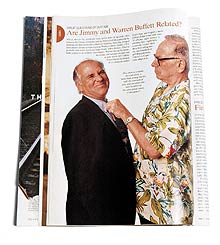
It turns out that 23andMe isn’t just a startup idea that’s waiting for technology to catch up. In 1999, Fortune Magazine posed the question, “Are Jimmy and Warren Buffett Related?” This week, 23andMe revealed the long-awaited answer, which is that the two Buffetts – well, let’s save that for the end.

Apparently Warren Buffett (finance guru) and Jimmy Buffett (musician), have always wondered if they are related to each other, potentially through a common ancestor who lived in a penal colony in the South Pacific. Earlier this year Anne Wojcicki, the co-founder of 23andMe, asked Jimmy and Warren if they would submit DNA for analysis. According to Warren Buffett’s assistant, he “just kept spitting into a little receptacle, and then we FedExed it. Not very elegant.” 23andMe then did Y chromosome and mtDNA analysis of Warren and Jimmy’s DNA.

I think this was a brilliant marketing move. There’s already strong evidence that people are interested in genetic genealogy (after all, you’re reading The Genetic Genealogist!), and involving celebrities is a great way to both introduce people to the technology and to the company. Congratulations to 23andMe on an interesting project. Looks like I’m going to have to add you to my sidebar of Genetic Genealogy Testing Firms!

Oh, and by the way, it turns out that Warren and Jimmy Buffett are not related (at least not through their Y chromosome or mtDNA lines). Joanna Mountain, the head of 23andMe’s ancestry product line and a former professor of anthropological genetics at Stanford, revealed that Jimmy and Warren would have to go back more than 10,000 years to find a common paternal ancestor. Warren shared his ten-page DNA report with Fortune, and it turns out that his paternal ancestors likely originate from northern Scandinavia, while his mtDNA likely has roots in Iberia or Estonia.

There is more discussion of this project at Valleywag, Buzzle.com, the WSJ, the Genealogue, and InfoWorld. Interestingly, by reading the InfoWorld article it would appear that the author has never previously heard of genetic genealogy, and thus it would appear that 23andMe’s project is already bearing fruit.

You and the $1000 Genome – Part IV: The Impact

In Part I, Part II, and Part III of the “You and the $1000 Genome” series we’ve examined the Archon X PRIZE for Genomics, the International HapMap Project, and the ethical issues associated with both. In this final installment of the series we will examine the potential impact of genomic or SNP sequencing and interpretation on both medicine and genealogy (finally, some genealogy for you patient genealogists out there!).

I believe that whole genome sequencing will have myriad uses. In the paper mentioned in Part III of the series (John A. Robertson, “The $1000 Genome: Ethical and Legal Issues in Whole Genome Sequencing of Individuals (pdf).” 2003 The American Journal of Bioethics 3(3):InFocus), Mr. Robertson suggests that demand for personal genome sequencing outside of the medical context could be quite limited. But that view might fail to take into account uses of genomic information other than identifying or predicting disease, such as the genetic genealogy setting. Very few could have predicted 10 years ago that thousands of genealogists would be submitting their DNA for limited sequencing as they are doing today. If information from whole genome sequencing can be used to analyze genealogy (which it surely will be), then this will create an entire niche that will increase commercial demand outside of the medical context. And this is only one such niche. There might be many many more, some of which will only develop after whole genome sequencing becomes economically available.

Here is a list of just a few of the uses of genomic sequencing:

1.Identification of genes involved in disease – scientists are far from understanding the genetic basis of most human conditions, both normal and disease. Having thousands of genomes in research databases will give researchers the ability to make these types of associations through comparative genomics.

2.Tailored preventative medicine – knowing one’s propensity for disease(s) will allow scientists and medical specialists to attempt to prevent the formation of these diseases. So see more about personalized genetics, read this informative interview at ScienceRoll with Steven Murphy, MD of the Gene Sherpa. If tailored preventative medicine is to come about, it will require the education of all healthcare specialists in genetics and the relationship between genetics and disease.

3.Genealogical research – whole genome sequencing will greatly advance the ability of genealogists to use DNA to study ancestral relationships. This will have a big effect on both autosomal and Y chromosome studies. Genealogical testing using autosomal markers is limited by both the low number of identified markers and the unknown frequency of sequences across all populations. Cheap and efficient genomic sequencing could alleviate both these limitations. Y chromosome studies will greatly benefit by a huge increase in the number of STR markers that could be used for relationship comparisons. Currently companies such as Family Tree DNA offer 67-marker tests. In a few years we will be able to compare all the STRs in the Y chromosome rather than just a few of them.

Recognizing the impact that cheap and efficient whole genome sequencing will have on science and society, Nature Genetics‘ ‘Question of the Year’ is “What would you do if this sequencing capacity were available immediately?” The website has numerous replies from prominent geneticists and presents a number of interesting thoughts on the topic. evolgen, another member of The DNA Network, has also provided an answer to the question on the evolgen blog. In addition, DNA Direct Talk has a round-up of recent blog discussions regarding the $1000 genome.

Here is a quote from Professor Stephen Hawking in support of the X PRIZE in Genomics:

“As you may know, I have recently expressed my belief that space exploration and the eventual colonization of space is critical for humanity’s survival. To bring about breakthroughs for personal spaceflight is a laudable aim and it is work done by the X PRIZE Foundation that will eventually unleash humanity from the gravitational bonds of earth. You may also know that I am suffering from what is known as Amyotrophic Lateral Sclerosis (ALS), or Lou Gehrig’s Disease, which is thought to have a genetic component to its origin. It is for this reason that I am a supporter of the $10M Archon X PRIZE for Genomics to drive rapid human genome sequencing. This prize and the resulting technology can help bring about an era of personalized medicine. It is my sincere hope that the Archon X PRIZE for Genomics can help drive breakthroughs in diseases like ALS at the same time that future X PRIZEs for space travel help humanity to become a galactic species.”

Well there you have it! It is probably quite obvious that I have high hopes for efficient and inexpensive genome sequencing and subsequent interpretation. Although the necessary technology is still a few years away, it is important that we as a society address the many issues that will result from these technologies. As always, I would appreciate any comments that you many have on this topic, or any thoughts you may have had while reading this series.

P.S. – I just stumbled across an interesting article at In the Pipeline about the use of cheap(er) genomic sequencing to follow the development of antibiotic resistance in bacteria (S. aureus). I don’t have access to the PNAS paper, but it appears that the genome (which is tiny compared to ours) was completely sequenced twice, once before treatment and once after treatment failed due to the development of resistance. The strain had developed a total of 35 mutations! The author makes a great statement at the end:

“The technology involved here is worth thinking about. Even now, this was a rather costly experiment as these things go, and it’s worth a paper in a good journal. But a few years ago, needless to say, it would have been a borderline-insane idea, and a few years before that it would have been flatly impossible. A few years from now it’ll be routine, and a few years after that it probably won’t be done at all, having been superseded by something more elegant that no one’s come up with yet. But for now, we’re entering the age where wildly sequence-intensive experiments, many of which no one even bothered to think about before, will start to run.”

Other Posts in the Series:
You and the $1000 Genome – Part I: The Archon X PRIZE for Genomics
You and the $1000 Genome – Part II: The International HapMap Project
You and the $1000 Genome – Part III: The Ethical Issues

Celebrity Genomes on DVD

As I mentioned recently, James Watson is about to be the first person to have his entire genomic information handed to him. According to this article in Today’s issue of the Observer, Watson “has decided to go ahead and have his entire genome put on the internet this week.” I’m not sure what the Observer used as its source – according to my research Watson hadn’t yet decided what he was going to do with the sequence. Update: A huge story from Newsweek states that Watson has decided to release his entire genome to a NIH database (minus the ApoE gene)!

I hope this gets lots of media coverage. This is a HUGE moment for genetics, one that we will all look back on. And I have to admit, I am very jealous of Watson’s opportunity! Here’s a great article on the subject, well worth a read!  Here are some highlights from the Observer article:

“Jim Watson, the Nobel laureate and co-discoverer of the structure of DNA, will be presented with a unique scientific prize this week: a DVD disc containing details of every one of the 3 billion units of DNA that make up his genes.

The award – to be made at Baylor College of Medicine in Houston on Thursday – is unprecedented. Yet if biotechnology companies get their way, a host of other scientists and celebrities will soon follow suit.

Among those lined up are Stephen Hawking; Larry King, the US talk show host; and Paul Allen, co-founder of Microsoft. In addition, Watson has been pushing, in private, for British stars, such as Wayne Rooney and Kate Moss, to be asked to have their genomes published.

The aim is to defuse public worries as it becomes cheaper and cheaper to decode genomes. The first genome cost more than $1 billion, and took several years, to sequence. Now costs have dropped to under $1 million and could be cut to under $1,000 in a few years.

Armed with this knowledge, doctors will be able to personalise treatments so medicines meet specific individuals’ requirements and match their genetic blueprints. Hence the involvement of famous scientists and celebrities. They are being involved to calm public worries that sequencing would provide data that could be misused by police, insurers or employers. But many scientists dislike involving famous people this way. At a recent genomics meeting in New York, several leading scientists raised objections to the rise of celebrity genetics.

‘I’d hate the availability of genome sequencing to be based purely on money and fame,’ Professor Michael Ashburner, a geneticist at Cambridge University, told the journal Nature. ‘Just doing famous or very rich people is bloody tacky, actually.’

In addition, many scientists fear cheap genome sequencing could have other, worrying consequences. Professor Steve Jones of University College London, said: ‘If you make your genome public, you are not just revealing information about yourself and what diseases you might be susceptible to, you are also giving away crucial data about the kind of illnesses your children might be prone to. Each of your children gets half your genes, after all. They might not want the world to know about the risks they face and become very unhappy in later life that you went public. Your other relatives might equally be displeased.’

This point has been acknowledged by Watson. Nevertheless, he has decided to go ahead and have his entire genome put on the internet this week – with the exception of one gene associated with the development of Alzheimer’s disease – Watson does not wish to reveal his risks of getting the disease.

However, there are other concerns, as Professor Ashburner points out. ‘Anyone who commits relatively minor offences can have their DNA taken and analysed. At present, the main use of this process is to create a DNA fingerprint that can be used to identify that individual. But soon we will be able to create an entire genome sequence of that individual from a swab or blood sample. We will end up knowing everything about their genes. In the end, we could have millions of people on a database and know every single genetic secret of each person. That has to be a very worrying prospect.’ “

I missed a couple of these ethical issues when I wrote about the $1000 genome, but Keith of Omics! Omics! was kind enough to share them with me in a comment to that post.

It does make some sense to sequence the genomes of famous people – it gives sequencing some media attention and plants that seed in people’s minds. I do have a suggestion for the researchers at 454 Life Sciences (who sequenced Watson’s genome and are probably looking forward to finally hearing from me!), why don’t you sequence a few genomes from some people who are suffering from disabling genetic disorders? Although remote, there might be BOTH a medical benefit and the necessary media attention!

You and the $1000 Genome – Part III: Ethical Issues

In Part I and Part II of the “You and the $1000 Genome” series we examined the history of the Archon X PRIZE for Genomics and the success of the International HapMap Project. Today we’ll talk about some of the ethical issues associated with efficient and inexpensive genome sequencing. The value of whole genome sequencing will only be realized if individuals believe they have complete and legal control over their genetic information. I am greatly indebted to a thorough analysis of this issue by John A. Robertson at the University of Texas School of Law (“The $1000 Genome: Ethical and Legal Issues in Whole Genome Sequencing of Individuals (pdf).” 2003 The American Journal of Bioethics 3(3):InFocus). Note that this analysis is not intended to constitute answers to any of the ethical questions – it is only meant to be part of the discourse.

The ethics surrounding the X PRIZE competition has led the Foundation to establish an Ethics Advisory Board to identify issues that may be involved in whole genome sequencing and the conduct of the X PRIZE competition. The goal of the Ethics Advisory Board is to not only “comply with existing ethical and legal standards, but to promote public dialogue about some of the more controversial ethical, legal, and social implications of emerging genomic technology and to actively participate in setting standards for the future use of these technologies in research and clinical care.”

Ownership of DNA and Sequencing:
It is probably obvious that a person has almost total control over their own DNA as long as it is attached to their body. However, all day long we are continuously shedding our DNA into our surroundings, leading to the more difficult question; who owns DNA once it has left the body? If I find DNA on the sidewalk (such as a cigarette, a coffee cup, a piece of hair), does it belong to me or does it belong to the ‘shedder’? This was one facet of a recent New York Times article addressing the extreme tactics that some genetic genealogists have employed to obtain DNA from (potential) family members (“Stalking Stranger’s DNA to Fill in the Family Tree” 2 April 2007, Amy Harmon). Since DNA contains information that can be used to specifically identify a person, should we have total and complete control over our DNA unless we knowingly waive that right?

Informed Consent:
It goes without saying that written informed consent is a vital component of genomic sequencing. Consent is necessary for sequencing, interpretation, and any eventual research. Unique to genomic sequencing and interpretation, however, is the potential for emotional and psychological distress. There are always risks involved with discovering the information contained within our own genomes. As a result, entities, especially commercial enterprises, will have to delicately balance protecting their clients from the emotional consequences of genomic sequencing with protecting themselves from liability. This will necessitate educating their clients of the potential risks of sequencing and interpretation while obtaining legally sufficient informed consent.

The X PRIZE Foundation has directed that the “Genome 100″, the 100 volunteers who will contribute DNA to the sequencing competition, must give fully informed consent. Members of the Genome 100 (who will theoretically remain anonymous) will also be asked if they would be willing to contribute their results to a database that will be accessible to others.

The HapMap Project is also concerned about informed consent and has even provided an example of the consent form that they used when obtaining samples for the Project. According to the Project, “[e]ach of the DNA donors gave individual consent to participate in the Project and signed a consent form that grants permission for the DNA samples to be used in future studies approved by relevant ethics committees.” Interestingly, the Project also used teams of geneticists and ethicists to work in the communities to discuss the issues and educate the public about the science of the HapMap Project. Although the process was different in each country, “it involved a combination of individual interviews, focus group discussions, community meetings, and public surveys… and …created a climate in which research could proceed in an atmosphere of greater openness and trust.” This might be a good model for companies engaging in whole genome sequencing and/or genome interpretation.

Risks and Genetic Counseling:
There are numerous risks involved in whole genome sequencing and interpretation, including the discovery of medical and/or behavioral disorders, both present and future. These risks should be addressed by both informed consent (to warn customers of potential dangers) and genetic counselors (to help customers deal with the results of sequencing). The UCSC Genome Bioinformatics Group, for instance, has strongly supported the efforts of the National Human Genome Research Institute to train individuals to provide professional genetic counseling.

Storage:
How should samples be used once the DNA has been sequenced? Should they be stored or should they be destroyed? This will undoubtedly be an issue requiring informed consent.

Perhaps more importantly, how should results be stored? It is vital that results be protected from unlawful detection or use under any circumstances. Online storage will require advanced theft protection measures. Results shared in hard copy, such as via DVD, should also be strongly protected to avoid theft (a whole new type of identity theft). According to the X PRIZE Foundation, “[a]ll data generated as part of the X PRIZE competition will be stored in secure databases. The X PRIZE Foundation encourages continued research into creative and secure database structures.”

Discrimination:
Almost everyone would argue that discrimination on the basis of genetic information is not an acceptable use of genomic sequencing. Although there is no federal prohibition of this type of discrimination, many states have their own laws that prevent genetic information discrimination. And it appears that the federal government will soon pass the Genetic Information Nondiscrimination Act (See “GINA, A Primer“) to create an extensive nationwide prohibition of discrimination on the basis of genetic information.

Sequencing the Genomes of Minors:
Minors often have little choice in their medical treatment because that duty is carried out by their parents or legal guardians. But should parents have the right to sequence their children’s genomes? How about the genomes of embryos that are not implanted? What if there is a medical necessity? Perhaps sequencing in those situations should be limited to only those regions that are involved in the medical situation at hand.

The “Geneticization” of Society:
In his article, Mr. Robertson coins the phrase “geneticization of society” to address the concern that our genetic information will come to represent our identities. In our society, a person is ideally represented by their goals and achievements, not by their genetic information. Unfortunately, just as people are judged by their physical appearance in today’s society, there is the danger that people will be judged by their genetic identity in tomorrow’s society. Are we limited by our genetic information, or are we more than our own genome? In my opinion, our identity is what we make it, not a sequence of A,T,C, and G’s.

While researching the ethics of the $1000 Genome, I came across a terrific quote at (Genetic Engineering & biotechnology News) by Chad Nusbaum, Ph.D., co-director of the genome sequencing and analysis program at the Broad Institute: “Science is moving way ahead of the ethics. We can’t stop the technological advancements but the gap keeps widening. It is our responsibility to understand the implications of our work and educate the public and elected officials so that a proper dialog can take place.”

Other Posts in the Series:
You and the $1000 Genome – Part I: The Archon X PRIZE for Genomics
You and the $1000 Genome – Part II: The International HapMap Project
You and the $1000 Genome – Part IV: The Impact

You and the $1000 Genome – Part II: The International HapMap Project

In Part I of the “You and the $1000 Genome” series we examined the Archon X PRIZE for Genomics, a $10 million purse for the group that can sequence 100 genomes in 10 days for no more than $10,000/genome with an error rate below 0.001%. With today’s technology this goal is still a few years away.

But do we need an entire genomic sequence to obtain all the relevant medical information that our DNA contains? After all, 99.9% of my DNA is exactly the same as everyone else’s! Why sequence that 99.9% over and over and over if the results are the same every time? Wouldn’t it be cheaper to just sequence and then decode the 0.1%?

Sequencing that 0.1% is the goal of the International HapMap Project. HapMap stands for “Haplotype Map”, and those of you who are genetic genealogists will instantly recognize the importance of the word haplotype. The goal of the HapMap Project, begun in 2002, is to identify SNP groups (haplotypes) from a total of 270 individuals representing the Yoruba people of Nigeria, the Han Chinese in Beijing, the Japanese, and U.S. residents with northern and western European ancestry. The HapMap is essentially a catalog of all the common genetic variants in human beings.

Phase I of the HapMap project, which is complete, identified 1 million SNPs in the human genome. SNPs are “single nucleotide polymorphisms”, a single variation in the genetic code. According to some scientists, 1 million SNPs is about 10% of the total SNPs in the human genome. Interestingly, the results of Phase I of the HapMap suggested that SNPs tend to cluster together at certain locations and may be passed onto the next generation in groups. For many regions of our DNA there are only a few different haplotypes in most humans, and researchers can identify these haplotypes using just a few single SNPs. As a result, a single person’s genotype (collection of haplotypes) can be created by sequencing as few as 300,000 to 600,000 SNPs. For a recent review of Phase I of the HapMap Project, read this 2005 article in PLoS Genetics.

Phase II of the HapMap Project identified close to 2.5 million SNPs using the same 270 samples. Although data acquisition for Phase II has been completed, analysis is still continuing.

As the HapMap data becomes available, researchers can use it to identify genes and SNPs that are involved in disease. If most people with colon cancer share a certain haplotype, researchers can use that information to identify the genes involved and doctors can use that information to predict who might be susceptible to colon cancer long before the disease develops. I’ve previously written about two studies using information from the HapMap to identify a locus associated with diabetes and prostate cancer.

So with the huge success of the HapMap Project, do we really need genome sequencing? Some would argue that haplotyping is not sufficient, especially when a genetic disease is found at very low frequencies in the population. According to Jonathan Rothberg, the founder and chairman of 454 Life Sciences, “genotyping rests on the hypothesis that common alleles contribute to common diseases. What if very uncommon alleles contribute to common diseases? Only deep sequencing would be able to answer this question. The deeper the sequencing, the less frequent variant you can find. You need deep coverage to ensure the statistical likelihood of finding rare mutations.” Indeed, some mutations are so rare that they are only found within specific families or populations. If these families aren’t part of the HapMap Project, there is the potential that their personal SNPs won’t be identified.

Despite the concerns, there is little doubt that the HapMap Project is a valuable contribution to the field of personalized medicine. It has already produced results that will further our understanding of the genetic component of diseases such as diabetes and prostate cancer. While HapMap sequencing has limitations that differentiate it from whole-genome sequencing, it is a much cheaper and immensely useful tool for scientists and medical specialists.

Other Posts in the Series:
You and the $1000 Genome – Part I: The Archon X PRIZE for Genomics
You and the $1000 Genome – Part III: Ethical Issues
You and the $1000 Genome – Part IV: The Impact

23andMe and Google

gumbert_mid.pngSpeaking of the $1000 genome, if you haven’t visited the 23andMe main page recently, you’ll probably want to check it out. The site has been redesigned and includes links to an About page and a Press Release page, a Contact page, and the Jobs page. I love the fact that the job benefits include “free genotyping for you and a family member or friend”!!

The front page also has a new description of the company:

“23andMe is a privately held company developing new ways to help you make sense of your own genetic information.

“Even though your body contains trillions of copies of your genome, you’ve likely never read any of it. Our goal is to connect you to the 23 paired volumes of your own genetic blueprint (plus your mitochondrial DNA), bringing you personal insight into ancestry, genealogy, and inherited traits. By connecting you to others, we can also help put your genome into the larger context of human commonality and diversity.

“Toward this goal, we are building on recent advances in DNA analysis technologies to enable broad, secure, and private access to trustworthy and accurate individual genetic information. Combined with educational and scientific resources with which to interpret and understand it, your genome will soon become personal in a whole new way.”

The press release page has only one release announcing that they have completed Series A Financing. A story from Reuters today revealed that Google Inc. has invested $3.9 million in 23and Me. Here’s the text of the story:

“STANFORD, California (Reuters) – Google Inc. has taken a small stake in a biotech company that was co-founded by the wife of one of Google’s founders, Sergey Brin, Google said in a U.S. regulatory filing on Tuesday.

Google said it had invested $3.9 million in the company, called 23andMe Inc., giving the Mountain View, California-based Google a minority stake in the start-up, according to a filing with the U.S. Securities and Exchange Commission.

23andMe is a privately held company that promises to help consumers understand and browse their own genetic information.

Besides Google, the initial round of outside funding in 23andMe includes venture capital firms New Enterprise Associates and Mohr Davidow Ventures and biotechnology giant Genentech Inc..

Anne Wojcicki, co-founder of 23andMe, was married earlier this month to Brin, Google’s co-founder and president.

Prior to Google’s investment in 23andMe, Brin provided around $2.6 million in interim debt financing to 23andMe, which was repaid as part of this financing transaction, the filing said.

Genentech’s Chief Executive Arthur Levinson is a member of the board of directors of Google. The company said Google’s audit committee and reviewed and approved the transaction after taking advice from independent advisors.

Linda Avey, a 20-year veteran of the biotech industry, is a co-founder of 23andMe, along with Wojcicki.

Esther Dyson, a veteran analyst of the computer and Internet industries, who now focuses on personal investment is a board member of 23andMe.”

Thanks to Techcrunch (although exposure through TechCrunch is great for any company, I wasn’t crazy about their coverage).

Update: EyeonDNA has links to other sites with more information about the latest developments at 23andMe!

You and the $1000 Genome – Part I: The Archon X PRIZE for Genomics

Over the next week and a half I will be examining the Archon X PRIZE for Genomics, a challenge from the Archon X PRIZE Foundation to foster the development of efficient and inexpensive genomic sequencing. Not only will the X PRIZE for Genomics change the face of medicine, but it will also have an ENORMOUS impact on the field of genetic genealogy, which we’ll discuss in Part IV of the series. Stay tuned for all the information you need to know about the prize, and if you have any thoughts or questions please leave a comment!

History of the Archon X PRIZE for Genomics:
In 2003 the J. Craig Venter Science Foundation announced a $500,000 Genomic Technology Prize that would be awarded to an the group whose technology significantly enhanced “the field of high throughput DNA sequencing by enabling a human genome to be sequenced for $1,000 or less.” The Foundation believed that crossing this threshold would enable the majority of individuals to afford genomic sequencing as part of medical treatment.

By 2006, Dr. Ventor’s $1000 genome challenge was picked up by the X PRIZE Foundation to create the Archon X PRIZE for Genomics, a $10 million dollar incentive for the first successful team. To win the prize purse, the registered group must build a device and use it to sequence 100 human genomes within 10 days or less, with an accuracy of no more than one error in every 100,000 bases sequenced (that’s just 0.001%!!) for no more than $10,000 per genome. As of May 2007 there are three teams registered for the competition; VisiGen, 454 Life Sciences, The Foundation for Applied Molecular Evolution (FfAME), and Reveo, Inc. If you’re curious, Genomics & Proteomics Magazine has summarized a number of the leading technologies that are being developed in pursuit of the X PRIZE (very technical information).

In August 2005, the National Human Genome Research Institute announced that it had awarded grants in excess of $32 million to promote the development of sequencing technologies that would significantly lower the cost of whole-genome sequencing. At the time, it cost roughly $10 million to sequence a human genome (a 50-fold decrease from the previous decade), and the NHGRI set a final goal of $1000 or less for an entire genome. As the NHGRI pointed out, “the ability to sequence an individual genome cost-effectively could enable health care professionals to tailor diagnosis, treatment, and prevention to each person’s unique genetic profile.”

Four years later, has there been progress?
454 Life Sciences, for example, has just announced in March that they have essentially completed sequencing of James Watson’s genome, arguably the first time a single person’s genome has been sequenced (the Human Genome Project’s source of DNA was reportedly an amalgam of different sources). For those that don’t know (can there be anyone?), James Watson is famous for having discovered the structure of DNA over 50 years ago. Interestingly, Watson has asked 454 to withhold his results for the apoE gene – associated with Alzheimer’s disease – as well as a number of other results, citing privacy concerns. Watson, after all, has a son who received 50% of his genetic makeup from Watson’s genome. In light of this, 454 has decided to hand over the results to Watson, who will then decided what to release to the public. (See Marshall, Eliot, “Sequencers of a Famous Genome Confront Privacy Issues” Science 30 March 2007:Vol. 315. no. 5820, p. 1780DOI: 10.1126/science.315.5820.1780). 454 estimates that the six-fold coverage of Watson’s genome cost an estimated $1 million. Still a long way to go to reach the $1000 goal.

Meanwhile, Reveo, Inc. just joined the competition on April 30th of this year, but Reveo’s founder, Dr. Sadeg M. Faris, believes that their technology will eventually be able to read an entire human genome “in minutes for pennies per genome.”

In the next post I will be examining whether or not the $1000 genome is really necessary considering recent developments in a related field.

The X PRIZE Foundation has released a video that explains the aims of the project.

Future Posts in the Series:
You and the $1000 Genome – Part II: The International HapMap Project
You and the $1000 Genome – Part III: Ethical Issues
You and the $1000 Genome – Part IV: The Impact

Famous DNA Review, Part II – Genghis Khan

In 2003, researchers from around the world released a paper that suggested that 8% of all Mongolian males have a common Y chromosome because they are the descendants of Genghis Khan (See “The Genetic Legacy of the Mongols,” 2003, Zerjal, et. al., American Journal of Human Genetics, 72: 717-721). The researchers examined the Y chromosome variability of over 2000 people from different regions in Asia and discovered a grouping of closely related lines. The cluster is believed to have originated about 1,000 years ago in Mongolia and its distribution coincides with the boundaries of the Mongol Empire.

Genghis Khan’s empire (he ruled from 1206 – 1227) stretched across Asia from the Pacific Ocean to the Caspian Sea and was reportedly extremely prolific. Khan’s son Tushi had as many as 40 sons. His grandson Kublai Khan is reported to have had as many as 22 sons, and perhaps many more. Together this family may have as many as 16 million descendants alive in Asia today. It is extremely important to note that until DNA can be extracted from Khan’s bones (which have never been found), there is no definitive proof that this Y chromosome cluster is actually descended from Genghis Khan.

When Family Tree DNA compared the markers in the paper to their database they determined that the Y chromosome cluster belongs to Haplogroup C3 (M217+). Forty-seven samples in their database exactly matched the markers identified in the paper. The company has summarized the marker results from the paper and have made that information freely available.

A newly released study from Russian scientists examined the Y chromosomes of 1,437 men from 18 Asian ethnic groups (Altai Kazakhs, Altai-Khizhis, Teleuts, Khakasses, Shor, Tuvinians, Todjins, Tofalars, Soyotes, Buryats, Khamnigans, Evenks, Mongolians, Kalmyks, Tajiks, Kurds, Persians and Russians). The researchers discovered that approximately 35% of Mongolians possess the “Khan” Y chromosome. Surprisingly, the results of the study suggest that although the Mongol Empire held eastern Russia for 250 years, there are few “Khan” Y chromosome carriers in that region.

You can read more about the 2007 study at UK Channel 4 or at Scientific Blogging.